

- ¥1380 - 2200
- LMAI Bio
- LM-2960R
- 进口/国产
- 2026年09月03日
- ELISA=1:500-1000 IHC-P=1:400-800 IHC-F=1:400-800 Flow-Cyt=1ug/Test IF=1:100-500 (石蜡切片需做抗原修复)
- Rabbit
- Human, Mouse, Rat, Dog, Pig, Cow, Horse, Rabbit,

企业认证
相关产品推荐更多 >
万千商家帮你免费找货
0 人在求购买到急需产品
相关阅读
AJE 润色服务限时 8 折起,权威机构信任 15+ 年Cytoscape 教程来了!快速实现顶刊同款通路网络图五大应用案例:Mustang Q 膜层析应用全解析1 个小工具,一次性搞定流程图、质粒图谱和信号通路图- 详细信息
- 文献和实验
- 技术资料
- 供应商:
上海联迈生物工程有限公司
- 库存:
大量
- 目录编号:
LM-2960R
- 克隆性:
多克隆
- 抗原来源:
Rabbit
- 保质期:
1年
- 抗体英文名:
ROM-K/Kcnj1
- 抗体名:
ATP调节钾离子通道ROM K抗体
- 宿主:
Rabbit
- 适应物种:
Human, Mouse, Rat, Dog, Pig, Cow, Horse, Rabbit,
- 免疫原:
KLH conjugated synthetic peptide derived from human ROM-K/KCNJ1:301-391/391 <Cytoplasmic>
- 亚型:
IgG
- 形态:
Lyophilized or Liquid
- 应用范围:
ELISA=1:500-1000 IHC-P=1:400-800 IHC-F=1:400-800 Flow-Cyt=1ug/Test IF=1:100-500 (石蜡切片需做抗原修复)
- 浓度:
1mg/ml
- 保存条件:
Store at -20 °C
- 规格:
100ul 200ul
| 英文名称 | ROM-K/Kcnj1 |
| 中文名称 | ATP调节钾离子通道ROM K抗体 |
| 别 名 | ROM K; ROM-K; inwardly rectifying subfamily J member 1; ATP regulated potassium channel ROM K; ATP sensitive inward rectifier potassium channel 1; ATP-regulated potassium channel ROM-K; ATP-sensitive inward rectifier potassium channel 1; Inward rectifier K(+) channel Kir1.1; inwardly rectifying K+ channel; IRK1_HUMAN; KCNJ 1; KCNJ; Kcnj1; Kir 1.1; Kir1.1; Potassium channel; Potassium channel inwardly rectifying subfamily J member 1; potassium inwardly-rectifying channel J1; ROMK 1; ROMK 2; ROMK; ROMK1; ROMK2. |
| 规格价格 | 100ul/1380元 购买 200ul/2200元 购买 大包装/询价 |
| 说 明 书 | 100ul 200ul |
| 研究领域 | 细胞生物 信号转导 通道蛋白 |
| 抗体来源 | Rabbit |
| 克隆类型 | Polyclonal |
| 交叉反应 | Human, Mouse, Rat, Dog, Pig, Cow, Horse, Rabbit, |
| 产品应用 | ELISA=1:500-1000 IHC-P=1:400-800 IHC-F=1:400-800 Flow-Cyt=1ug/Test IF=1:100-500 (石蜡切片需做抗原修复) not yet tested in other applications. optimal dilutions/concentrations should be determined by the end user. |
| 分 子 量 | 45kDa |
| 细胞定位 | 细胞膜 |
| 性 状 | Lyophilized or Liquid |
| 浓 度 | 1mg/ml |
| 免 疫 原 | KLH conjugated synthetic peptide derived from human ROM-K/KCNJ1:301-391/391 <Cytoplasmic> |
| 亚 型 | IgG |
| 纯化方法 | affinity purified by Protein A |
| 储 存 液 | 0.01M TBS(pH7.4) with 1% BSA, 0.03% Proclin300 and 50% Glycerol. |
| 保存条件 | Store at -20 °C for one year. Avoid repeated freeze/thaw cycles. The lyophilized antibody is stable at room temperature for at least one month and for greater than a year when kept at -20°C. When reconstituted in sterile pH 7.4 0.01M PBS or diluent of antibody the antibody is stable for at least two weeks at 2-4 °C. |
| PubMed | PubMed |
| 产品介绍 | background: Potassium channels are present in most mammalian cells, where they participate in a wide range of physiologic responses. The protein encoded by this gene is an integral membrane protein and inward-rectifier type potassium channel. It is activated by internal ATP and probably plays an important role in potassium homeostasis. The encoded protein has a greater tendency to allow potassium to flow into a cell rather than out of a cell. Mutations in this gene have been associated with antenatal Bartter syndrome, which is characterized by salt wasting, hypokalemic alkalosis, hypercalciuria, and low blood pressure. Multiple transcript variants encoding different isoforms have been found for this gene. [provided by RefSeq, Jul 2008]. Function: In the kidney, probably plays a major role in potassium homeostasis. Inward rectifier potassium channels are characterized by a greater tendency to allow potassium to flow into the cell rather than out of it. Their voltage dependence is regulated by the concentration of extracellular potassium; as external potassium is raised, the voltage range of the channel opening shifts to more positive voltages. The inward rectification is mainly due to the blockage of outward current by internal magnesium. This channel is activated by internal ATP and can be blocked by external barium. Subunit: Interacts with SGK1 and SLC9A3R2/NHERF2. Subcellular Location: Membrane; Multi-pass membrane protein. Tissue Specificity: In the kidney and pancreatic islets. Lower levels in skeletal muscle, pancreas, spleen, brain, heart and liver. Post-translational modifications: Phosphorylation at Ser-44 by SGK1 is necessary for its expression at the cell membrane. DISEASE: Defects in KCNJ1 are the cause of Bartter syndrome type 2 (BS2) [MIM:241200]; also termed hyperprostanglandin E syndrome 2. BS refers to a group of autosomal recessive disorders characterized by impaired salt reabsorption in the thick ascending loop of Henle with pronounced salt wasting, hypokalemic metabolic alkalosis, and varying degrees of hypercalciuria. BS2 is a life-threatening condition beginning in utero, with marked fetal polyuria that leads to polyhydramnios and premature delivery. Another hallmark of BS2 is a marked hypercalciuria and, as a secondary consequence, the development of nephrocalcinosis and osteopenia. Similarity: Belongs to the inward rectifier-type potassium channel (TC 1.A.2.1) family. KCNJ1 subfamily. SWISS: P48048 Gene ID: 3758 Database links: Entrez Gene: 3758 Human Entrez Gene: 56379 Mouse Entrez Gene: 24521 Rat Omim: 600359 Human SwissProt: P48048 Human SwissProt: O88335 Mouse SwissProt: P35560 Rat Unigene: 527830 Human Unigene: 390168 Mouse Unigene: 22609 Rat Important Note: This product as supplied is intended for research use only, not for use in human, therapeutic or diagnostic applications. |
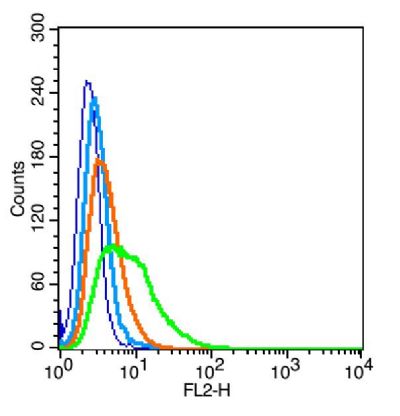
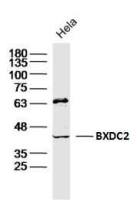
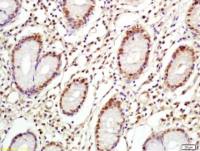
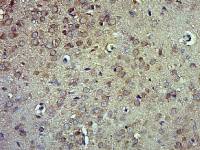
| 产品图片 | 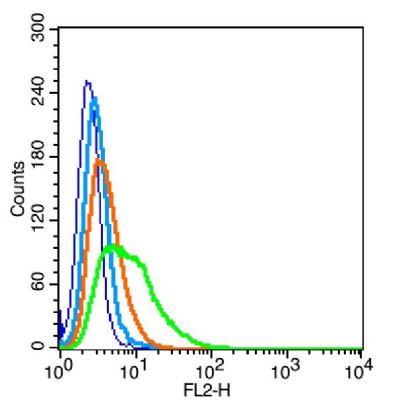 Blank control: RSC96(blue), the cells were fixed with 2% paraformaldehyde (10 min). Isotype Control Antibody: Rabbit IgG(orange) ; Secondary Antibody: Goat anti-rabbit IgG-PE(white blue), Dilution: 1:100 in 1 X PBS containing 0.5% BSA ; Primary Antibody Dilution: 1μg in 100 μL1X PBS containing 0.5% BSA(green). |
风险提示:丁香通仅作为第三方平台,为商家信息发布提供平台空间。用户咨询产品时请注意保护个人信息及财产安全,合理判断,谨慎选购商品,商家和用户对交易行为负责。对于医疗器械类产品,请先查证核实企业经营资质和医疗器械产品注册证情况。
 文献和实验
文献和实验Sci Adv:蒋若天 / 温祥毅揭示钾离子通道参与健康和衰老视网膜视觉信号调控新机制
(Two-pore-domain potassium channel,K2P)是一类四乙胺(Tetraethylammonium, TEA)非敏感性背景钾离子通道家族,不同亚类 K2P 对不同刺激敏感性不同,多种内源性和外源性的刺激可调控 K2P 通道激活,如:机械刺激 、多不饱和脂肪酸刺激 、酸度 pH 刺激等 10。 双孔酸敏感钾离子通道 3 (Tandem pore domain acid-sensitive K channel 3 ,TASK-3) 是 K2P 众多亚家族中的一类。TASK
环已基碳二亚胺(DCCD)与该亚基的谷氨酸残基结合后,质子通道即被关闭,F0 F1 -ATP酶活力被抑制。 线粒体内膜质子转移ATP酶的抑制剂有两类:一类直接抑制ATP的水解,如栎皮酮(quercetin),既能抑制水溶性F1 的酶活力,也抑制结合在膜上的酶活力。另一类抑制质子通过膜的转移,间接也抑制酶活力,例如寡霉素、DCCD等,它们不抑制水溶性F1 的酶活力。 钠钾 ATP酶〔(Na ,K )-ATP酶〕动物细胞质膜上都有此酶,它的活力需要钠离子(Na ),钾离子
扫描仪中,都采用机械式的二维X,Y线性扫描技术实现,即X,Y方向都采用直线驱动器和直线导轨实现往复运动。此类装置,由于驱动系统的频率限制,驱动器的扫描惯性大,使得扫描效率低,分析时间相当长;并且往复行程长,对直线导轨的精度要求相当高。二、光机结合的二维扫描系统为同样实现生物芯片的二维扫描,我们的实验装置设计如图2,采用了振镜和大数值孔径的远心f-è物镜相结合实现X方向扫描,Y方向的运动仍采用直线驱动器和直线导轨实现。 系统中,对于f-è物镜,满足x=2fè(è为振镜的摆动角度,f为物镜焦距)的线性
 技术资料
技术资料暂无技术资料 索取技术资料

