

- ¥1380 - 2200
- LMAI Bio
- LM-12630R
- 进口/国产
- 2025年07月15日
- WB=1:500-2000 ELISA=1:500-1000 IHC-P=1:400-800 IHC-F=1:400-800 Flow-Cyt=1μg/Test IF=1:100-500 (石蜡切片需做抗原修复)
- Rabbit
- Human, Mouse, Rat, Dog, Pig, Cow, Horse, Sheep,

企业认证
相关产品推荐更多 >

万千商家帮你免费找货
0 人在求购买到急需产品
- 详细信息
- 文献和实验
- 技术资料
- 供应商:
上海联迈生物工程有限公司
- 库存:
大量
- 目录编号:
LM-12630R
- 克隆性:
多克隆
- 抗原来源:
Rabbit
- 保质期:
1年
- 抗体英文名:
DAP12
- 抗体名:
自然杀伤激活受体相关蛋白DAP12抗体
- 宿主:
Rabbit
- 适应物种:
Human, Mouse, Rat, Dog, Pig, Cow, Horse, Sheep,
- 免疫原:
KLH conjugated synthetic peptide derived from human DAP12:31-113/113
- 亚型:
IgG
- 形态:
Lyophilized or Liquid
- 应用范围:
WB=1:500-2000 ELISA=1:500-1000 IHC-P=1:400-800 IHC-F=1:400-800 Flow-Cyt=1μg/Test IF=1:100-500 (石蜡切片需做抗原修复)
- 浓度:
1mg/ml
- 保存条件:
Store at -20 °C
- 规格:
100ul 200ul
| 英文名称 | DAP12 |
| 中文名称 | 自然杀伤激活受体相关蛋白DAP12抗体 |
| 别 名 | DAP 12; DAP12; DNAX activation protein 12; DNAX-activation protein 12; KAR-associated protein; KARAP; Killer activating receptor associated protein; Killer-activating receptor-associated protein; PLOSL; TYOBP_HUMAN; TYRO protein tyrosine kinase binding protein; TYRO protein tyrosine kinase-binding protein; TYROBP. |
| 规格价格 | 100ul/1380元 购买 200ul/2200元 购买 大包装/询价 |
| 说 明 书 | 100ul 200ul |
| 研究领域 | 细胞生物 免疫学 信号转导 细胞凋亡 激酶和磷酸酶 细胞膜受体 |
| 抗体来源 | Rabbit |
| 克隆类型 | Polyclonal |
| 交叉反应 | Human, Mouse, Rat, Dog, Pig, Cow, Horse, Sheep, |
| 产品应用 | WB=1:500-2000 ELISA=1:500-1000 IHC-P=1:400-800 IHC-F=1:400-800 Flow-Cyt=1μg/Test IF=1:100-500 (石蜡切片需做抗原修复) not yet tested in other applications. optimal dilutions/concentrations should be determined by the end user. |
| 分 子 量 | 10kDa |
| 细胞定位 | 细胞膜 |
| 性 状 | Lyophilized or Liquid |
| 浓 度 | 1mg/ml |
| 免 疫 原 | KLH conjugated synthetic peptide derived from human DAP12:31-113/113 |
| 亚 型 | IgG |
| 纯化方法 | affinity purified by Protein A |
| 储 存 液 | 0.01M TBS(pH7.4) with 1% BSA, 0.03% Proclin300 and 50% Glycerol. |
| 保存条件 | Store at -20 °C for one year. Avoid repeated freeze/thaw cycles. The lyophilized antibody is stable at room temperature for at least one month and for greater than a year when kept at -20°C. When reconstituted in sterile pH 7.4 0.01M PBS or diluent of antibody the antibody is stable for at least two weeks at 2-4 °C. |
| PubMed | PubMed |
| 产品介绍 | background: This gene encodes a transmembrane signaling polypeptide which contains an immunoreceptor tyrosine-based activation motif (ITAM) in its cytoplasmic domain. The encoded protein may associate with the killer-cell inhibitory receptor (KIR) family of membrane glycoproteins and may act as an activating signal transduction element. This protein may bind zeta-chain (TCR) associated protein kinase 70kDa (ZAP-70) and spleen tyrosine kinase (SYK) and play a role in signal transduction, bone modeling, brain myelination, and inflammation. Mutations within this gene have been associated with polycystic lipomembranous osteodysplasia with sclerosing leukoencephalopathy (PLOSL), also known as Nasu-Hakola disease. Its putative receptor, triggering receptor expressed on myeloid cells 2 (TREM2), also causes PLOSL. Multiple alternative transcript variants encoding distinct isoforms have been identified for this gene. [provided by RefSeq, Mar 2010] Function: Non-covalently associates with activating receptors of the CD300 family. Cross-linking of CD300-TYROBP complexes results in cellular activation. Involved for instance in neutrophil activation mediated by integrin. Subunit: Homodimer; disulfide-linked. Interacts with SIRPB1 and TREM1. Interacts with CLECSF5. Interacts with SIGLEC14. Interacts with CD300LB and CD300E. Interacts with CD300D. Interacts (via ITAM domain) with SYK (via SH2 domains); activates SYK mediating neutrophils and macrophages integrin-mediated activation. Interacts with KLRC2 and KIR2DS3. Subcellular Location: Membrane. Tissue Specificity: Expressed at low levels in the early development of the hematopoietic system and in the promonocytic stage and at high levels in mature monocytes. Expressed in hematological cells and tissues such as peripheral blood leukocytes and spleen. Also found in bone marrow, lymph nodes, placenta, lung and liver. Expressed at lower levels in different parts of the brain especially in the basal ganglia and corpus callosum. Post-translational modifications: Tyrosine phosphorylated. DISEASE: Defects in TYROBP are a cause of polycystic lipomembranous osteodysplasia with sclerosing leukoencephalopathy (PLOSL) [MIM:221770]; also called presenile dementia with bone cysts or Nasu-Hakola disease (NHD). PLOSL is a recessively inherited disease characterized by a combination of psychotic symptoms rapidly progressing to presenile dementia and bone cysts restricted to wrists and ankles. PLOSL has a global distribution, although most of the patients have been diagnosed in Finland and Japan, with an estimated population prevalence of 2x10(-6) in the Finns. Similarity: Belongs to the TYROBP family. SWISS: O43914 Gene ID: 7305 Database links: Entrez Gene: 7305 Human Entrez Gene: 22177 Mouse Entrez Gene: 282390 Cow Entrez Gene: 476477 Dog Omim: 604142 Human SwissProt: Q95J79 Cow SwissProt: O43914 Human Unigene: 515369 Human Important Note: This product as supplied is intended for research use only, not for use in human, therapeutic or diagnostic applications. |
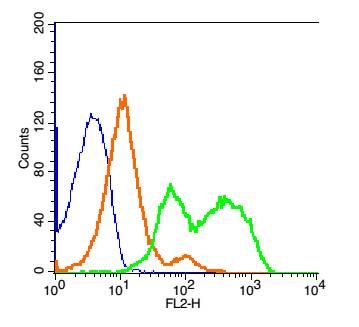
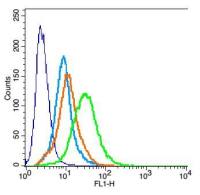
| 产品图片 | 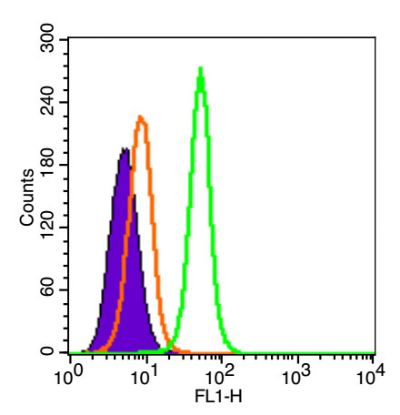 Blank control (Black line): U937(Black). Primary Antibody (green line): Rabbit Anti-DAP12 Conjugated FITC antibody (bs-12630R-FITC) Dilution: 3μg /10^6 cells; Isotype Control Antibody (orange line): Rabbit IgG-FITC . Protocol The cells were fixed with 4%PFA (10min at room temperature). The cells were then incubated in 5%BSA to block non-specific protein-protein interactions followed by the antibody for 15 min at room temperature. Cells stained with Primary Antibody for 30 min at room temperature.Acquisition of 20,000 events was perf 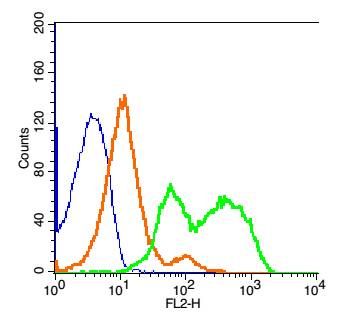 Blank control: mouse splenocytes(blue) Isotype Control Antibody: Rabbit IgG-PE(orange) ; Primary Antibody Dilution: 1μl in 100 μL1X PBS containing 0.5% BSA(green). |
风险提示:丁香通仅作为第三方平台,为商家信息发布提供平台空间。用户咨询产品时请注意保护个人信息及财产安全,合理判断,谨慎选购商品,商家和用户对交易行为负责。对于医疗器械类产品,请先查证核实企业经营资质和医疗器械产品注册证情况。
 文献和实验
文献和实验基酸,能与含有免疫受体酪氨酸激活基序(ITAM)的接头蛋白(如 DAP12)相互作用。这一结构特征在经典免疫学框架中通常与激活信号传导相关联。然而,高通量功能筛选研究显示,Siglec-15 在依赖 DAP12 表达的同时,却表现出对 T 细胞活性的持续抑制作用 [6]。这种抑制性与激活信号的交织与语境依赖性,使得 Siglec 家族在免疫调节中展现出超越传统二元分类的复杂性。 研究决策Step1:基于免疫逃逸维度的靶点筛选 肿瘤免疫逃逸机制的复杂性在于其多层
毒性 通过抗体依赖性细胞介导的细胞毒作用(ADCC)杀伤靶细胞,IgG类抗体的Fab段与靶细胞表面抗原结合后,其Fc段可与NK细胞、巨噬细胞、中性粒细胞和嗜酸性粒细胞表面的FcrRIII结合,从而介导效应细胞杀伤携带特异性抗原的靶细胞,从而激活免疫细胞,例如自然杀伤细胞,巨噬细胞等,以及病毒、细菌感染的细胞。 6、参与超敏反应和自身免疫病 IgE为亲细胞抗体,可通过其Fc段与肥大细胞和嗜碱性粒细胞表面的IgE高亲和力Fc受体结合,使其致敏。当相同的抗原再次进入机体时,可以直接与致敏原细胞表面的IgE结合
网络 第二节 机体抗病毒免疫 机体抗病毒感染免疫应答包括非特异性免疫与特异性免疫。前者指获得性免疫力产生之前,机体对病毒初次感染的天然抵抗力,主要为单核吞噬细胞、自然杀伤细胞及干扰素等的作用。后者指抗体介导的和细胞介导的抗病毒作用。本节中干扰素将单独阐述。 一、非特异性因素的抗病毒作用 (一)机械和化学屏障 皮肤为鳞状
 技术资料
技术资料暂无技术资料 索取技术资料

