

- ¥780 - 2200
- LMAI Bio
- LM-1178R
- 进口/国产
- 2025年07月12日
- ELISA=1:500-1000 IHC-P=1:400-800 IHC-F=1:400-800 IF=1:100-500 (石蜡切片需做抗原修复)
- Rabbit
- Human, Mouse, Rat, Rabbit,

企业认证
相关产品推荐更多 >

万千商家帮你免费找货
0 人在求购买到急需产品
- 详细信息
- 文献和实验
- 技术资料
- 供应商:
上海联迈生物工程有限公司
- 库存:
大量
- 目录编号:
LM-1178R
- 克隆性:
多克隆
- 抗原来源:
Rabbit
- 保质期:
1年
- 抗体英文名:
PAR-2
- 抗体名:
蛋白酶激活受体-2抗体
- 宿主:
Rabbit
- 适应物种:
Human, Mouse, Rat, Rabbit,
- 免疫原:
KLH conjugated synthetic peptide derived from human PAR2 (101-150aa):101-150/397
- 亚型:
IgG
- 形态:
Lyophilized or Liquid
- 应用范围:
ELISA=1:500-1000 IHC-P=1:400-800 IHC-F=1:400-800 IF=1:100-500 (石蜡切片需做抗原修复)
- 浓度:
1mg/ml
- 保存条件:
Store at -20 °C
- 规格:
50ul 100ul 200ul
| 英文名称 | PAR-2 |
| 中文名称 | 蛋白酶激活受体-2抗体 |
| 别 名 | Coagulation factor II receptor like 1; Coagulation factor II receptor-like 1; Coagulation factor II thrombin receptor like 1; F2RL1; G protein coupled receptor 11; G-protein coupled receptor 11; GPR11; PAR 2; PAR-2; PAR2_HUMAN; Protease activated receptor 2; Proteinase activated receptor 2; Proteinase-activated receptor 2; Thrombin receptor like 1; Thrombin receptor-like 1. |
| 规格价格 | 50ul/780元 购买 100ul/1380元 购买 200ul/2200元 购买 大包装/询价 |
| 说 明 书 | 50ul 100ul 200ul |
| 研究领域 | 肿瘤 细胞膜受体 G蛋白偶联受体 |
| 抗体来源 | Rabbit |
| 克隆类型 | Polyclonal |
| 交叉反应 | Human, Mouse, Rat, Rabbit, |
| 产品应用 | ELISA=1:500-1000 IHC-P=1:400-800 IHC-F=1:400-800 IF=1:100-500 (石蜡切片需做抗原修复) not yet tested in other applications. optimal dilutions/concentrations should be determined by the end user. |
| 分 子 量 | 40kDa |
| 细胞定位 | 细胞膜 |
| 性 状 | Lyophilized or Liquid |
| 浓 度 | 1mg/ml |
| 免 疫 原 | KLH conjugated synthetic peptide derived from human PAR2 (101-150aa):101-150/397 |
| 亚 型 | IgG |
| 纯化方法 | affinity purified by Protein A |
| 储 存 液 | 0.01M TBS(pH7.4) with 1% BSA, 0.03% Proclin300 and 50% Glycerol. |
| 保存条件 | Store at -20 °C for one year. Avoid repeated freeze/thaw cycles. The lyophilized antibody is stable at room temperature for at least one month and for greater than a year when kept at -20°C. When reconstituted in sterile pH 7.4 0.01M PBS or diluent of antibody the antibody is stable for at least two weeks at 2-4 °C. |
| PubMed | PubMed |
| 产品介绍 | background: The Proteinase-activated receptor 2 (PAR2) is a member of the proteinase-activated receptor subfamily. It is activated through proteolytic exposure of an occult tethered ligand by trypsin and trypsin-like proteases. This is in contrast to other members of the subfamily which are activated by the protease thrombin. PAR2 has been implicated in acute inflammatory response, asthma, and pain transmission. PAR2 expression has been documented in the periphery. ESTs have been isolated from adrenal, brain, breast, heart/melanocyte/uterus, kidney, lung, and vessel libraries. Coagulation factor II (thrombin) receptor-like 1 (F2RL1)is a member of the large family of 7-transmembrane-region receptors that couple to guanosine-nucleotide-binding proteins. F2RL1 is also a member of the protease-activated receptor family. It is activated by trypsin, but not by thrombin. It is activated by proteolytic cleavage of its extracellular amino terminus. The new amino terminus functions as a tethered ligand and activates the receptor. The F2RL1 gene contains two exons and is widely expressed in human tissues. The predicted protein sequence is 83% identical to the mouse receptor sequence. [provided by RefSeq]. Function: Receptor for trypsin and trypsin-like enzymes coupled to G proteins. Its function is mediated through the activation of several signaling pathways including phospholipase C (PLC), intracellular calcium, mitogen-activated protein kinase (MAPK), I-kappaB kinase/NF-kappaB and Rho. Can also be transactivated by cleaved F2R/PAR1. Involved in modulation of inflammatory responses and regulation of innate and adaptive immunity, and acts as a sensor for proteolytic enzymes generated during infection. Generally is promoting inflammation. Can signal synergistically with TLR4 and probably TLR2 in inflammatory responses and modulates TLR3 signaling. Has a protective role in establishing the endothelial barrier; the activity involves coagulation factor X. Proposed to have a bronchoprotective role in airway epithelium, but also shown to compromise the airway epithelial barrier by interrupting E-cadherin adhesion. Involved in the regulation of vascular tone; activation results in hypotension presumably mediated by vasodilation. Associates with a subset of G proteins alpha subunits such as G alpha-q, G alpha-11, G alpha-14, G alpha-12 and G alpha-13, but probably not with G(o) alpha, G(i) subunit alpha-1 and G(i) subunit alpha-2. However, according to PubMed:21627585 can signal through G(i) subunit alpha. Believed to be a class B receptor which internalizes as a complex with arrestin and traffic with it to endosomal vesicles, presumably as desensitized receptor, for extended periods of time. Mediates inhibition of TNF-alpha stimulated JNK phosphorylation via coupling to G alpha-q/11; the function involves dissociation of RIPK1 and TRADD from TNFR1. Mediates phosphorylation of nuclear factor NF-kappa-B RELA subunit at 'Ser-536'; the function involves IKBKB and is predominantly independent of G proteins. Involved in cellular migration. Involved in cytoskeletal rearrangement and chemotaxis through beta-arrestin-promoted scaffolds; the function is independent of G alpha-q/11 and involves promotion of cofilin dephosphoryltaion and actin filament severing. Induces redistribution of COPS5 from the plasma membrane to the cytosol and activation of the JNK cascade is mediated by COPS5. Involved in the recruitment of leukocytes to the sites of inflammation and is the major PAR receptor capable of modulating eosinophil function such as proinflammatory cytokine secretion, superoxide production and degranulation. During inflammation promotes dendritic cell maturation, trafficking to the lymph nodes and subsequent T-cell activation. Involved in antimicrobial response of innate immnune cells; activation enhances phagocytosis of Gram-positive and killing of Gram-negative bacteria. Acts synergistically with interferon-gamma in enhancing antiviral responses. Implicated in a number of acute and chronic inflammatory diseases such as of the joints, lungs, brain, gastrointestinal tract, periodontium, skin, and vascular systems, and in autoimmune disorders. Subunit: Interacts with TLR4, COPS5 and TMED2. Interacts with GNAQ, GNA11, GNA12, GNA13 and GNA14. Subcellular Location: Cell membrane; Multi-pass membrane protein. Tissue Specificity: Widely expressed in tissues with especially high levels in pancreas, liver, kidney, small intestine, and colon. Moderate expression is detected in many organs, but none in brain or skeletal muscle. Post-translational modifications: A proteolytic cleavage generates a new N-terminus that functions as a tethered ligand. Activating serine proteases include trypsin, mast cell tryptase, coagulation factors VII and Xa, myeloblastin/PRTN3 and membrane-type serine protease 1/ST14. Proposed subsequent cleaveage by serine proteases is leading to receptor deactivation and include neutrophil elastase and cathepsin G. At least in part, implicated proteases are also shown to activate the receptor; the glycosylation status of the receptor is thought to contribute to the difference. In addition to conventional trypsin-like proteases is proposed to be activated by other proteases and glycosidases derived from bacteria, fungi and insects: serine protease allergens such as dust mite Der p3 and Der p9 and mold Pen c13, Porphyromonas gingivalis arginine-specific (trypsin-like) cysteine proteinases called gingipains, Streptomyces griseus exogenous chitinase, and an Alternaria alternata aspartate protease. Cleavage by the Alternaria alternata aspartate protease generates non-conventional processed forms. N-glycosylated and sialylated. Multiple phosphorylated on serine and threonine residues in the cytoplasmic region upon receptor activation; required for receptor desensitization and recruitment of beta-arrestin. Monoubiquitinated by CBL at the plasma membrane and in early endosomes; not required for receptor endocytosis but for translocation to late endosomes or lysosomes. Deubiquitination involves STAMBP and USP8; required for lysosomal trafficking and receptor degradation. Similarity: Belongs to the G-protein coupled receptor 1 family. SWISS: P55085 Gene ID: 2150 Database links: Entrez Gene: 2150 Human Entrez Gene: 14063 Mouse Entrez Gene: 116677 Rat Omim: 600933 Human SwissProt: P55085 Human SwissProt: P55086 Mouse SwissProt: Q63645 Rat Unigene: 154299 Human Unigene: 1614 Mouse Unigene: 10543 Rat Important Note: This product as supplied is intended for research use only, not for use in human, therapeutic or diagnostic applications. PAR2也是细胞表面受体,通过G蛋白影响细胞功能,PAR蛋白全称为蛋白酶活化受体(Protease-activated receptors),是独立家族的G蛋白偶联受体,经研究认为PAR2与炎症,实体肿瘤等密切相关。 |
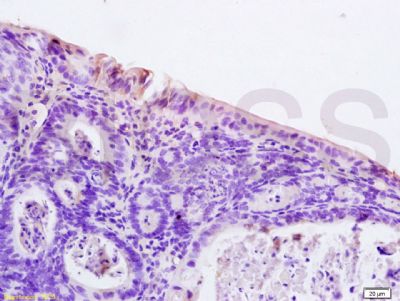
| 产品图片 | 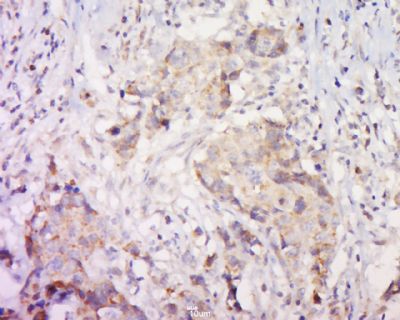 Tissue/cell: human colon carcinoma; 4% Paraformaldehyde-fixed and paraffin-embedded; Antigen retrieval: citrate buffer ( 0.01M, pH 6.0 ), Boiling bathing for 15min; Block endogenous peroxidase by 3% Hydrogen peroxide for 30min; Blocking buffer (normal goat serum,C-0005) at 37℃ for 20 min; Incubation: Anti-APR-2 Polyclonal Antibody, Unconjugated(bs-1178R) 1:500, overnight at 4°C, followed by conjugation to the secondary antibody(SP-0023) and DAB(C-0010) staining 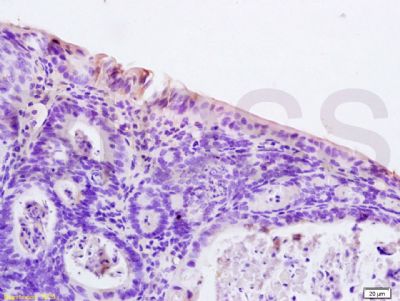 Tissue/cell: rat colitis tissue; 4% Paraformaldehyde-fixed and paraffin-embedded; Antigen retrieval: citrate buffer ( 0.01M, pH 6.0 ), Boiling bathing for 15min; Block endogenous peroxidase by 3% Hydrogen peroxide for 30min; Blocking buffer (normal goat serum,C-0005) at 37℃ for 20 min; Incubation: Anti-PAR-2 Polyclonal Antibody, Unconjugated(bs-1178R) 1:200, overnight at 4°C, followed by conjugation to the secondary antibody(SP-0023) and DAB(C-0010) staining |
风险提示:丁香通仅作为第三方平台,为商家信息发布提供平台空间。用户咨询产品时请注意保护个人信息及财产安全,合理判断,谨慎选购商品,商家和用户对交易行为负责。对于医疗器械类产品,请先查证核实企业经营资质和医疗器械产品注册证情况。
 文献和实验
文献和实验功能障碍。这种急性危重疾病发病机制仍然很大程度上未知。 在秀丽隐杆线虫中,热应激通过钙网蛋白和蛋白酶钙蛋白酶导致普遍的坏死细胞死亡——这些蛋白质的消耗限制了热应激引起的这些线虫的致死率。在脊椎动物中,程序性细胞坏死是由混合谱系激酶域样 (MLKL) 或 gasdermin 家族蛋白(例如 gasdermin D)介导的,它们在激活时会在细胞质或细胞内膜上形成孔。 热应激触发 RIPK3 依赖性细胞死亡(图源自 Science ) MLKL 被受体相互作用蛋白激酶 3 (RIPK3) 依赖
「体温低」竟能更长寿!Nature Aging 研究揭示低温延寿的关键机制
线虫(Caenorhabditis elegans)中,低温(15℃)能促进激活因子 PSME-3 介导的蛋白酶活性,而且 PSME-3 的表达能延长寿命。研究还表明,将体外培养的人类细胞暴露在适度偏低的体温(36℃)下,能激活人类版本的 PSME-3,并有望减少疾病相关的蛋白质改变。 图片来源:Nature Aging 主要研究内容 寒冷诱导的 PA28γ/PSME3 触发蛋白酶体活性 蛋白酶体(一类蛋白质复合物)可以通过降解不需要的、损坏的和错误折叠的易于聚集的蛋白质,包括与疾病相关的突变蛋白,来预防衰老和病理
禁食 16 小时就可以唤醒身体「时钟」!Cell 子刊揭示间歇性禁食有益健康的关键节点
和激活蛋白酶体。并确定肝脏蛋白酶体可能是禁食的「计时器」,为探索间歇性禁食促进健康的潜在机制提供了一个重要靶点。 图片来源:Cell Reports 揭开间歇性禁食背后的秘密 当前,尽管间歇性禁食已被证明从许多方面对健康有益,但不同实验室的禁食计划各不相同,主要原因是还没有找到生物体在体内对禁食表现出明显反应的确切时间点,即究竟禁食多久才更利于健康。 为揭开间歇性禁食背后的秘密,研究团队绘制了 5 种喂养方案下、多达 600 个小鼠代谢组织样品的昼夜转录通路图谱,其中囊括了小鼠的重要
 技术资料
技术资料暂无技术资料 索取技术资料

