- ¥780 - 2200
- 康朗生物
- kl-0177R
- 中国/美国/德国
- 2025年11月12日
- WB=1:500-2000 ELISA=1:500-1000 IHC-P=1:400-800 IHC-F=1:400-800 Flow-Cyt=1μg /test ICC=1:100-500 IF=1:100-500
- Rabbit
- Human, Mouse, Rat,

11 年钻石会员
企业认证
相关产品推荐更多 >



万千商家帮你免费找货
0 人在求购买到急需产品
- 详细信息
- 询价记录
- 技术资料
- 供应商:
上海康朗生物科技有限公司
- 库存:
大量
- 目录编号:
kl-0177R
- 克隆性:
多克隆
- 抗原来源:
Rabbit
- 保质期:
12个月
- 抗体英文名:
RAGE antibody
- 抗体名:
晚期糖基化终末产物特异性受体抗体
- 宿主:
Rabbit
- 适应物种:
Human, Mouse, Rat,
- 免疫原:
KLH conjugated synthetic peptide derived from rat AGER:151-250/403 <Extracellular>
- 亚型:
IgG
- 形态:
冻干粉或液体
- 应用范围:
WB=1:500-2000 ELISA=1:500-1000 IHC-P=1:400-800 IHC-F=1:400-800 Flow-Cyt=1μg /test ICC=1:100-500 IF=1:100-500
- 浓度:
1mg/ml
- 保存条件:
-20 °C
- 规格:
50ul 100ul 200ul
RAGE antibody
| 中文名称 | 晚期糖基化终末产物特异性受体抗体 |
| 别 名 | Advanced glycosylation end product specific receptor; Advanced glycosylation end product-specific receptor; AGER; EC 2.7.11.22; LE 9211 A antigen;LE-9211-A antigen; MGC22357; MOK; RAGE 1; RAGE1; MOK protein kinase; Receptor for advanced glycation endproducts;Renal tumor antigen 1; Renal tumor antigen; Renal cell carcinoma antigen (MOK protein kinase); Renal tumor antigen 1; RAGE_HUMAN. |
 |
Specific References (5) | bs-0177R has been referenced in 5 publications. [IF=3.73] Yu, Wei, et al. "Curcumin Alleviates Diabetic Cardiomyopathy in Experimental Diabetic Rats." PloS one 7.12 (2012): e52013. WB ; Rat. PubMed:23251674 [IF=2.61] Huang, Li-feng, et al. "The effect of high-mobility group box 1 protein on activity of regulatory T cells after thermal injury in rats." Shock 31.3 (2009): 322. other ; Rat. PubMed:18665051 [IF=2.50] Zhu, Xiao-mei, et al. "Anti-RAGE antibody ameliorates severe thermal injury in rats through regulating cellular immune function." Acta Pharmacologica Sinica (2014). other ; Rat. PubMed:25152026 [IF=2.73] Sun, Yan‐Na, et al. "Effects of insulin combined with idebenone on blood–brain barrier permeability in diabetic rats." Journal of Neuroscience Research (2014). WB ; Rat. PubMed:25421718 [IF=3.88] Fu, Juanli, et al. "Tetrachlorobenzoquinone exerts neurological pro-inflammatory activity by promoting HMGB1 release, which induces TLR4 clustering within the lipid raft." Toxicological Sciences (2016): kfw124. WB ; Rat. PubMed:27413111 |
| 规格价格 | 50ul/780元 购买 100ul/1380元 购买 200ul/2200元 购买 大包装/询价 |
| 说 明 书 | 50ul 100ul 200ul |
| 研究领域 | 肿瘤 心血管 免疫学 生长因子和激素 糖尿病 内分泌病 |
| 抗体来源 | Rabbit |
| 克隆类型 | Polyclonal |
| 交叉反应 | Human, Mouse, Rat, |
| 产品应用 | WB=1:500-2000 ELISA=1:500-1000 IHC-P=1:400-800 IHC-F=1:400-800 Flow-Cyt=1μg /test ICC=1:100-500 IF=1:100-500 (石蜡切片需做抗原修复) not yet tested in other applications. optimal dilutions/concentrations should be determined by the end user. |
| 分 子 量 | 42kDa |
| 细胞定位 | 细胞膜 分泌型蛋白 |
| 性 状 | Lyophilized or Liquid |
| 浓 度 | 1mg/ml |
| 免 疫 原 | KLH conjugated synthetic peptide derived from rat AGER:151-250/403 <Extracellular> |
| 亚 型 | IgG |
| 纯化方法 | affinity purified by Protein A |
| 储 存 液 | 0.01M TBS(pH7.4) with 1% BSA, 0.03% Proclin300 and 50% Glycerol. |
| 保存条件 | Store at -20 °C for one year. Avoid repeated freeze/thaw cycles. The lyophilized antibody is stable at room temperature for at least one month and for greater than a year when kept at -20°C. When reconstituted in sterile pH 7.4 0.01M PBS or diluent of antibody the antibody is stable for at least two weeks at 2-4 °C. |
| PubMed | PubMed |
| 产品介绍 | background: Advanced glycosylation end product-specific receptor (AGER; RAGE) is a member of the immunoglobulin superfamily of cell surface molecules that binds molecules that have been irreversibly modified by non-enzymatic glycation and oxidation, and are know as advanced glycation end products (AGEs). It is expressed by endothelium, mononuclear phagocytes, neurons and smooth muscle cells. Whereas RAGE is present at high levels during development, especially in the central nervous system, its levels decline during maturity.The increased expression of RAGE is associated with several pathological states, such as diabetic vasculopathy, neuropathy, retinopathy and other disorders, including Alzheimer's disease and immune/inflammatory reactions of the vessel walls. In diabetic tissues, the production of RAGE is due to the overproduction of AGEs that eventually overwhelm the protective properties of RAGE. This results in oxidative stress and endothelial cell dysfunction that leads to vascular disease in diabetics. In the brain, RAGE also binds amyloid beta (Ab). Because Ab is overproduced in neurons and vessels in the brains of Alzheimer disease, this leads to the hyperstimulation of RAGE. The RAGE-Ab interaction is thought to result in oxidative stress leading to neuronal degeneration. Function: Mediates interactions of advanced glycosylation end products (AGE). These are nonenzymatically glycosylated proteins which accumulate in vascular tissue in aging and at an accelerated rate in diabetes. Acts as a mediator of both acute and chronic vascular inflammation in conditions such as atherosclerosis and in particular as a complication of diabetes. AGE/RAGE signaling plays an important role in regulating the production/expression of TNF-alpha, oxidative stress, and endothelial dysfunction in type 2 diabetes. Interaction with S100A12 on endothelium, mononuclear phagocytes, and lymphocytes triggers cellular activation, with generation of key proinflammatory mediators. Receptor for amyloid beta peptide. Contributes to the translocation of amyloid-beta peptide (ABPP) across the cell membrane from the extracellular to the intracellular space in cortical neurons. ABPP-initiated RAGE signaling, especially stimulation of p38 mitogen-activated protein kinase (MAPK), has the capacity to drive a transport system delivering ABPP as a complex with RAGE to the intraneuronal space. Interaction with S100B after myocardial infarction may play a role in myocyte apoptosis by activating ERK1/2 and p53/TP53 signaling. Subunit: Interacts with S100B, S100A1 and APP. Interacts with S100A12. Subcellular Location: Isoform 1: Cell membrane; Single-pass type I membrane protein. Isoform 2: Secreted. Tissue Specificity: Endothelial cells and cardiomyocytes. Similarity: Contains 2 Ig-like C2-type (immunoglobulin-like) domains. Contains 1 Ig-like V-type (immunoglobulin-like) domain. SWISS: Q63495 Gene ID: 81722 Database links: Entrez Gene: 177 Human Entrez Gene: 11596 Mouse Entrez Gene: 81722 Rat Omim: 600214 Human SwissProt: Q15109 Human SwissProt: Q62151 Mouse SwissProt: Q63495 Rat Unigene: 534342 Human Unigene: 3383 Mouse Unigene: 9829 Rat Important Note: This product as supplied is intended for research use only, not for use in human, therapeutic or diagnostic applications. 晚期糖基化终末产物受体(AGER)与其配体AGEs形成的AGEs-AGER 系统在糖尿病血管病变的发生、发展过程中起着重要作用. 年龄及晚期糖基化终末产物(AGEs)等多种因素均能调节AGER基因的表达. 糖尿病患者体内晚期糖基化终末产物受体(AGER)的高表达加速了病人血管病变的发展过程,并增加了病变的复杂性.阻断AGER通路可缓解糖尿病血管的病变过程。 因此,AGER可以作为治疗糖尿病血管病变的药物靶点,并为临床治疗糖尿病血管病变提供了新的思路. |
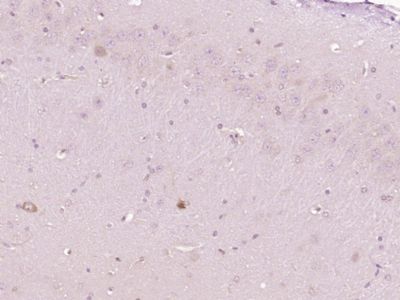
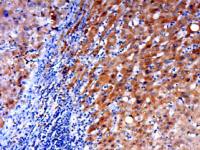
| 产品图片 | 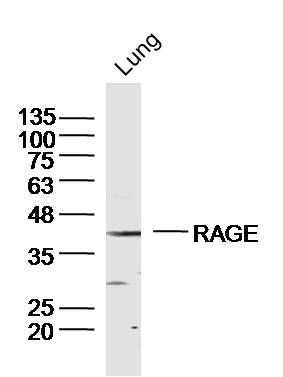 Sample: lung (mouse) Lysate at 40 ug Primary: Anti-RAGE (bs-0177R)at 1/300 dilution Secondary: IRDye800CW Goat Anti-Rabbit IgG at 1/20000 dilution Predicted band size: 42kD Observed band size: 42 kD 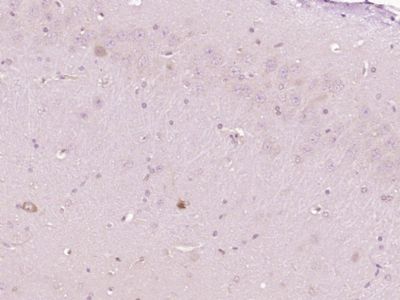 Paraformaldehyde-fixed, paraffin embedded (Rat brain); Antigen retrieval by boiling in sodium citrate buffer (pH6.0) for 15min; Block endogenous peroxidase by 3% hydrogen peroxide for 20 minutes; Blocking buffer (normal goat serum) at 37°C for 30min; Antibody incubation with (RAGE) Polyclonal Antibody, Unconjugated (bs-0177R) at 1:400 overnight at 4°C, followed by operating according to SP Kit(Rabbit) (sp-0023) instructionsand DAB staining. 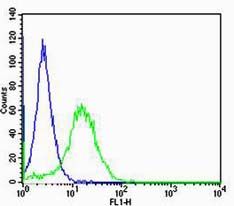 Cell: NIH/3T3 Concentration:1:100 Host/Isotype:Rabbit/IgG Flow cytometric analysis of Rabbit IgG isotype control (Cat#: bs-0177R) on NIH/3T3(green) compared with control in the absence of primary antibody (blue) followed by Alexa Fluor 488-conjugated goat anti-rabbit IgG(H+L) secondary antibody . |
风险提示:丁香通仅作为第三方平台,为商家信息发布提供平台空间。用户咨询产品时请注意保护个人信息及财产安全,合理判断,谨慎选购商品,商家和用户对交易行为负责。对于医疗器械类产品,请先查证核实企业经营资质和医疗器械产品注册证情况。
- 作者
- 内容
- 询问日期
 技术资料
技术资料暂无技术资料 索取技术资料
RAGE antibody
¥780 - 2200