


- ¥4300
- GeneTex

- 美国
- GTX23611
- 2025年07月16日
- WB, IHC-P, IHC-Fr
- Rabbit
- Human, Mouse, Rat, Frog, Squirrel

企业认证
相关产品推荐更多 >


万千商家帮你免费找货
0 人在求购买到急需产品
相关阅读
香烟烟雾如何加速声带纤维化?CD44-透明质酸轴是关键通路Takara 秋促来袭,提取+反转录+定量套装仅 1200 元abinScience 体内级抗体 全年锁价 低至 ¥1200阿拉丁 22万+ 科研级产品现货速发,品质严控、科研无忧- 详细信息
- 询价记录
- 文献和实验
- 技术资料
- 免疫原:
Synthetic peptides corresponding to residues C(362) W R K R Q P R (R/L) E E R K A P E S Q E D(380) of rat RAGE.
- 亚型:
IgG
- 形态:
Liquid
- 保存条件:
Store as concentrated solution. Centrifuge briefly prior to opening vial. For short-term storage (1-2 weeks), store at 4ºC. For long-term storage, aliquot and store at -20ºC or below. Avoid multiple freeze-thaw cycles.
- 克隆性:
Polyclonal
- 标记物:
Unconjugated
- 适应物种:
Human, Mouse, Rat, Frog, Squirrel
- 保质期:
12 months from the shipping date of the product.
- 抗原来源:
Rat
- 目录编号:
GTX23611
- 级别:
Primary Antibodies
- 库存:
Available
- 供应商:
GeneTex
- 宿主:
Rabbit
- 应用范围:
WB, IHC-P, IHC-Fr
- 浓度:
0.33 mg/ml (Please refer to the vial label for the specific concentration.)
- 靶点:
RAGE
- 抗体英文名:
RAGE antibody
- 抗体名:
RAGE 抗体
- 规格:
100 μl
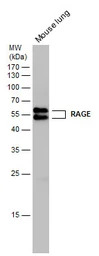
Mouse tissue extract (50 μg) was separated by 12% SDS-PAGE, and the membrane was blotted with RAGE antibody (GTX23611) diluted at 1:5000. The HRP-conjugated anti-rabbit IgG antibody (GTX213110-01) was used to detect the primary antibody.
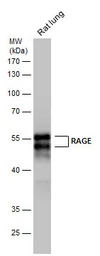
Rat tissue extract (50 μg) was separated by 10% SDS-PAGE, and the membrane was blotted with RAGE antibody (GTX23611) diluted at 1:5000. The HRP-conjugated anti-rabbit IgG antibody (GTX213110-01) was used to detect the primary antibody.

RAGE antibody detects RAGE protein in rat lung by immunohistochemical analysis.
Sample: Paraffin-embedded rat lung.
RAGE antibody (GTX23611) diluted at 1:400.
Antigen Retrieval: Citrate buffer, pH 6.0, 15 min
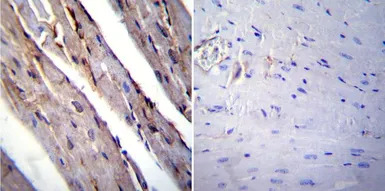
IHC-P analysis of normal mouse heart tissue with (ledt) or without (right) RAGE antibody at a dilution of 1:20. Heat induced antigen retrieval was performed using 10mM sodium citrate (pH6.0) buffer, microwaved for 8-15 minutes.
Antigen Retrieval: Trilogy™ (EDTA based, pH 8.0) buffer, 15min

IHC-P analysis of normal mouse kidney tissue with (ledt) or without (right) RAGE antibody at a dilution of 1:20. Heat induced antigen retrieval was performed using 10mM sodium citrate (pH6.0) buffer, microwaved for 8-15 minutes.
Antigen Retrieval: Trilogy™ (EDTA based, pH 8.0) buffer, 15min
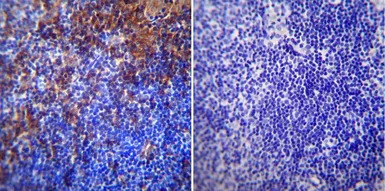
IHC-P analysis of normal mouse lymph node tissue with (ledt) or without (right) RAGE antibody at a dilution of 1:20. Heat induced antigen retrieval was performed using 10mM sodium citrate (pH6.0) buffer, microwaved for 8-15 minutes.
Antigen Retrieval: Trilogy™ (EDTA based, pH 8.0) buffer, 15min
风险提示:丁香通仅作为第三方平台,为商家信息发布提供平台空间。用户咨询产品时请注意保护个人信息及财产安全,合理判断,谨慎选购商品,商家和用户对交易行为负责。对于医疗器械类产品,请先查证核实企业经营资质和医疗器械产品注册证情况。
 询价记录
询价记录 暂无询价记录
 文献和实验
文献和实验Fukuoka CY et al., PLoS One 2020 (PMID:32750068)
Al-Attar R et al., Gene 2020 (PMID:32777527)
Abedini A et al., J Clin Invest 2018 (PMID:29337308)
Ono H et al., Sci Rep 2018 (PMID:30002389)
Logan SM et al., PeerJ 2018 (PMID:29888131)
Sukjamnong S et al., Am J Physiol Lung Cell Mol Physiol 2017 (PMID:28522560)
Fukuoka CY et al., PLoS One 2017 (PMID:28099448)
Saby C et al., Oncotarget 2016 (PMID:27121132)
Daffu G et al., Diabetes 2015 (PMID:26253613)
Chen YC et al., Sci Rep 2016 (PMID:26739898)
Juranek JK et al., Front Cell Neurosci 2015 (PMID:26733811)
Rai V et al., J Exp Med 2012 (PMID:23209312)
Shang L et al., PLoS One 2010 (PMID:20404919)
Lee CC et al., Biochem Pharmacol 2013 (PMID:23948063)
Rai V et al., J Biol Chem 2012 (PMID:22194616)
Pollreisz A et al., Atherosclerosis 2010 (PMID:20701913)
Ru-Jeng Teng et al., Free Radic Biol Med 2021 (PMID:33607217)
Laura Hansen et al., J Am Heart Assoc 2021 (PMID:34689598)
Lu WH et al., Toxics 2020 (PMID:32947820)
RACE and RAGE Cloning in Parasitic Microbial Eukaryotes
and RAGE, we used to successfully clone partial and full-length ORFs from amitochondriate parasitic microbial eukaryotes. The RACE approach uses cDNA as template for PCR cloning whereas RAGE uses genomic DNA. These two approaches were used to complement
Rapid Amplification of Gene Ends (RAGE) from Gene Libraries by Anchored PCR
Isolation of a full-length gene on the basis of limited sequence information is often troublesome and challenging. Tremendous effort is needed to isolate a specific gene by screening cDNA or genomic libraries by oligonucleotide or nucleic
Generation of Antibody Molecules Through Antibody Engineering
been overcome to a large extent using genetic-engineering techniques to produce chimeric mouse/human and completely human antibodies. Such an approach is particularly suitable because of the domain structure of the antibody molecule ( 2 ), where functional
 技术资料
技术资料暂无技术资料 索取技术资料

