

- ¥600 - 6000
- Sino Biological Inc.
- 10600-P07E-RN
- 北京
- 2026年01月08日

相关产品推荐更多 >


万千商家帮你免费找货
0 人在求购买到急需产品
相关阅读
源叶生物 十万种现货试剂速发,品质稳、品类全,实验不再等!Takara 秋促来袭,提取+反转录+定量套装仅 1200 元abinScience 体内级抗体 全年锁价 低至 ¥1200阿拉丁 22万+ 科研级产品现货速发,品质严控、科研无忧- 详细信息
- 文献和实验
- 技术资料
- 库存:
99
- 英文名:
Protein A Agarose Beads / Resin
- 保质期:
12个月
- 供应商:
北京义翘神州科技股份有限公司
- 规格:
1 mL/5 mL/10 mL/25 mL/50 mL
| 规格: | 1 mL | 产品价格: | ¥600.0 |
|---|---|---|---|
| 规格: | 5 mL | 产品价格: | ¥1500.0 |
| 规格: | 10 mL | 产品价格: | ¥2500.0 |
| 规格: | 25 mL | 产品价格: | ¥4000.0 |
| 规格: | 50 mL | 产品价格: | ¥6000.0 |
Introduction
| Sino Biological Protein A Agarose Beads / Resin was produced by immobilizing recombinant protein A to 4% cross-linked agarose matrix. The recombinant protein A contains IgG binding domains, eliminating nonspecific binding sites and reducing steric hindrance. |
Specifications
| Ligand | Recombinant protein A |
| Dynamic binding capacity | ~30 mg human IgG/ml drained medium |
| Matrix | 4% highly cross-linked agarose |
| Bead size | 45–165 μm |
| Mean bead size | 90 μm |
| Maximum linear flow rate | >150 cm/h |
| pH stability | Long term:3-9 Short term: 2-10 Working: 2-9 |
| Sanitization | Sanitize the packed column with 2% Hibitane/20% ethanol or with 70% ethanol |
| Storage | +4–8 °C in 20% ethanol |
| Package | 1ml, 5ml, 10ml, 25ml, 50ml, Bulk |
Experiment:
| Column: | 5x 45 mm, bed volume 0.9 ml |
| Resin: | Protein A agarose resin |
| Binding Buffer: | 50 mM Tris, 100 mM NaCl, pH 8.0 |
| Elution Buffer: | 100 mM glycin, 10 mM NaCl, pH 3.0 |
| Sample: | Human IgG, 2.2 mg/ml |
| Flow Rate: | 0.3 ml/min |
| Procedure: | The column was equilibrated with biding buffer, then apply the sample at fow rate of 0.3 ml/min, when the flowthrough concentration reach 0.22 mg/min stop loading and wash the columm with biding buffer, when asorbency of 280 nm decrease to base line, elute with elution buffer. |
| Result: | 26.7 mg human IgG was recovered in eluant, Dynamic binding capacity of the colun is about 29.7 mg/ml |
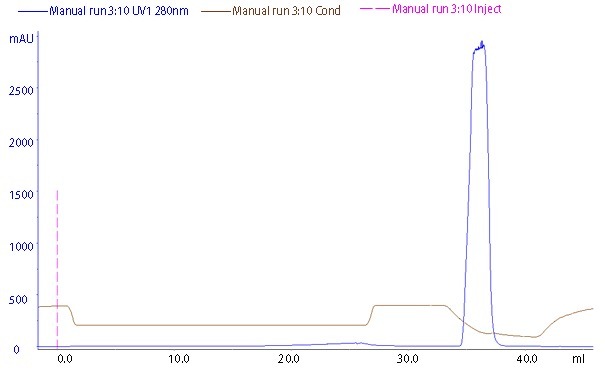 |
| Chromatography graph of measuring dynamic binding capacity |
Repeated Cycle Usage
|
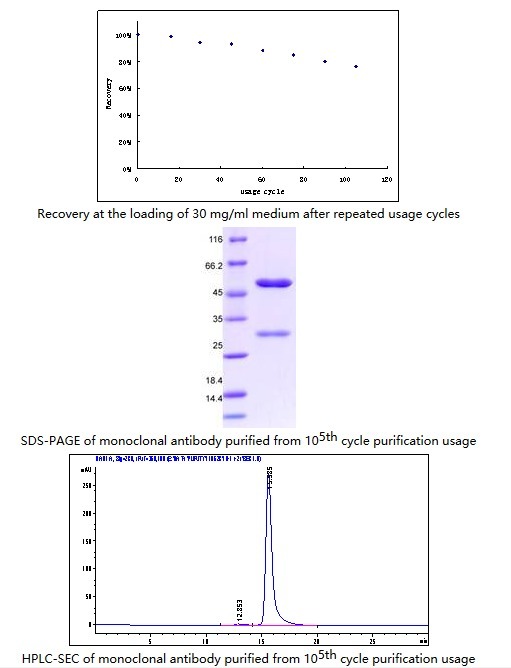
Repeated usage in practical manufacturing: The feedstock used was the supernatant of 293 cell line expressing various humanized monocolnal antibody, human monoclonal antibody or protein-Fc chimera. The volume of culture varies from 1000ml to 2000ml. |
|
| Column: | bed volumn of 20 ml with dimention of 26x 100 m |
| Flow rate: | 7 ml/min |
| Binding buffer | 50 mM Tris, 100 mM NaCl, pH 8.0 |
| Elution buffer | 100 mM glycerin, 10 mM NaCl, pH 3.0 |
| CIP buffer: | 50 mM NaOH, 1 M NaCl |
| Purification cycle | • 5 cv binding buffer wash the column • 5 cv elution buffer • 2 cv binding buffer • 3 cv CIP buffer • 3 cv binding buffer |
| Measure column capacity: | Comlumn capacity was tested every 15 practical purification cycle by applying 600 mg of a humanized monoclonal antibody with concentration of 1 mg/ml, and measure the recovery of the antibody. The procedure is the same with purification cycle. All capacity test experiment use the same antibody. |
CIP Protocol
|
The most common CIP procedure for Protein A resin is washing the resin with 2 column volumes of 6 M guanidine hydrochloride to remove precipitated or denatured substances, followed by re-equilibrating with at least 5 column volumes of binding buffer. For strongly bound hydrophobic proteins, lipoproteins and lipids, wash the resin with a non-ionic detergent, for instance, 0.1%. Triton X-100, at 37 °C. Immediately re-equilibrate with at least 5 column volumes of binding buffer. If the above methods are still not effective to remove the impurities, wash the medium with 5 column volumes of 50 mM NaOH, 1 M NaCl solution, Re-equilibrate with at least 5 column volumes of binding buffer. |
Protein A residual
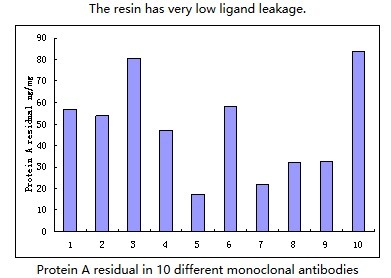 Protein A residual in 10 monoclonal antibodies randomly taken from manufactural purification. The feedstock used was the supernatant of 293 cell line expressing various humanized monocolnal antibody, human monoclonal antibody or protein-Fc chimera. The volume of culture loaded varies from 1000 ml to 2000 ml. |
Stability Study
| The IgG binding capacity and recovery was maintained after seven days storage at room temperature in solutions list below: 3 M NaSCN 6 M guanidine-HCl 8 M urea 0.1 M glycine, pH 3.0 70% ethanol. 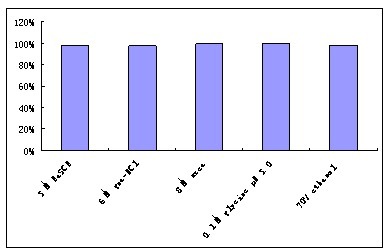 Recovery of antibody at the loading burden of 30 mg/ml medium after storage in varous solutions. |
Column Regeneration
| Regeneration step should be operated after elution to remove the residue proteins and impurities on the resin for repeated use. Wash the resin with 2–3 bed volumes of regeneration buffer followed by re-equilibration with 2–3 bed volumes of binding buffer. Sometimes the regeneration buffer is the same with the elution buffer, such as 0.1 M glycine buffer pH 3.0 or 0.1 M citric acid pH 3.0. When the elution buffer has a milder condition to avoid aggregation or degradation, the regeneration buffer is different, with a lower pH or containing different salts. But this procedure does not guarantee removing all kinds of impurities like denatured proteins or lipids. In this case, cleaning in place procedure is indispensable. |
Storage
| For storage, keep the medium at 2°C to 8°C in a suitable bacteriostat, e.g. 20% ethanol and/or 0.02% sodium azide. Notice: The resin must not be frozen. |
IgG binding of protein A, G, and L
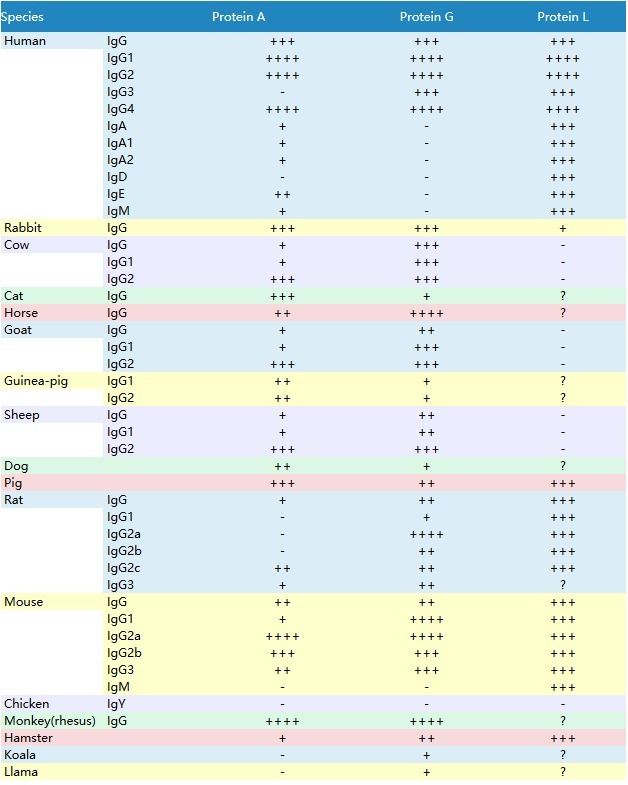 Strong binding ++, medium interaction +, weak or no interaction -. |
风险提示:丁香通仅作为第三方平台,为商家信息发布提供平台空间。用户咨询产品时请注意保护个人信息及财产安全,合理判断,谨慎选购商品,商家和用户对交易行为负责。对于医疗器械类产品,请先查证核实企业经营资质和医疗器械产品注册证情况。
 文献和实验
文献和实验1, Oller-Salvia B, et al. Genetic Encoding of a Non-Canonical Amino Acid for the Generation of Antibody-Drug Conjugates Through a Fast Bioorthogonal Reaction.Journal of visualized experiments : JoVE, PubMed ID: 30272643
2, Walser F, et al. Ubiquitin Phosphorylation at Thr12 Modulates the DNA Damage Response.Molecular cell, PubMed ID: 33022275
3, Wu Z, et al. SIRT3 alleviates sepsis-induced acute lung injury by inhibiting pyroptosis via regulating the deacetylation of FoxO3a.Pulmonary pharmacology & therapeutics, PubMed ID: 37499855
4, Mairaville C, et al. Identification of monoclonal antibodies from naive antibody phage-display libraries for protein detection in formalin-fixed paraffin-embedded tissues.Journal of immunological methods, PubMed ID: 39059744
2 广州精达公司现状 全自动发酵设备 分离纯化系统图3 广州精达公司现状 在获得重组蛋白A纯品之后,通过化学偶联的方法,将蛋白A结合到琼脂糖Sepharose CL-4B上,制备成蛋白A亲和层析柱。广州精达公司重组蛋白A纯化柱产品可参见图4。用户在使用重组蛋白A纯化柱时,血清样品中的抗体分子可以与蛋白A结合,而其他杂蛋白因为不能与蛋白A结合而穿过层析柱。结合在柱子上的IgG可以用酸洗或1M精氨酸洗脱使之解离,用收集管编号收集
材料 琼脂糖凝胶介质镍亲和柱 紫外检测仪 蛋白电泳装置及夹子、玻璃板、灌胶支架、缓冲液槽等附件 5 ml 注射器 0.45 μm 滤器 超声破碎仪 试剂 1. 结合缓冲液:20 mM Tris-HCl,150 mM NaCl,10 mM 咪唑,pH=8.0 2. 洗脱缓冲液:20 mM Tris-HCl,150 mM NaCl,不同梯度浓度的咪唑,pH=8.0 3. 20%乙醇 4. 三蒸水 5. 透析液:20 mM Tris
【原创】Protein A Sepharose 之进化篇。。。
[img][/img]Protein A 柱之进化 Protein A是一种金黄色葡萄球菌细胞壁蛋白质,能特异性地与人和哺乳动物抗体(主要是IgG)的Fc区结合。因而,将Protein A 与琼脂糖凝胶以一定的方式结合,可制备用于抗体纯化的亲和填料。 早期的Protein A柱结合的都是天然Protein A。天然Protein A由5个IgG结合域和其它未知功能的非Fc结合域组成,分子量约42KD,结构如图1所示。这种柱子对IgG的亲和能力很强,可以吸附大量的lgG。但同时,天然
 技术资料
技术资料需要更多技术资料 索取更多技术资料
资料下载:
10600-P07E-RN.pdf 附 (下载 1 次)
请 [登录] 后再下载,该资料由北京义翘神州科技股份有限公司(Sino Biological Inc.)提供,您的下载记录将同步给资料所有人,用于资料服务和业务跟进。

