

- ¥2800
- 上海雅吉
- bsm-30090M-FITC
- 2026年08月04日

相关产品推荐更多 >


万千商家帮你免费找货
0 人在求购买到急需产品
相关阅读
香烟烟雾如何加速声带纤维化?CD44-透明质酸轴是关键通路Takara 秋促来袭,提取+反转录+定量套装仅 1200 元五大应用案例:Mustang Q 膜层析应用全解析1 个小工具,一次性搞定流程图、质粒图谱和信号通路图- 详细信息
- 文献和实验
- 技术资料
- 克隆性:
多克隆
- 抗体英文名:
HLA-DR-FITC
- 规格:
50T
中文名称FITC标记小鼠抗HLA-DR单克隆抗体
别 名DR alpha chain precursor; DRB1; DRB4; HLA class II histocompatibility antigen; HLA class II histocompatibility antigen DR alpha chain; HLA DR1B; HLA DR3B; HLA DRA; HLA DRA1; HLA DRB1; HLA DRB3; HLA DRB4; HLA DRB5; HLADR4B; HLADRA1; HLADRB; Major histocompatibility complex class II DR alpha; Major histocompatibility complex class II DR beta 1; Major histocompatibility complex class II DR beta 3; Major histocompatibility complex class II DR beta 4; Major histocompatibility complex class II DR beta 5; MGC117330; MHC cell surface glycoprotein; MHC class II antigen DRA; MHC II; DRA_HUMAN. FITC HLA-DR;
规格50T
研究领域细胞生物 免疫学
抗体来源Mouse
克隆类型Monoclonal
交叉反应 Human,
产品应用Flow-Cyt=20ulTest (石蜡切片需做抗原修复)
not yet tested in other applications.
optimal dilutions/concentrations should be determined by the end user.
分 子 量26kDa
细胞定位细胞浆 细胞膜
性 状Liquid
免 疫 原:
亚 型IgG
纯化方法affinity purified by Protein A
储 存 液0.01M TBS(pH7.4) with 1% BSA, 0.03% Proclin300 and 50% Glycerol.

保存条件Store at -20 °C for one year. Avoid repeated freeze/thaw cycles. The lyophilized antibody is stable at room temperature for at least one month and for greater than a year when kept at -20°C. When reconstituted in sterile pH 7.4 0.01M PBS or diluent of antibody the antibody is stable for at least two weeks at 2-4 °C.
PubMedPubMed
FITC标记小鼠抗HLA-DR单克隆抗体产品介绍background:
HLA-DRA is one of the HLA class II alpha chain paralogues. This class II molecule is a heterodimer consisting of an alpha and a beta chain, both anchored in the membrane. It plays a central role in the immune system by presenting peptides derived from extracellular proteins. Class II molecules are expressed in antigen presenting cells (APC: B lymphocytes, dendritic cells, macrophages). The alpha chain is approximately 33-35 kDa and its gene contains 5 exons. Exon 1 encodes the leader peptide, exons 2 and 3 encode the two extracellular domains, and exon 4 encodes the transmembrane domain and the cytoplasmic tail. DRA does not have polymorphisms in the peptide binding part and acts as the sole alpha chain for DRB1, DRB3, DRB4 and DRB5. [provided by RefSeq]
Function:
Binds peptides derived from antigens that access the endocytic route of antigen presenting cells (APC) and presents them on the cell surface for recognition by the CD4 T-cells. The peptide binding cleft accommodates peptides of 10-30 residues. The peptides presented by MHC class II molecules are generated mostly by degradation of proteins that access the endocytic route, where they are processed by lysosomal proteases and other hydrolases. Exogenous antigens that have been endocytosed by the APC are thus readily available for presentation via MHC II molecules, and for this reason this antigen presentation pathway is usually referred to as exogenous. As membrane proteins on their way to degradation in lysosomes as part of their normal turn-over are also contained in the endosomal/lysosomal compartments, exogenous antigens must compete with those derived from endogenous components. Autophagy is also a source of endogenous peptides, autophagosomes constitutively fuse with MHC class II loading compartments.
Subunit:
Heterodimer of an alpha and a beta subunit; also referred as MHC class II molecule. In the endoplasmic reticulum (ER) it forms an heterononamer; 3 MHC class II molecules bind to a CD74 homotrimer (also known as invariant chain or HLA class II histocompatibility antigen gamma chain).
Subcellular Location:
Cell membrane; Single-pass type I membrane protein. Endoplasmic reticulum membrane; Single-pass type I membrane protein. Golgi apparatus, trans-Golgi network membrane; Single-pass type I membrane protein. Endosome membrane; Single-pass type I membrane protein. Lysosome membrane; Single-pass type I membrane protein. Late endosome membrane; Single-pass type I membrane protein. Note=The MHC class II complex transits through a number of intracellular compartments in the endocytic pathway until it reaches the cell membrane for antigen presentation.
Post-translational modifications:
Ubiquitinated by MARCH1 or MARCH8 at Lys-244 leading to down-regulation of MHC class II. When associated with ubiquitination of the beta subunit of HLA-DR: HLA-DRB4 'Lys-254', the down-regulation of MHC class II may be highly effective.
Similarity:
Belongs to the MHC class II family.
Contains 1 Ig-like C1-type (immunoglobulin-like) domain.
SWISS:
P01903
Gene ID:
3122
Database links:
Entrez Gene: 3122 Human
Omim: 142860 Human
SwissProt: P01903 Human
Unigene: 520048 Human
Important Note:
This product as supplied is intended for research use only, not for use in human, therapeutic or diagnostic applications.
FITC标记小鼠抗HLA-DR单克隆抗体产品图片
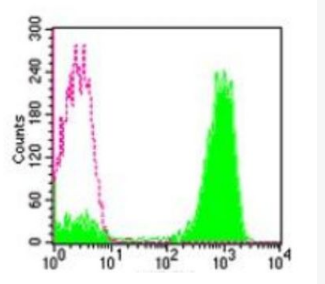
| 产品图片 |  Flow cytometry staining of normal human peripheral blood cells with CDHLA-DR/FITC (bsm-30090M-FITC)(Red histogram) or Mouse IgG2a Isotype Control (FITC Conjugate)(C03-12001)(Blue histogram) . Total cells were used for analysis. |
风险提示:丁香通仅作为第三方平台,为商家信息发布提供平台空间。用户咨询产品时请注意保护个人信息及财产安全,合理判断,谨慎选购商品,商家和用户对交易行为负责。对于医疗器械类产品,请先查证核实企业经营资质和医疗器械产品注册证情况。
 文献和实验
文献和实验Fraction Monoclonal Mouse Anti-Digoxin 产品详情 FITC标记小鼠抗地高辛Digoxin单克隆抗体 FITC-conjugated IgG Fraction Monoclonal Mouse Anti-Digoxin
恶性肿瘤病人外周血免疫指标的流式细胞仪检测及免疫治疗前后免疫功能变化的研究
,其中年龄和性别构成比与病人组差异无显著性(P>0.05)。 1.2 材料与仪器 小鼠抗人单克隆抗体CD4/CD8/CD3、CD19、CD20、CD3/CD16+56、CD3/HLA-DR、CD3/CD25及同型对照、红细胞裂解液(Optilyse C)均为法国Immunotech公司出品。流式细胞仪(Epics XL·MCL)是美国BECKMAN COULTER公司生产。 1.3 研究方法 使用直接免疫荧光标记全血溶血法,流式细胞仪测定肿瘤病人外周血淋巴细胞表面抗原表达。
血单个核细胞(PBMC)。样本采集后24小时内检测。 试剂: 1. 检测DC细胞用的BDIS荧光标记的单克隆抗体。 四色分析: LIN1 FITC:货号340546,含有CD3、CD14、CD16、CD19、CD20、CD56 CD123 PE(Anti-IL-3Ra):货号340545 Anti-HLA-DR PerCP:货号347364 CD11c APC:货号340544 Mouse IgG1 PE:货号349043 Mouse IgG2a APC:货号340473
 技术资料
技术资料暂无技术资料 索取技术资料

