


- $247 - 475
- Alomone
- 以色列
- ACC-125
- 2025年07月14日
- IH, WB
- Rabbit
- 见官方网站

企业认证
相关产品推荐更多 >

万千商家帮你免费找货
0 人在求购买到急需产品
- 详细信息
- 文献和实验
- 技术资料
- 免疫原:
见官方网站
- 亚型:
见官方网站
- 形态:
液体或冻干粉
- 保存条件:
-20°C
- 克隆性:
多克隆
- 标记物:
见官方网站
- 适应物种:
见官方网站
- 保质期:
6个月
- 抗原来源:
Rabbit
- 目录编号:
ACC-125
- 级别:
高
- 库存:
大量
- 供应商:
上海信裕生物科技有限公司
- 宿主:
Rabbit
- 应用范围:
IH, WB
- 浓度:
见官方网站
- 靶点:
见官方网站
- 抗体英文名:
Anti-CaVγ8
- 抗体名:
Anti-CaVγ8
- 规格:
25 µl, 50 µl, 0.2 ml
Anti-CaVγ8
TARP gamma-8, Voltage-dependent calcium channel gamma-8 subunit, Cacng8Cat #: ACC-125
Sizes: 25 µl, 50 µl, 0.2 ml
Source: Rabbit
Type: Polyclonal
Applications: IH, WB
May also work in: IC, IFC, IP
Reactivity: M, R
May also work in: H
Application key:
CBE- Cell-based ELISA, FC- Flow cytometry, IC- Immunocytochemistry, IE- Indirect ELISA, IFC- Indirect flow cytometry, IH- Immunohistochemistry, IP- Immunoprecipitation, LCI- Live cell imaging, N- Neutralization, WB- Western blotSpecies reactivity key:
H- Human, M- Mouse, R- RatCLICK HERE TO RECEIVE A 25 µl FREE TRIAL SAMPLE!
Alomone Labs is pleased to offer a highly specific antibody directed against an epitope of rat CaVγ8. Anti-CaVγ8 antibody (#ACC-125) can be used in western blot and immunohistochemistry applications. It has been designed to recognize CaVγ8 from rat, mouse and human samples.
- Applications
- Specifications
- Scientific Background
- Related Products

Western blot analysis of rat testis (lanes 1 and 4), rat brain (lanes 2 and 5) and mouse brain (lanes 3 and 6) lysates:
1-3. Anti-CaVγ8 antibody (#ACC-125), (1:400).
4-6. Anti-CaVγ8 antibody, preincubated with the control peptide antigen.
Immunohistochemistry
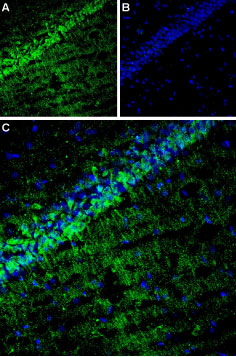
Expression of CaVγ8 in rat hippocampus
Immunohistochemical staining of rat hippocampus using Anti-CaVγ8 antibody (#ACC-125). A. CaVγ8 staining (green) appears in neuronal soma (horizontal arrows) and in the neuronal processes (diagonal arrows). B. Nuclear staining using DAPI as the counterstain (blue). C. Merged image of A and B.
Immunogen
Peptide (C)ESLKRWNEERGLW(S)EK, corresponding to amino acid residues 2-17 of rat CaVγ8 (Accession Q8VHW5). Intracellular, N-terminus.

HomologyRat, mouse, human - 15/16 amino acid residues identical.
PurityAffinity purified on immobilized antigen.
FormulationLyophilized powder. Reconstituted antibody contains phosphate buffered saline (PBS), pH 7.4, 1% BSA, 0.05% NaN3.
Standard quality control of each lotWestern blot analysis.
Peptide confirmationConfirmed by amino acid analysis and mass spectrometry.
Storage before reconstitutionThe antibody ships as a lyophilized powder at room temperature. Upon arrival, it should be stored at -20°C.
Reconstitution25 µl, 50 µl or 0.2 ml double distilled water (DDW), depending on the sample size.
Antibody concentration after reconstitution0.85 mg/ml.
Storage after reconstitutionThe reconstituted solution can be stored at 4°C for up to 1 week. For longer periods, small aliquots should be stored at -20°C. Avoid multiple freezing and thawing. Centrifuge all antibody preparations before use (10000 x g 5 min).
Control antigen storage before reconstitutionLyophilized powder can be stored intact at room temperature for 2 weeks. For longer periods, it should be stored at -20°C.
Control antigen reconstitution100 µl double distilled water (DDW).
Control antigen storage after reconstitution-20ºC.
Preadsorption Control1 µg peptide per 1 µg antibody.
Scientific background
Transmembrane AMPA receptor regulatory proteins (TARPs) serve as auxiliary subunits of AMPA receptors that regulate functional aspects of these receptors such as: fast excitatory synaptic transmission, surface trafficking, enhancing synaptic clustering and increasing glutamate affinity. Generally, TARPs are responsible for regulating expression, channel properties and localization of AMPA receptors in the brain1.
TARPs are non-pore-forming integral membrane proteins with four transmembrane domains that are widely expressed in the CNS.
The TARP family is divided in Type I and type II subfamily. Type I TARPs comprise four calcium channel γ subunits: γ2, γ3, γ4, and γ-8, also known as Cacng2, 3, 4 and 8, respectively2,3.
γ-8 TARP predominantly expressed in the telencephalon with abundant distribution on hippocampal excitatory synapses and extrasynaptic membranes. It is expressed in low levels in newborn and neonatal brain and can be found in higher levels in adult brain4. γ-8 plays an important role in increasing the number of synaptic and extrasynaptic AMPA receptors on dendrites and spines5.
The C terminus of γ-8 contains 3 unique stretches of amino acids that are not found in any of the other TARPs. In addition, it contains PDZ-binding motifs2. In heterologous cells, γ-8 prolong the current rise time in response to small amounts of glutamate and slow GluA1 receptor desensitization and deactivation3.
Several studies have shown that overexpression of TARP γ-8 increases the number of AMPARs in the plasma membrane. In γ-8 knockout mice, AMPA receptor expression is severely reduced from the synaptic and extrasynaptic membranes of dendrites and does not progress through the secretory pathway5,6.
References
- Cho, C.H. et al. (2007) Neuron 55, 890.
- Milstein, A.D. et al. (2009) Proc. Natl. Acad. Sci. U.S.A. 106, 11348.
- Hamad, M.I. et al. (2014) Development 141, 1737.
- Tomita, S. et al. (2003) J. Cell Biol. 161, 805.
- Fukaya, M. et al. (2006) Eur. J. Neurosci. 24, 2177.
- Kato, A.S. et al. (2010) Neuron 68,1082.
风险提示:丁香通仅作为第三方平台,为商家信息发布提供平台空间。用户咨询产品时请注意保护个人信息及财产安全,合理判断,谨慎选购商品,商家和用户对交易行为负责。对于医疗器械类产品,请先查证核实企业经营资质和医疗器械产品注册证情况。
 文献和实验
文献和实验Cell:颜宁团队最新研究!首次破解这两种药物联合使用引起致命副作用的结构基础
构成,包括核心 α1 亚基、胞外 α2δ 亚基、胞内 β 亚基,某些成员还带有跨膜的 γ 亚基。从兔子骨骼肌中分离出的多亚基 Cav1.1 复合物,被命名为 rCav1.1,一直是各种抗高血压药物(如 DHP 药物和孔阻滞剂)对 LTCC 调节进行结构分析的代表。 由于 LTCC 成员之间的序列保守性,研究者克服大量的技术障碍,首先收集了用 AMIO 或 AMIO 结合 MNI-1(简称 AM)处理的 rCav1.1 的冷冻电镜数据。 为了研究生理上更相关的人类 LTCC 上的药物相互作用,研究
颜宁团队 2021 首秀+ 2020 年度文章赏析,看大牛如何玩转结构生物学!
吡啶化合物调控电压门控钙离子通道 Cav1.1 的机制2020 年 10 月 30 日,颜宁团队在 Angewandte Chemie 上在线发表了 Structural Basis of the Modulation of the Voltage-Gated Calcium Ion Channel Cav1.1 by Dihydropyridine Compounds*。1,4 - 二氢吡啶 (DHP) 是最常用的抗高血压药,通过抑制 L 型电压门控 Ca2+(Cav) 通道发挥作用。DHP 化合
癌 (NCT00562666)、肾癌[19,20]、乳腺癌[21]、前列腺癌[10]、神经母细胞瘤[21]和肺癌[23,24]等。这些临床研究证实了γδ T细胞的过继性转移是安全可行的[25]。 而本文开头提到的Adicet Bio公司正在开发的产品通过anti-CD20 CAR和γδ T细胞内源性细胞毒性受体靶向恶性B细胞,在临床前模型中表现出高效的抗肿瘤活性,有效地控制了肿瘤的生长。 图3. Adicet基于γδ T细胞的细胞疗法流程(图片来源于Adicet官网) 目前γδ T细胞疗法面临的最大阻碍包括
 技术资料
技术资料暂无技术资料 索取技术资料

