


- $527
- Alomone
- 以色列
- ACC-1062-AG
- 2025年07月10日
- IC, LCI
- Rabbit
- 见官方网站

企业认证
相关产品推荐更多 >

万千商家帮你免费找货
0 人在求购买到急需产品
- 详细信息
- 文献和实验
- 技术资料
- 免疫原:
见官方网站
- 亚型:
见官方网站
- 形态:
液体或冻干粉
- 保存条件:
-20°C
- 克隆性:
多克隆
- 标记物:
见官方网站
- 适应物种:
见官方网站
- 保质期:
6个月
- 抗原来源:
Rabbit
- 目录编号:
ACC-1062-AG
- 级别:
高
- 库存:
大量
- 供应商:
上海信裕生物科技有限公司
- 宿主:
Rabbit
- 应用范围:
IC, LCI
- 浓度:
见官方网站
- 靶点:
见官方网站
- 抗体英文名:
Anti-Orai1 (extracellular)-ATTO-488
- 抗体名:
Anti-Orai1 (extracellular)-ATTO-488
- 规格:
50 µl
Anti-Orai1 (extracellular)-ATTO-488
CRACM1, TMEM142ACat #: ACC-1062-AG
Sizes: 50 µl
Source: Rabbit
Type: Polyclonal
Applications: IC, LCI
May also work in: IH
Reactivity: M, R
Application key:
CBE- Cell-based ELISA, FC- Flow cytometry, IC- Immunocytochemistry, IE- Indirect ELISA, IFC- Indirect flow cytometry, IH- Immunohistochemistry, IP- Immunoprecipitation, LCI- Live cell imaging, N- Neutralization, WB- Western blotSpecies reactivity key:
H- Human, M- Mouse, R- RatAlomone Labs is pleased to offer a highly specific antibody directed against an extracellular epitope of mouse Orai1. Anti-Orai1 (extracellular) antibody (#ACC-062) can be used in western blot, live cell imaging and indirect flow cytometry applications, and has been designed to recognize Orai1 channel from mouse and rat samples.
Alomone Labs is pleased to offer a new version of antibody that is directly labeled with an ATTO-488 fluorescent dye. ATTO dyes are characterized by strong absorption (high extinction coefficient), high fluorescence quantum yield, and high photo-stability. The ATTO-488 label is analogous to the well known dye fluorescein isothiocyanate (FITC) and can be used with filters typically used to detect FITC. The Anti-Orai1 (extracellular)-ATTO-488 antibody (#ACC-062-AG) has been tested in live cell imaging applications and is specially suited for experiments requiring simultaneous labeling of different markers.
- Applications
- Specifications
- Scientific Background
- Related Products
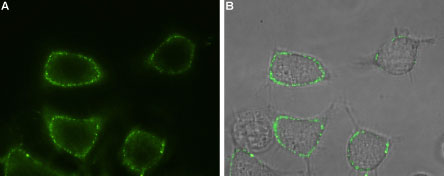
Expression of Orai1 in rat RBL cells
Immunocytochemical staining of intact living rat basophilic leukemia (RBL) cells using Anti-Orai1 (extracellular)-ATTO-488 antibody (#ACC-062-AG), (1:100). A. Extracellular staining of RBL cells (green). B. Merge of A and live view of the cells.
Immunogen
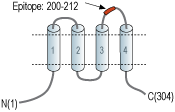
Peptide (C)KFLPLKRQAGQPS, corresponding to amino acid residues 200-212 of mouse Orai1 (Accession Q8BWG9). 2nd extracellular loop.
HomologyRat - identical.
PurityAffinity purified on immobilized antigen.
FormulationLyophilized powder. Reconstituted antibody contains phosphate buffered saline (PBS), pH 7.4, 1% BSA, 0.05% NaN3.
SpecificityWill not recognize human Orai1.
LabelATTO-488. Maximum absorption 501 nm; maximum fluorescence 523 nm. The fluorescence is excited most efficiently in the 480 - 515 nm range. This label is analogous to the well known dye fluorescein isothiocyanate (FITC) and can be used with filters typically used to detect FITC.
Standard quality control of each lotWestern blot analysis (unlabeled antibody, #ACC-062), and direct flow cytometry (labeled antibody).
Peptide confirmationConfirmed by amino acid analysis and mass spectrometry.
Storage before reconstitutionThe antibody ships as a lyophilized powder at room temperature. Upon arrival, it should be stored at -20°C.
Reconstitution50 µl double distilled water (DDW).
Antibody concentration after reconstitution1 mg/ml.
Storage after reconstitutionThe reconstituted solution can be stored at 4°C, protected from the light, for up to 1 week. For longer periods, small aliquots should be stored at -20°C. Avoid multiple freezing and thawing. Centrifuge all antibody preparations before use (10000 × g 5 min).
Control antigen storage before reconstitutionLyophilized powder can be stored intact at room temperature for 2 weeks. For longer periods, it should be stored at -20°C.
Control antigen reconstitution100 µl double distilled water (DDW).
Control antigen storage after reconstitution-20ºC.
Preadsorption Control1 µg peptide per 1 µg antibody.
Scientific background
Cytosolic calcium (Ca2+) has long been known to act as a key second messenger in many intracellular pathways including synaptic transmission, muscle contraction, hormonal secretion, cell growth and proliferation1,2. Intracellular Ca2+ levels are controlled by either the influx of Ca2+ through the calcium-release-activated Ca2+ channels (CRAC), or from intracellular stores which gained much attention.
Recently, several key players of the store operated complex have been identified3. Orai1 (also known as CRACM1) acts as the store operated Ca2+channel (SOC) and STIM1, which acts as the endoplasmic reticulum Ca2+sensor3,4. The formation of functional channels requires the presence of both Orai1 and STIM1 proteins working as a complex and involves the co-clustering of Orai1 on the plasma membrane with STIM1 on the endoplasmic reticulum4-6. TRPC1, a member of the transient receptor potential family was also suggested to act as a player in the SOC complex7. In T-cells, Ca2+ entry following activation by antigen-receptor engagement occurs solely through CRAC channels where Orai1 constitutes the pore forming subunit3,8.
Orai1 is a plasma membrane protein with four potential transmembrane domains and intracellular N- and C-terminus. In addition, two mammalian homologs to Orai1 have been identified; Orai2 and Orai33,9. All three, Orai1 Orai2 and Orai3, are capable of forming store operated channels with different magnitudes9.
References
- Eisner, D.A. et al. (2005) Exp. Physiol. 90, 3.
- Chakrabarti, R. And Chakrabarti, R. (2006) J.Cell. Biochem. 99, 1503.
- Feske, S. et al. (2006) Nature 441, 179.
- Pickett, J. (2006) Nature Reviews Mol. Cell Biol. 7, 794.
- Luik, R.M. et al. (2006) J. Cell. Biol. 174, 815.
- Wu, M.M. et al. (2006) J. Cell. Biol. 174, 803.
- Ong, H.L. et al. (2007) J. Biol. Chem. 282, 9105.
- Luik, R.M and Lewis, R.S. (2007) Trends Mol.Med. 13, 103.
- DeHaven, W.I. et al. (2007) J. Biol. Chem. 282, 17548.
风险提示:丁香通仅作为第三方平台,为商家信息发布提供平台空间。用户咨询产品时请注意保护个人信息及财产安全,合理判断,谨慎选购商品,商家和用户对交易行为负责。对于医疗器械类产品,请先查证核实企业经营资质和医疗器械产品注册证情况。
 文献和实验
文献和实验Anti-factor Xa (Anti-Xa) Assay
The anti-factor Xa (anti-Xa) assay is a functional assay that facilitates the measurement of antithrombin (AT)-catalyzed inhibition of factor Xa by unfractionated heparin (UFH) and direct inhibition of factor Xa by low-molecular-weight
Assessment of Extracellular ATP Concentrations
Most cells release ATP to the extracellular milieu. Extracellular ATP plays important signaling roles by activating a score of broadly distributed cell surface purinergic receptors (purinoceptors). Biological responses regulated by purinergic
Special Stains for Extracellular Matrix
Extracellular matrix and cells are the components of connective tissue. Extracellular matrix provides tissue with tensile strength, elasticity, and resistance to compressive forces. Although immunohistochemistry is often used to study matrix
 技术资料
技术资料暂无技术资料 索取技术资料

