- ¥5000
- AATBIO
- 美国
- 13835
- 2025年12月16日

企业认证
相关产品推荐更多 >


万千商家帮你免费找货
0 人在求购买到急需产品
- 详细信息
- 文献和实验
- 技术资料
- 英文名:
Amplite™ Fluorimetric Ascorbic Acid Assay Kit
- 库存:
4W
- 供应商:
研卉生物
- 规格:
200T
Amplite™ 荧光法抗坏血酸检测试剂盒
Platform
| Fluorescence microplate reader | |
| Excitation | 340 nm |
| Emission | 430 nm |
| Cutoff | 420 nm |
| Recommended plate | Solid black |
Components
| Component A: Ascorbrite™ Blue | 1 vial |
| Component B: Enzyme Mix | 2 bottles (lyophilized powder) |
| Component C: Assay Buffer | 1 bottle (20 mL) |
| Component D: Ascorbic Acid Standard (MW=176.1) | 1 vial (3.52 mg) |
| Component E: DMSO | 1 vial (100 µL) |
Example protocol
At a glance
Protocol summary
- Prepare test samples with diluted ascorbic acid standards (50 µL)
- Add equal volume of working solution (50 µL)
- Incubate at room temperature for 30 minutes to 1 hour
- Monitor fluorescence intensity at Ex/Em = 340/430 nm
Important notes
To achieve the best results, it’s strongly recommended to use the black plates. Thaw kit components at room temperature before use.
Preparation of stock solution
1. Ascorbrite™ Blue stock solution (200X):
Add 50 µL of DMSO (Component E) into Ascorbrite™ Blue (Component A) to make 200X Ascorbrite™ Blue stock solution.
2. Ascorbic Acid standard solution (100 mM):
Add 200 µL of ddH2O into ascorbic acid standard vial (Component D) to make 100 mM ascorbic acid standard solution.
Preparation of standard solution
Add 10 µL of 100 mM ascorbic acid into 990 µL of assay buffer to get 1000 µM ascorbic acid solution (AA7). Then take the 1000 µM ascorbic acid standard solution and perform 1:3 serial dilutions to get serially diluted ascorbic acid standards (AA1 - AA6). Note: Ascorbic acid aqueous solution is not stable and will oxidize into DHA.
Preparation of working solution
Total AA Assay
Add 5 mL of Assay Buffer (Component C) into one bottle of Enzyme Mix (Component B). Then add 25 µL of AscorbriteTM Blue stock Solution (200X) into the same bottle. Mix well.
DHA Assay
In an appropriate container, add 5 mL of Assay Buffer (Component C) with 25 µL of AscorbriteTM Blue stock Solution (200X). Mix well. Note: Alternatively, one can make enzyme stock solution by adding 100 μL ddH2O into one Enzyme Mix bottle (Component B) to make 50X enzyme stock solution, and use it proportionally for total AA assay (for example, for 1mL total AA assay working solution, add 20 μL 50X enzyme stock solution and 5 μL 200X Ascorbrite™ Blue stock Solution into 1 mL Assay Buffer). Note: The working solution is not stable. Use promptly and avoid direct exposure to light.
Procedure
Table 1. Layout of ascorbic acid standards and test samples in a solid black 96-well microplate. AA = Ascorbic Acid Standard (AA1-AA7, 1 to 1000 µM); BL = blank control; TS = test sample.
| BL | BL | TS | TS |
| AA1 | AA1 | ... | ... |
| AA2 | AA2 | ... | ... |
| AA3 | AA3 | ||
| AA4 | AA4 | ||
| AA5 | AA5 | ||
| AA6 | AA6 | ||
| AA7 | AA7 |
Table 2. Reagent composition for each well.
| Well | Volume | Reagent |
| AA1-AA7 | 50 µL | Serial Dilution (1 to 1000 µM) |
| BL | 50 µL | Assay Buffer (Component C) |
| TS | 50 µL | Test Sample |
- Prepare ascorbic acid standards (AA), blank control (BL), and test samples (TS) according to the layout of Tables 1 and 2. For a 384-well plate, use 25 µL of reagent per well instead of 50 µL.
- Add 50 µL of working solution into each well of ascorbic acid standard, blank control, and test samples to make the total ascorbic acid assay volume of 100 µL/well. For a 384-well plate, add 25 µL of working solution into each well instead, for a total volume of 50 µL/well.
- Incubate the reaction at room temperature for 30 minutes to 1 hour.
- Monitor the fluorescence increase with a fluorescence plate reader at Ex/Em = 340/430 nm (cut off: 420 nm).
Data Analysis
The reading (RFU) obtained from the blank standard well is used as a negative control. Subtract this value from the other standards' readings to obtain the base-line corrected values. Then, plot the standards' readings to obtain a standard curve and equation. This equation can be used to calculate Ascorbic Acid samples. We recommend using the Online Linear Regression Calculator which can be found at: https://www.aatbio.com/tools/linear-logarithmic-semi-log-regression-online-calculator
Images
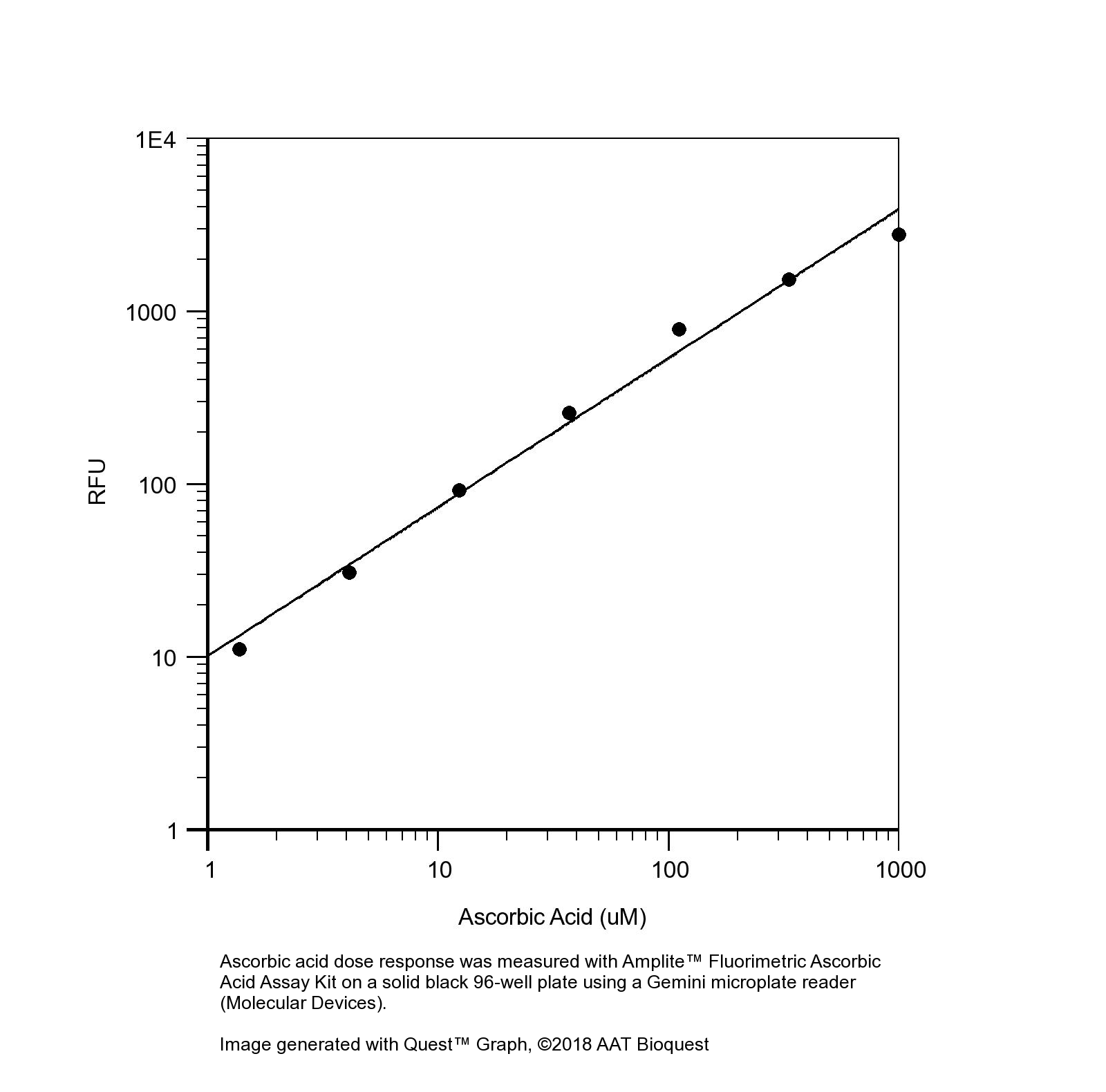 Figure 1. Ascorbic acid dose response was measured with Amplite™ Fluorimetric Ascorbic Acid Assay Kit on a solid black 96-well plate using a Gemini microplate reader (Molecular Devices). Figure 1. Ascorbic acid dose response was measured with Amplite™ Fluorimetric Ascorbic Acid Assay Kit on a solid black 96-well plate using a Gemini microplate reader (Molecular Devices). |
References
An alcohol oxidase of Phanerochaete chrysosporium with a distinct glycerol oxidase activity
Authors: Linke D, Lehnert N, Nimtz M, Berger RG.
Journal: Enzyme Microb Technol (2014): 7
Bioelectrocatalytic sensor for triglycerides in human skin sebum based on enzymatic cascade reaction of lipase, glycerol kinase and glycerophosphate oxidase
Authors: Jeong CY, Han YD, Yoon JH, Yoon HC.
Journal: J Biotechnol (2014): 7
Epigallocatechin-3-gallate (EGCG) inhibits 3-hydroxy-3-methylglutaryl-CoA reductase in the presence of glycerol
Authors: Wu Q, Li JZ, Zhao TY, Li TB, Wang JX, Sui Y.
Journal: Pak J Pharm Sci (2014): 1905
Functional characterization of Yersinia pestis aerobic glycerol metabolism
Authors: Willias SP, Chauhan S, Motin VL.
Journal: Microb Pathog (2014): 33
Identification and glycerol-induced correction of misfolding mutations in the X-linked mental retardation gene CASK
Authors: LaConte LE, Chavan V, Mukherjee K.
Journal: PLoS One (2014): e88276
Isolation of peripheral blood mononuclear cells using glycerol density gradient
Authors: Aimola IA, Inuwa HM, Nok AJ, Mamman AI, Habila N, Muhammad A, Ndidi US, Ignatius B, Jande PL, Oghor R, Isaac LC, Afolabi-Balogun NB.
Journal: Cell Biochem Biophys (2014): 583
Quantitative analysis of glycerol levels in human urine by liquid chromatography-tandem mass spectrometry
Authors: Dong Y, Ma Y, Yan K, Shen L, Wang X, Xu Y, He G, Wu Y, Lu J, Yang Z, Feng F.
Journal: J Chromatogr B Analyt Technol Biomed Life Sci (2014): 30
Rapid monitoring of glycerol in fermentation growth media: Facilitating crude glycerol bioprocess development
Authors: Abad S, Perez X, Planas A, Turon X.
Journal: Talanta (2014): 210
Synthesis of substituted 1,3-diesters of glycerol using wittig chemistry
Authors: Lowe HI, Toyang NJ, Watson CT, Bryant J.
Journal: Nat Prod Commun (2014): 687
The glycoglycerolipid 1,2-dipalmitoyl-3-(N-palmitoyl-6'-amino-6'-deoxy-alpha-d-glucosyl)-sn-glycerol is no inhibitor of the human Myt1 kinase
Authors: Rohe A, Gollner C, Erdmann F, Sippl W, Schmidt M.
Journal: J Enzyme Inhib Med Chem (2014): 514
风险提示:丁香通仅作为第三方平台,为商家信息发布提供平台空间。用户咨询产品时请注意保护个人信息及财产安全,合理判断,谨慎选购商品,商家和用户对交易行为负责。对于医疗器械类产品,请先查证核实企业经营资质和医疗器械产品注册证情况。
 文献和实验
文献和实验一、反应曲线 首先,我们了解一下化学反应的时间与吸光度一个曲线图,可以划分为四个区:延迟区、等速区、过渡区和平衡区,如下图所示: 二、反应原理 对于延迟区来讲,无规律可寻,对于指标检测没有意义。 等速区对应的指标检测方法是速率法。速率法又称连续监测法,是在测定酶活性或用酶法测定代谢产物时,连续选取时间-吸光度曲线中线性期内4个以上测光点作为读数点,并以单位时间吸光度变化值计算结果。线性期就是此期间内各测光点之间的吸光度差值相等,此线性期对酶促反应的底物来说属于零级反应。其测光点一般设置在加入
Annexin V是一种钙离子依赖性磷脂结合蛋白,与磷脂酰丝氨酸PS有高度亲和力,可通过细胞外侧暴露的PS与凋亡早期细胞胞膜结合,将Annexin V标记上荧光染料利用流式细胞仪或荧光显微镜可检测细胞凋亡。 由于凋亡晚期或坏死细胞膜完整性丧失,细胞核染色液可进入细胞内染色细胞核,搭配Annexin V使用可将处于不同凋亡时期的细胞区分开。 A.悬浮细胞: 按照实验方案进行凋亡诱导,300 g离心5 min,弃上清,收集细胞,用PBS洗涤细胞一次,轻轻重悬浮细胞并计数。 取1~5 ×
相关专题 维生素C(vitaminC)又称为抗坏血酸,一般水果、蔬菜中维生素C的含量均较高,不同的水果、蔬菜品种,以及同一品种在不同栽培条件、不同成熟度等情况下,其维生素C的含量都有所不同。测定维生素C含量,可以作为果蔬品质指标之一。 Ⅰ.滴定法 原理 维生素C具有很强的还原性,染料2,6-二氯酚靛酚(2,6-dichlorophenolindophenol)具有较强的氧化性,且在酸性溶液中呈红色
 技术资料
技术资料暂无技术资料 索取技术资料