

- ¥385 - 379985
- 翌圣生物
- 92619ES
- 中国
- 2026年11月09日

企业认证
相关产品推荐更多 >
万千商家帮你免费找货
0 人在求购买到急需产品
相关阅读
Dove 医学期刊 APC 折后约 1.95w,中国大陆作者专享AJE 润色 84 折,送京东卡等福利,优惠码 DXYAJE五大应用案例:Mustang Q 膜层析应用全解析1 个小工具,一次性搞定流程图、质粒图谱和信号通路图- 详细信息
- 文献和实验
- 技术资料
- 英文名:
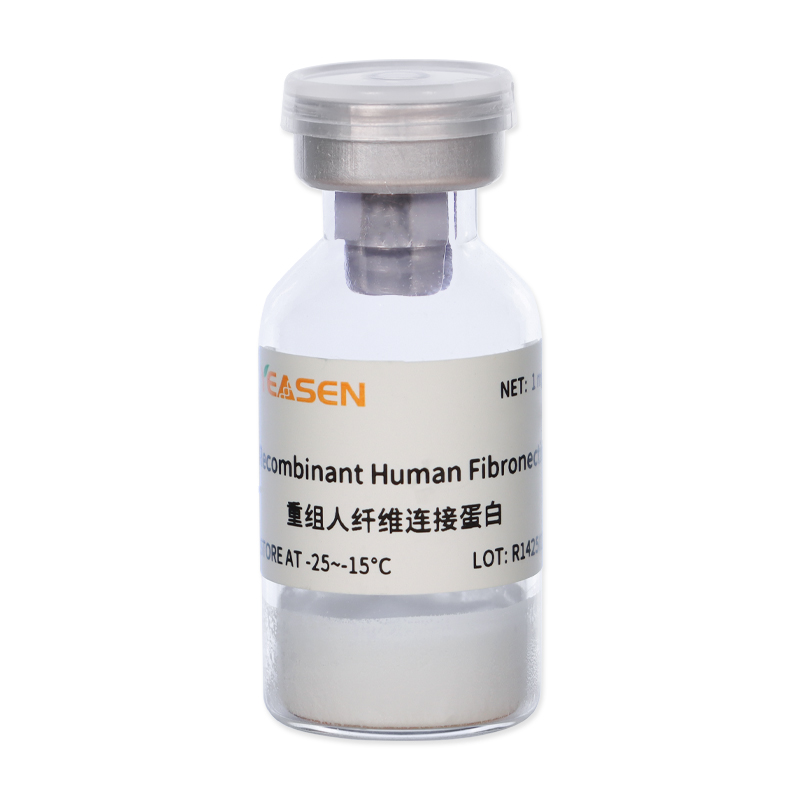
HiActi® Recombinant Human Fibronectin Protein(CHO)YSNectin重组人纤维连接蛋白
- 供应商:
翌圣生物
- 保存条件:
-25 ~ -15℃保存,收到货之后有效期1年。复溶后,无菌条件下,-85 ~ -65℃保存,3个月有效期。
- 规格:
1 mg(92619ES03)/5 mg(92619ES08)/10 mg(92619ES10)/100 mg(92619ES60)/1 g(92619ES80)/100 μg(92619ES01)
| 规格: | 1 mg(92619ES03) | 产品价格: | ¥968 |
|---|---|---|---|
| 规格: | 5 mg(92619ES08) | 产品价格: | ¥3738 |
| 规格: | 10 mg(92619ES10) | 产品价格: | ¥4118 |
| 规格: | 100 mg(92619ES60) | 产品价格: | ¥39985 |
| 规格: | 1 g(92619ES80) | 产品价格: | ¥379985 |
| 规格: | 100 μg(92619ES01) | 产品价格: | ¥385 |
产品描述:
人纤连蛋白是一种糖蛋白,在人体细胞粘附、生长、迁移和伤口愈合过程中起着至关重要的作用。它存在于细胞外基质中,并参与各种细胞功能,如细胞分化和胚胎发生。纤连蛋白在介导细胞与其周围环境之间的相互作用中也很重要。
重组人纤连蛋白可作为一种细胞培养基质,替换Matrigel、鼠尾胶原、血源纤连蛋白等,提高细胞贴壁率,增强细胞代谢水平,缩短细胞生长周期。也可直接添加到培养基中,替换或降低血清使用量,促进细胞贴壁、迁移、移动生长、维持细胞状态。
本产品来源于CHO细胞,以冻干粉形式供货,为细胞培养级别,具有批次间差异小、无潜在病毒感染风险等特点。
翌圣生物提供两种重组人纤连蛋白(FN),92619ES和40113ES,使用效果一致,具体产品区别如下:
| 产品编号 | 92619ES | 40113ES |
| 产品名称 | Recombinant Human Fibronectin(CHO,His Tag) 重组人纤维连接蛋白 | Recombinant Human Fibronectin 重组人纤维连接蛋白 |
| 表达系统 | CHO Cells | 水稻种子 |
| 内毒素 | <0.5 EU/μg | <0.5 EU/μg |
| 标签 | His | 无 |
产品属性:
| 产品别称 | Fibronectin, FN1, CIG, ED-B, FINC, FN, FNZ, GFND, GFND2, LETS, MSF |
| 种属 | Human |
| Accession | P02751 |
| 标签 | N-His |
| 表达系统 | CHO |
| 分子量 | The protein has a predicted MW of 97 kDa. And it migrates as 100-130 kDa under reducing (R) condition (SDS-PAGE) due to glycosylation. |
| 纯度 | > 90% as determined by SDS-PAGE. |
| 内毒素 | < 0.5 EU per μg by the LAL method. |
| 制剂 | Lyophilized from a 0.2 μm filtered concentrated solution in PBS. |
| 外观 | Lyophilized Powder |
| 生物活性 | The ED50as determined by a celI adhesion assay using B16-F1 mouse melanoma cells is less than 1.1 μg/mL,corresponding to a specific activity of > 1.17 X 10^7 IU/mg.Fully biologically active when compared to standard. |
| 复溶方法 | 开盖之前,先离心,以将内容物带到底部。PBS复溶,复溶后建议分装为一次实验用量,-20℃冻存,避免反复冻融。 |
产品特色:
高纯度、高活性、低内毒素、高批间一致性
应用案例:
SDS-PAGE
Figure 1. Human Fibronectin on SDS-PAGE under reduced condition. The purity is greater than 90%.
Bioactivity-Cell based assay
Figure 2. The ED50 as determined by a celI proliferation assay using B16-F1 mouse melanoma cells is less than 1.1 μg/mL, corresponding to a specific activity of > 1.17 X 10⁷ IU/mg. Fully biologically active when compared to standard.
应用案例
培养人原代T细胞,YEASEN 的Recombinant Human Fibronectin培养效果优于竞品公司。
使用方法(以6孔板为例,其他培养板加样体积请参考表1)
1.包被/铺板实验
1)取出适量的重组人纤维连接蛋白(rFN),用无菌1×PBS,pH 7.2~7.4稀释至工作液浓度,终浓度参考范围50~100 μg/mL。混匀后,加入到6孔板中,800 μL/孔,保证工作液完全覆盖6孔板底部。
2)将加有rFN工作液的6孔板,放置在4℃过夜或者37 ℃包被1 h。
3)收集6孔板中的工作液,放置4 ℃保存,一周内可用于其他培养瓶/板包被。
4)取出rFN包被后的6孔板,加入正常的细胞培养基后,可直接接种细胞,rFN促进细胞贴壁、生长等。
5)若包被后的6孔板暂不使用,放置在4 ℃密封保存,建议一周内使用完。
【注】: 包被/铺板实验中,重组人纤维连接蛋白(rFN)工作液的加入量,应根据培养皿/瓶的大小进行调整,请参见下表1。
表1不同培养瓶/板包被时推荐 rFN加入量
| 培养皿 | 底面积 (cm2) | 推荐rFN工作液加入量 |
| 96孔板 | 0.32 | 50 μL |
| 24孔板 | 2 | 200 μL |
| 12孔板 | 4.5 | 400 μL |
| 6孔板 | 9.6 | 800 μL |
| 35 mm培养皿 | 8 | 600 μL |
| 60 mm培养皿 | 21 | 1.6 mL |
| 25 cm2培养瓶 | 25~28 | 2.0 mL |
2.细胞实验
细胞培养过程中,将rFN直接加入细胞培养基中,可促进细胞贴壁、迁移、维持细胞状态等。终浓度参考范围5~50 μg/mL。
储存条件:
-25 ~ -15℃保存,收到货之后有效期1年。
复溶后,无菌条件下,-85 ~ -65℃保存,3个月有效期。
风险提示:丁香通仅作为第三方平台,为商家信息发布提供平台空间。用户咨询产品时请注意保护个人信息及财产安全,合理判断,谨慎选购商品,商家和用户对交易行为负责。对于医疗器械类产品,请先查证核实企业经营资质和医疗器械产品注册证情况。
 文献和实验
Sertoli cells, but not testicular endothelial cells, contribute to optimized culture of spermatogonia in pigs
Purification of Fibronectin from Human Plasma
, wound healing, hemostasis, and thrombosis (1 ). Fibronectin is secreted as a dimer, with a monomer molecular weight of approx 220–250 kDa; the monomers are joined by two disulfide bonds near the carboxyl terminus of the protein (2 ). Like many proteins
Preparation of recombinant fibronectin fragments for functional and structural studies
integrin receptors. The mosaic nature of fibronectin permits it to be analyzed by a “dissection” strategy, where protein fragments generated by recombinant expression in E. coli , P. pastoris , and human cell lines are employed in structural and functional
that their polypeptide components are frequently comprised of a series of sequence repeats or “modules” (1 ). This mosaic nature of ECM macromolecules permits their properties to be analyzed by a “dissection” strategy (2 ), where protein fragments generated
 技术资料
暂无技术资料 索取技术资料