

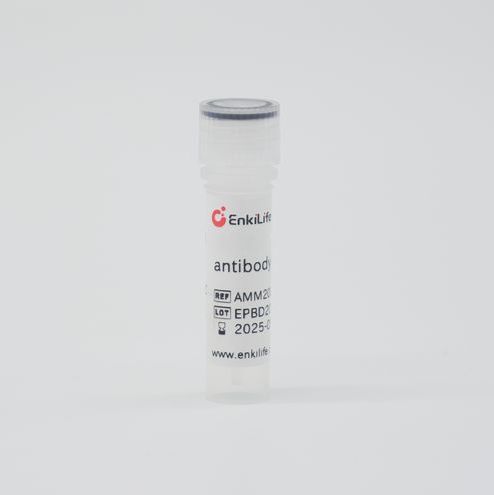
- ¥1200 - 2150
- EnkiLife
- APRab15660
- 2026年04月17日
- WB,IHC,ICC/IF,ELISA
- Rabbit
- Human,Mouse,Rat,Monkey

企业认证
相关产品推荐更多 >
万千商家帮你免费找货
0 人在求购买到急需产品
相关阅读
细胞污染识别与处理全攻略:5 种常见类型+关键误区Cytoscape 教程来了!快速实现顶刊同款通路网络图五大应用案例:Mustang Q 膜层析应用全解析1 个小工具,一次性搞定流程图、质粒图谱和信号通路图- 详细信息
- 文献和实验
- 技术资料
- 形态:
Liquid
- 保存条件:
Store at 4°C short term. Aliquot and store at -20°C long term. Avoid freeze/thaw cycles.
- 标记物:
Unconjugated
- 适应物种:
Human,Mouse,Rat,Monkey
- 供应商:
武汉恩玑生命科技有限公司
- 宿主:
Rabbit
- 应用范围:
WB,IHC,ICC/IF,ELISA
- 规格:
50uL/100uL
| 规格: | 50uL | 产品价格: | ¥1200.0 |
|---|---|---|---|
| 规格: | 100uL | 产品价格: | ¥2150.0 |
产品概述
产品性能
免疫原
产品应用
研究背景
tumor protein p63(TP63) Homo sapiens This gene encodes a member of the p53 family of transcription factors. The functional domains of p53 family proteins include an N-terminal transactivation domain, a central DNA-binding domain and an oligomerization domain. Alternative splicing of this gene and the use of alternative promoters results in multiple transcript variants encoding different isoforms that vary in their functional properties. These isoforms function during skin development and maintenance, adult stem/progenitor cell regulation, heart development and premature aging. Some isoforms have been found to protect the germline by eliminating oocytes or testicular germ cells that have suffered DNA damage. Mutations in this gene are associated with ectodermal dysplasia, and cleft lip/palate syndrome 3 (EEC3); split-hand/foot malformation 4 (SHFM4); ankyloblepharon-ectodermal defects-cleft lip/palate; ADULT syndrome (acro-dermato-ungual-lacrimcofactor:Binds 1 zinc ion per subunit.,disease:Defects in TP63 are a cause of cervical, colon, head and neck, lung and ovarian cancers.,disease:Defects in TP63 are a cause of ectodermal dysplasia Rapp-Hodgkin type (EDRH) [MIM:129400]; also called Rapp-Hodgkin syndrome or anhidrotic ectodermal dysplasia with cleft lip/palate. Ectodermal dysplasia defines a heterogeneous group of disorders due to abnormal development of two or more ectodermal structures. EDRH is characterized by the combination of anhidrotic ectodermal dysplasia, cleft lip, and cleft palate. The clinical syndrome is comprised of a characteristic facies (narrow nose and small mouth), wiry, slow-growing, and uncombable hair, sparse eyelashes and eyebrows, obstructed lacrimal puncta/epiphora, bilateral stenosis of external auditory canals, microsomia, hypodontia, cone-shaped incisors, enamel hypoplasia, dystrophic nails, and cleft lip/cleft palate.,disease:Defects in TP63 are the cause of acro-dermato-ungual-lacrimal-tooth syndrome (ADULT syndrome) [MIM:103285]; a form of ectodermal dysplasia. Ectodermal dysplasias (EDs) constitute a heterogeneous group of developmental disorders affecting tissues of ectodermal origin. EDs are characterized by abnormal development of two or more ectodermal structures such as hair, teeth, nails and sweat glands, with or without any additional clinical sign. Each combination of clinical features represents a different type of ectodermal dysplasia. ADULT syndrome involves ectrodactyly, syndactyly, finger- and toenail dysplasia, hypoplastic breasts and nipples, intensive freckling, lacrimal duct atresia, frontal alopecia, primary hypodontia, and loss of permanent teeth. ADULT differs significantly from EEC3 syndrome by the absence of facial clefting.,disease:Defects in TP63 are the cause of ankyloblepharon-ectodermal defects-cleft lip/palate (AEC) [MIM:106260]. AEC is an autosomal dominant condition characterized by congenital ectodermal dysplasia with coarse, wiry, sparse hair, dystrophic nails, slight hypohidrosis, scalp infections, ankyloblepharon filiforme adnatum, maxillary hypoplasia, hypodontia and cleft lip/palate.,disease:Defects in TP63 are the cause of ectrodactyly-ectodermal dysplasia-cleft lip/palate syndrome type 3 (EEC3) [MIM:604292]. EEC3 is an autosomal dominant syndrome characterized by ectrodactyly of hands and feet, ectodermal dysplasia and facial clefting.,disease:Defects in TP63 are the cause of limb-mammary syndrome (LMS) [MIM:603543]. LMS is characterized by ectrodactyly, cleft palate and mammary-gland abnormalities.,disease:Defects in TP63 are the cause of non-syndromic orofacial cleft type 8 (OFC8) [MIM:129400]. Non-syndromic orofacial cleft is a common birth defect consisting of cleft lips with or without cleft palate. Cleft lips are associated with cleft palate in two-third of cases. A cleft lip can occur on one or both sides and range in severity from a simple notch in the upper lip to a complete opening in the lip extending into the floor of the nostril and involving the upper gum.,disease:Defects in TP63 are the cause of split-hand/foot malformation 4 (SHFM4) [MIM:605289]. Split-hand/split-foot malformation is a limb malformation involving the central rays of the autopod and presenting with syndactyly, median clefts of the hands and feet, and aplasia and/or hypoplasia of the phalanges, metacarpals, and metatarsals. There is restricted overlap between the mutational spectra of EEC3 and SHFM4.,domain:The transactivation inhibitory domain (TID) can interact with, and inhibit the activity of the N-terminal transcriptional activation domain of TA*-type isoforms.,function:Acts as a sequence specific DNA binding transcriptional activator or repressor. The isoforms contain a varying set of transactivation and auto-regulating transactivation inhibiting domains thus showing an isoform specific activity. May be required in conjunction with TP73/p73 for initiation of TP53/p53 dependent apoptosis in response to genotoxic insults and the presence of activated oncogenes. Involved in Notch signaling by probably inducing JAG1 and JAG2. Plays a role in the regulation of epithelial morphogenesis. The ratio of DeltaN-type and TA*-type isoforms may govern the maintenance of epithelial stem cell compartments and regulate the initiation of epithelial stratification from the undifferentiated embryonal ectoderm. Required for limb formation from the apical ectodermal ridge.,PTM:May be sumoylated.,similarity:Belongs to the p53 family.,similarity:Contains 1 SAM (sterile alpha motif) domain.,subunit:Binds DNA as a homotetramer. Isoform composition of the tetramer may determine transactivation activity. Isoforms Alpha and Gamma interact with HIPK2. Interacts with SSRP1, leading to stimulate coactivator activity.,tissue specificity:Widely expressed, notably in heart, kidney, placenta, prostate, skeletal muscle, testis and thymus, although the precise isoform varies according to tissue type. Progenitor cell layers of skin, breast, eye and prostate express high levels of DeltaN-type isoforms. Isoform 10 is predominantly expressed in skin squamous cell carcinomas, but not in normal skin tissues.,
研究领域
Cell Cycle; Cell Cycle Inhibitors; p53; Cell Biology; Apoptosis; Intracellular; p53 Pathway; Epigenetics and Nuclear Signaling; DNA / RNA; DNA Damage & Repair; DNA Damage Response; Transcription; Cancer susceptibility; Tumor Suppressors; Cancer; Oncoproteins/suppressors; Tumor suppressors
风险提示:丁香通仅作为第三方平台,为商家信息发布提供平台空间。用户咨询产品时请注意保护个人信息及财产安全,合理判断,谨慎选购商品,商家和用户对交易行为负责。对于医疗器械类产品,请先查证核实企业经营资质和医疗器械产品注册证情况。
 文献和实验
文献和实验Polyclonal Antibody Production
Zealand White Rabbits and have them delivered to the ARC. Don’t put all your eggs in one basket only using one rabbit. Let them get accustomed to there home there for two weeks before the first pre-bleed. Pre-bleed
Polyclonal Antibody Production
Polyclonal Antibody Production Very useful for rapid and simple generation of antibodies for western blots, ELISA assays, and immunoprecipitation. Rabbit Immunization Initial Preparation Your antigen
Generation and Selection of Rabbit Antibody Libraries by Phage Display
The rabbit antibody repertoire is an exceptional source for both polyclonal antibodies (pAbs) and monoclonal antibodies (mAbs) that combine high specificity with high avidity and affinity, respectively. In contrast to rabbit pAbs
 技术资料
技术资料暂无技术资料 索取技术资料

