

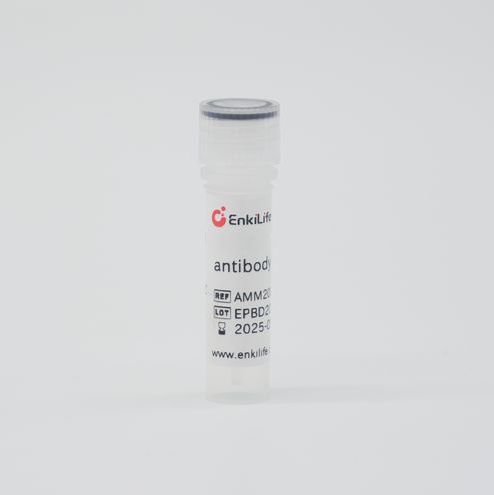
- ¥1350 - 2250
- EnkiLife
- APRab04388
- 2026年04月17日
- WB,IHC,ICC/IF,ELISA
- Rabbit
- Human,Mouse,Rat

企业认证
相关产品推荐更多 >
万千商家帮你免费找货
0 人在求购买到急需产品
相关阅读
香烟烟雾如何加速声带纤维化?CD44-透明质酸轴是关键通路Takara 秋促来袭,提取+反转录+定量套装仅 1200 元五大应用案例:Mustang Q 膜层析应用全解析1 个小工具,一次性搞定流程图、质粒图谱和信号通路图- 详细信息
- 文献和实验
- 技术资料
- 形态:
Liquid
- 保存条件:
Store at 4°C short term. Aliquot and store at -20°C long term. Avoid freeze/thaw cycles.
- 标记物:
Unconjugated
- 适应物种:
Human,Mouse,Rat
- 供应商:
武汉恩玑生命科技有限公司
- 宿主:
Rabbit
- 应用范围:
WB,IHC,ICC/IF,ELISA
- 规格:
50uL/100uL
| 规格: | 50uL | 产品价格: | ¥1350.0 |
|---|---|---|---|
| 规格: | 100uL | 产品价格: | ¥2250.0 |
产品概述
产品性能
免疫原
产品应用
研究背景
The protein encoded by this gene is part of a complex of proteins that constitute adherens junctions (AJs). AJs are necessary for the creation and maintenance of epithelial cell layers by regulating cell growth and adhesion between cells. The encoded protein also anchors the actin cytoskeleton and may be responsible for transmitting the contact inhibition signal that causes cells to stop dividing once the epithelial sheet is complete. Finally, this protein binds to the product of the APC gene, which is mutated in adenomatous polyposis of the colon. Mutations in this gene are a cause of colorectal cancer (CRC), pilomatrixoma (PTR), medulloblastoma (MDB), and ovarian cancer. Alternative splicing results in multiple transcript variants. [provided by RefSeq, Aug 2016],disease:A chromosomal rearrangement involving CTNNB1 may be a cause of salivary gland pleiomorphic adenomas (PA) [181030]. Pleiomorphic adenomas are the most common benign epithelial tumors of the salivary gland. Translocation t(3;8)(p21;q12) with PLAG1.,disease:Activating mutations in CTNNB1 have oncogenic activity resulting in tumor development. Somatic mutations are found in various tumor types, including colon cancers, ovarian and prostate carcinomas, hepatoblastoma (HB), hepatocellular carcinoma (HCC). HBs are malignant embryonal tumors mainly affecting young children in the first three years of life.,disease:Defects in CTNNB1 are a cause of medulloblastoma (MDB) [MIM:155255]. MDB is a malignant, invasive embryonal tumor of the cerebellum with a preferential manifestation in children.,disease:Defects in CTNNB1 are a cause of pilomatrixoma (PTR) [MIM:132600]; a common benign skin tumor.,disease:Defects in CTNNB1 are associated with colorectal cancer (CRC) [MIM:114500].,disease:Defects in CTNNB1 are associated with ovarian cancer [MIM:167000]. Ovarian cancer is the leading cause of death from gynecologic malignancy. It is characterized by advanced presentation with loco-regional dissemination in the peritoneal cavity and the rare incidence of visceral metastases. These typical features relate to the biology of the disease, which is a principal determinant of outcome.,function:Involved in the regulation of cell adhesion and in signal transduction through the Wnt pathway.,online information:Beta-catenin entry,PTM:EGF stimulates tyrosine phosphorylation. Phosphorylation on Tyr-654 decreases CDH1 binding and enhances TBP binding.,PTM:Phosphorylation by GSK3B requires prior phosphorylation of Ser-45 by another kinase. Phosphorylation proceeds then from Thr-41 to Ser-37 and Ser-33.,PTM:Ubiquitinated by a E3 ubiquitin ligase complex containing UBE2D1, SIAH1, CACYBP/SIP, SKP1A, APC and TBL1X (Probable). Its ubiquitination leads to its subsequent proteasomal degradation.,similarity:Belongs to the beta-catenin family.,similarity:Contains 12 ARM repeats.,subcellular location:Cytoplasmic when it is unstabilized (high level of phosphorylation) or bound to CDH1. Translocates to the nucleus when it is stabilized (low level of phosphorylation). Interaction with GLIS2 and MUC1 promotes nuclear translocation.,subunit:Two separate pools are found in the cytoplasm: one is PSEN1/cadherin/catenin complex which anchors to the actin cytoskeleton. The other pool is part of a large complex containing AXIN1, AXIN2, APC, CSNK1A1 and GSK3B that promotes phosphorylation on N-terminal Ser and Thr residues and ubiquitination of CTNNB1 via BTRC and its subsequent degradation by the proteasome. Wnt-dependent activation of DVL antagonizes the action of GSK3B. When GSK3B activity is inhibited the complex dissociates, CTNNB1 is dephosphorylated and is no longer targeted for destruction. The stabilized protein translocates to the nucleus, where it binds TCF/LEF-1 family members, TBP, BCL9 and possibly also RUVBL1 and CHD8. Binds CTNNBIP and EP300. CTNNB1 forms a ternary complex with LEF1 and EP300 that is disrupted by CTNNBIP1 binding (By similarity). Interacts with TAX1BP3 (via the PDZ domain); this interaction inhibits the transcriptional activity of CTNNB1 (By similarity). Interacts with AJAP1, BAIAP1, CARM1, CTNNA3, CXADR and PCDH11Y. Binds SLC9A3R1. Interacts with GLIS2 and MUC1. Interacts with SLC30A9. Interacts with XIRP1 (By similarity). Interacts with PTPRU (via the cytoplasmic juxtamembrane domain).,tissue specificity:Expressed in several hair follicle cell types: basal and peripheral matrix cells, and cells of the outer and inner root sheats. Expressed in colon.,
研究领域
Stem cell pathway; Adherens_Junction; Protein_Acetylation
风险提示:丁香通仅作为第三方平台,为商家信息发布提供平台空间。用户咨询产品时请注意保护个人信息及财产安全,合理判断,谨慎选购商品,商家和用户对交易行为负责。对于医疗器械类产品,请先查证核实企业经营资质和医疗器械产品注册证情况。
 文献和实验
文献和实验Polyclonal Antibody Production
Zealand White Rabbits and have them delivered to the ARC. Don’t put all your eggs in one basket only using one rabbit. Let them get accustomed to there home there for two weeks before the first pre-bleed. Pre-bleed
Polyclonal Antibody Production
Polyclonal Antibody Production Very useful for rapid and simple generation of antibodies for western blots, ELISA assays, and immunoprecipitation. Rabbit Immunization Initial Preparation Your antigen
Generation and Selection of Rabbit Antibody Libraries by Phage Display
The rabbit antibody repertoire is an exceptional source for both polyclonal antibodies (pAbs) and monoclonal antibodies (mAbs) that combine high specificity with high avidity and affinity, respectively. In contrast to rabbit pAbs
 技术资料
技术资料暂无技术资料 索取技术资料

