

- 询价
- BIO-RAD

- MCA497SBUV400
- 2026年01月19日
- F
- Mouse

企业认证
相关产品推荐更多 >
万千商家帮你免费找货
0 人在求购买到急需产品
- 详细信息
- 文献和实验
- 技术资料
- 免疫原:
Thioglycollate stimulated peritoneal macrophages from C57BL/6 mice.
- 亚型:
IgG2b
- 形态:
Purified IgG conjugated to StarBright UltraViolet 400 - liquid
- 克隆性:
Monoclonal Antibody
- 标记物:
StarBright UltraViolet 400
- 适应物种:
Mouse
- 保质期:
自发货之日起 12 个月
- 目录编号:
Cl:A3-1
- 供应商:
伯乐生命医学产品(上海)有限公司
- 应用范围:
F
- 浓度:
For information on the concentration of our StarBright Dye conjugated reagents please visit our FAQ page.
- 抗体名:
F4/80 antibody | Cl:A3-1
- 规格:
100 Tests/0.5ml
大鼠抗小鼠 F4/80 抗体(克隆号:A3-1)可识别小鼠 F4/80 抗原。该抗原是一种约 160 kDa 的细胞表面糖蛋白,属于 EGF‑TM7 蛋白家族,与人类含 EGF 模块的粘蛋白样激素受体 1(EMR1)具有 68% 的整体氨基酸同源性。
F4/80 的表达具有异质性,并随巨噬细胞的成熟与活化而调节。F4/80 抗原在多种成熟组织巨噬细胞上表达,包括库普弗细胞、朗格汉斯细胞、小胶质细胞、肠道固有层巨噬细胞、腹腔巨噬细胞、肺巨噬细胞、胸腺巨噬细胞、骨髓基质巨噬细胞以及脾脏红髓巨噬细胞等(Hume 等人,1984)。F4/80 抗原也在部分树突状细胞亚群上表达,但在脾脏和淋巴结 T 细胞区巨噬细胞中不表达(Gordon 等人,1994)。F4/80 抗原的配体及其生物学功能尚未完全阐明,但有研究提示其可能在效应性 CD8⁺ 调节性 T 细胞的生成中发挥作用(Lin 等人,2005)。
大鼠抗小鼠 F4/80 抗体(克隆号:Cl:A3-1)可调节小鼠在单核细胞增生李斯特菌感染过程中释放的细胞因子水平(Warschkau & Kiderlen,1999)。
本产品另提供人源抗独特型抗体 CI:A31(克隆号 17867,货号 HCA154),该抗体能够结合并阻断大鼠抗小鼠 F4/80 抗体(克隆号 Cl:A3-1)的活性,可在使用克隆 A3‑1 的实验中进行对照。
| 项目 | 内容 |
|---|---|
| 靶物种 | 小鼠 |
| 产品形式 | 纯化IgG,与StarBright UltraViolet 400偶联 - 液体 |
| 制备方法 | 通过Protein G亲和层析,从组织培养上清液中纯化获得IgG |
| 缓冲溶液 | 磷酸盐缓冲液 |
| 防腐剂/稳定剂 | 0.09% NaN₃ 1% 牛血清白蛋白 0.1% Pluronic F68 0.1% PEG 3350 0.05% Tween 20 |
| 免疫原 | C57BL/6小鼠硫代 乙醇酸盐刺激的腹腔巨噬细胞 |
| 近似蛋白浓度 | 关于我司StarBright染料偶联试剂的浓度信息,请访问FAQ页面。 |
| 融合伙伴 | 免疫HOB2大鼠脾细胞与小鼠NS1骨髓瘤细胞融合 |
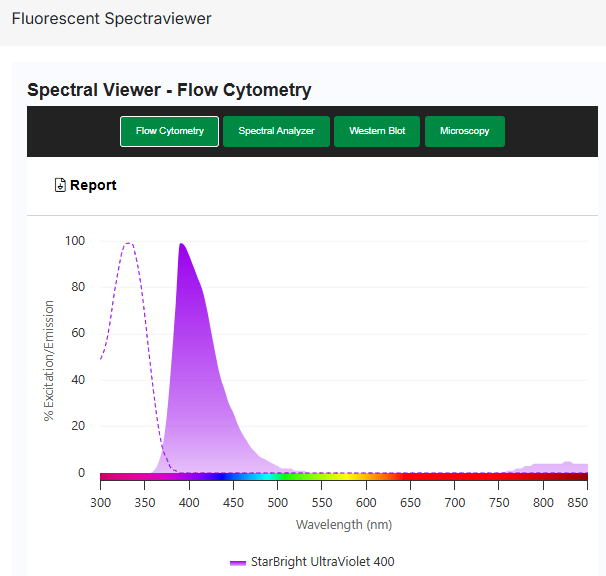
| 最大激发/发射波长 | 荧光染料:StarBright UltraViolet 400 最大激发波长:335 nm 最大发射波长:394 nm |
| 监管声明 | 仅供研究使用 |
| 保质期 | 自发货之日起12个月 |
| 专利信息 | 本产品受美国专利号10,150,841及相关美国和外国对应专利的保护。 |
储存信息
本品在环境温度下运输。
请于 +4°C 储存,切勿冷冻。
本品应原液保存。
应用
本品已有以下应用的文献报道,相关信息来自我司实验室测试、同行评审的文献或原始开发者的个人交流。具体信息可参考引用的文献。一般实验操作建议请参阅抗体实验方案页面。
| 应用名称 | 已验证 | 推荐最低稀释度 | 推荐最高稀释度 |
|---|---|---|---|
| 流式细胞术 | ✓ | 原液 | - |
若本品未针对某项特定技术进行测试,并不代表其不适用于该技术。推荐的参考工作稀释度仅供参考,建议用户在其体系中通过适当的阴性/阳性对照,自行滴定确定最佳使用浓度。
流式细胞术
建议使用 5 µl 工作稀释液标记 100 µl 体积中的 10⁶ 个细胞。最佳实验流程建议在上样前以 6,000 g 离心 5 分钟。
Expression of F4/80 is heterogeneous and is modulated during macrophage maturation and activation. The F4/80 antigen is expressed on a wide range of mature tissue macrophages including Kupffer cells, Langerhans cells, microglia, macrophages located in the gut lamina propria, peritoneal cavity, lung, thymus, bone marrow stroma and macrophages in the red pulp of the spleen (Hume, et al. 1984). F4/80 antigen is also expressed on a subpopulation of dendritic cells but is absent from macrophages located in T cell areas of the spleen and lymph node (Gordon, et al. 1994). The ligands and biological functions of the F4/80 antigen have not been fully determined but a role for F4/80 in the generation of efferent CD8+ve regulatory T cells is proposed (Lin, et al. 2005)
Rat anti mouse F4/80 antibody, clone Cl:A3-1 modulates cytokine levels released in response to Listeria monocytogenes (Warschkau & Kiderlen, 1999).
A Human anti-idiotypic CI:A31 antibody, clone 17867 (HCA154 ) which binds to and blocks activity of Rat anti mouse F4/80 antibody, clone Cl:A3-1 is also available for use as a control in experiments utilizing clone A3-1.
储存信息
Store at +4°C. DO NOT FREEZE.
This product should be stored undiluted.
应用
| Application Name | Verified | Min Dilution | Max Dilution |
|---|---|---|---|
| Flow Cytometry | ✓ | Neat |
Flow Cytometry
Use 5ul of the suggested working dilution to label 106 cells in 100ul. Best practices suggest a 5 minutes centrifugation at 6,000g prior to sample application.
风险提示:丁香通仅作为第三方平台,为商家信息发布提供平台空间。用户咨询产品时请注意保护个人信息及财产安全,合理判断,谨慎选购商品,商家和用户对交易行为负责。对于医疗器械类产品,请先查证核实企业经营资质和医疗器械产品注册证情况。
 文献和实验
文献和实验Source Reference
- Austyn, J.M. & Gordon, S. (1981) F4/80, a monoclonal antibody directed specifically against the mouse macrophage.
Eur J Immunol. 11 (10): 805-15.
Antibody Characterization Reference
- Hume, D.A. et al. (1984) The mononuclear phagocyte system of the mouse defined by immunohistochemical localisation of antigen F4/80: macrophages associated with epithelia.
Anat Rec. 210 (3): 503-12. - Lee, S.H. et al. (1985) Quantitative analysis of total macrophage content in adult mouse tissues. Immunochemical studies with monoclonal antibody F4/80.
J Exp Med. 161 (3): 475-89.
References for F4/80 antibody
- Warschkau, H. & Kiderlen, A.F. (1999) A monoclonal antibody directed against the murine macrophage surface molecule F4/80 modulates natural immune response to Listeria monocytogenes.
J Immunol. 163 (6): 3409-16. - Moore, K.J. et al. (2000) Divergent response to LPS and bacteria in CD14-deficient murine macrophages.
J Immunol. 165 (8): 4272-80. - Brown, G.D. et al. (2002) Dectin-1 is a major beta-glucan receptor on macrophages.
J Exp Med. 196: 407-12. - Biffi, A. et al. (2004) Correction of metachromatic leukodystrophy in the mouse model by transplantation of genetically modified hematopoietic stem cells.
J Clin Invest. 113: 1118-29. - Dandekar, A.A.et al. (2004) Bystander CD8 T-cell-mediated demyelination is interferon-gamma-dependent in a coronavirus model of multiple sclerosis.
Am J Pathol. 164: 363-9. - Bevaart, L. et al. (2004) CpG oligodeoxynucleotides enhance FcgammaRI-mediated cross presentation by dendritic cells.
Int Immunol. 16: 1091-8. - Pizza, F.X. et al. (2005) Neutrophils contribute to muscle injury and impair its resolution after lengthening contractions in mice.
J Physiol. 562 (Pt 3): 899-913. - Lin, H.H. et al. (2005) The macrophage F4/80 receptor is required for the induction of antigen-specific efferent regulatory T cells in peripheral tolerance.
J Exp Med. 201 (10): 1615-25.
Further Reading
- Gordon, S. et al. (1992) Antigen markers of macrophage differentiation in murine tissues.
Curr Top Microbiol Immunol. 181: 1-37.
Ultraviolet Irradiation of Cells
Ultraviolet (UV) radiation is mutagenic in a wide variety of organisms and is a major source of physical deoxyribonucleic acid (DNA) damage. The mutations caused and the biological consequences of exposing cell cultures to UV light
which encodes the heme catabolic enzyme, heme-oxygenase-1 (HO-1 ), is strongly induced by oxidizing agents such as ultraviolet-A (UVA, 320–400nm) radiation, has provided a powerful indicator of cellular redox state (see also Chapter 23 ). This phenomenon
荧光标记物质的波长 做荧光标记用得着。 已搜索,无重复。 前一个数字是激发波长,后一个是发射波长 Fluorochrome--Excitation Wavelength--Emission Wavelength Acid Fuchsin 540 630 Acridine Orange(Bound to DNA) 502 526 Acridine Red 455-600 560-680 Acridine Yellow 470 550
 技术资料
技术资料暂无技术资料 索取技术资料

