

- 询价
- BIO-RAD

- MCA500SBY665
- 2026年01月20日
- F
- Mouse

企业认证
相关产品推荐更多 >
万千商家帮你免费找货
0 人在求购买到急需产品
- 详细信息
- 文献和实验
- 技术资料
- 免疫原:
CBAT6 thymocytes
- 亚型:
IgG2a
- 形态:
Purified IgG conjugated to StarBright Yellow 665 - liquid
- 克隆性:
Monoclonal Antibody
- 标记物:
StarBright Yellow 665
- 适应物种:
Mouse
- 保质期:
自发货之日起 12 个月
- 目录编号:
KT3
- 供应商:
伯乐生命医学产品(上海)有限公司
- 应用范围:
F
- 浓度:
For information on the concentration of our StarBright Dye conjugated reagents please visit our FAQ page.
- 抗体名:
CD3 antibody | KT3
- 规格:
100 Tests/0.5ml
大鼠抗小鼠CD3抗体(克隆号KT3)可识别小鼠CD3抗原,该抗原表达于成熟T细胞表面。该抗体可用于诱导CD3阳性细胞(T细胞)的增殖与细胞毒性反应(Tomonari,1988年文献)。
注:为获得最佳染色效果,建议在室温条件下进行孵育操作。
| 项目 | 内容 |
|---|---|
| 靶物种 | 小鼠 |
| 产品形式 | 纯化IgG,与StarBright Yellow 665偶联 - 液体 |
| 制备方法 | 通过Protein G亲和层析,从组织培养上清液中纯化获得IgG |
| 缓冲溶液 | 磷酸盐缓冲液 |
| 防腐剂/稳定剂 | 0.09% NaN₃ 1% 牛血清白蛋白 0.1% Pluronic F68 0.1% PEG 3350 0.05% Tween 20 |
| 免疫原 | CBAT6 胸腺细胞 |
| 近似蛋白浓度 | 关于我司StarBright染料偶联试剂的浓度信息,请访问FAQ页面。 |
| 细胞融合 | 免疫SD大鼠脾细胞与小鼠NSO骨髓瘤细胞融合 |
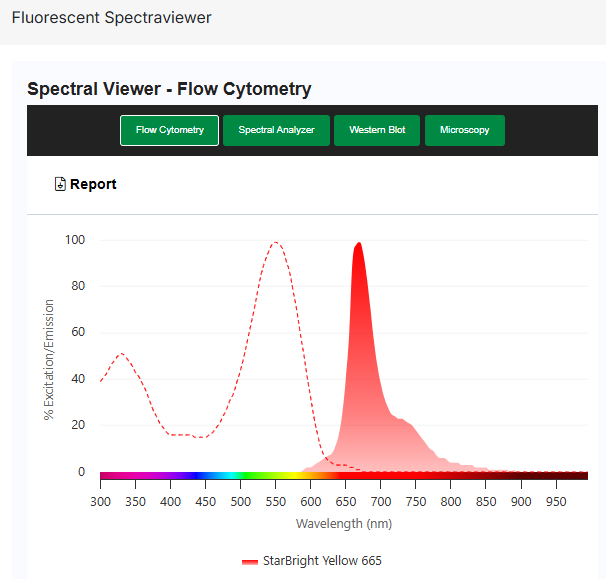
| 最大激发/发射波长 | 荧光染料:StarBright Yellow 665 最大激发波长:554 nm 最大发射波长:670 nm |
| 监管声明 | 仅供研究使用 |
| 保质期 | 自发货之日起12个月 |
| 专利信息 | 本产品受美国专利号10,150,841及相关美国和外国对应专利的保护。 |
储存信息
本产品运输条件为环境温度。
请于+4°C条件下储存,切勿冷冻。
本品应原液保存,无需稀释。
应用说明
根据本实验室测试结果、同行评审文献或原始研发机构提供的资料,本产品已验证适用于以下实验应用。具体使用细节可参阅相关参考文献。如需通用实验方案建议,请访问抗体使用指南页面。
| 应用名称 | 已验证 | 推荐最低稀释度 | 推荐最高稀释度 |
|---|---|---|---|
| 流式细胞术 | ✓ | 原液 | - |
若本品未针对某项特定技术进行测试,并不代表其不适用于该技术。推荐的参考工作稀释度仅供参考,建议用户在其体系中通过适当的阴性/阳性对照,自行滴定确定最佳使用浓度。
流式细胞术
建议使用 5 µl 工作稀释液标记 100 µl 体积中的 10⁶ 个细胞。最佳实验流程建议在上样前以 6,000 g 离心 5 分钟。
NB. For optimal staining incubations should be performed at room temperature.
储存信息
Store at +4°C. DO NOT FREEZE.
This product should be stored undiluted.
应用
| Application Name | Verified | Min Dilution | Max Dilution |
|---|---|---|---|
| Flow Cytometry | ✓ | Neat |
Flow Cytometry
Use 5ul of the suggested working dilution to label 106 cells in 100ul. Best practices suggest a 5 minutes centrifugation at 6,000g prior to sample application.
风险提示:丁香通仅作为第三方平台,为商家信息发布提供平台空间。用户咨询产品时请注意保护个人信息及财产安全,合理判断,谨慎选购商品,商家和用户对交易行为负责。对于医疗器械类产品,请先查证核实企业经营资质和医疗器械产品注册证情况。
 文献和实验
文献和实验Source Reference
- Tomonari, K. & Lovering, E. (1988) T-cell receptor-specific monoclonal antibodies against a V beta 11-positive mouse T-cell clone.
Immunogenetics. 28 (6): 445-51.
References for CD3 antibody
- Tomonari, K. (1988) A rat antibody against a structure functionally related to the mouse T-cell receptor/T3 complex.
Immunogenetics. 28 (6): 455-8. - Lazarovits, A.I. et al. (1999) Mechanisms of induction of renal allograft tolerance in CD45RB-treated mice.
Kidney Int. 55: 1303-10. - Heitmann, S. et al. (1999) Immunohistological characterization of leukocytes in the lungs of healthy mice and after bacterial intratracheal infection.
Lab Anim. 33: 288-94. - Tarlton, J.F. et al. (2000) The role of up-regulated serine proteases and matrix metalloproteinases in the pathogenesis of a murine model of colitis.
Am J Pathol. 157: 1927-35. - Lacroix-Lamandé, S. et al. (2002) Role of gamma interferon in chemokine expression in the ileum of mice and in a murine intestinal epithelial cell line after Cryptosporidium parvum infection.
Infect Immun. 70 (4): 2090-9. - Kumar, L. et al. (2002) Differential role of SLP-76 domains in T cell development and function.
Proc Natl Acad Sci U S A. 99: 884-9. - Hare, K.J. et al. (2003) Modeling TCR signaling complex formation in positive selection.
J Immunol. 171: 2825-31. - Erlandsson, L. et al. (2004) Impaired B-1 and B-2 B cell development and atypical splenic B cell structures in IL-7 receptor-deficient mice.
Eur J Immunol. 34: 3595-603.
流式抗体的选择和配色原则由于在流式细胞实验过程中,荧光抗体对单细胞悬液的标记效果直接影响实验的数据质量。因此,需要考虑各种影响流式抗体品质及检测效果的因素,例如抗体特异性、荧光素信号强弱、荧光素标记方式、同型对照等。本文介绍如何选择合适的流式抗体: 1、需要满足抗体选择的最基本条件:目标蛋白特异性,反应种属以及应用实验等。 靶标特异性:确定标记物名称,确定是细胞表面表达,还是细胞内表达。细胞内表达需要进行透膜。 物种来源:确定待测样本的种属来源。例如,抗小鼠的抗体,不能用于人的样本的检测
,则不应选择小鼠或大鼠源的一抗,最好选兔源的一抗,则二抗则可选择偶联了检测分子(酶、荧光素、生物素等)的抗兔IgG。 如果选择有偶联物的一抗则不适用上述情况,除免疫组化外的其它对不含内源性免疫球蛋白样本的检测方法,则抗体宿主物种的影响不大,如对不含IgG 的细胞裂解物样本的western blotting检测,尽管如此,含有血清的组织裂解物和组织培养上清中含有免疫球蛋白,还原变性样本中含IgG,在western blot 检测中则结合出现IgG 分子50 and 25 kDa 的重链和轻链
,比如WB、IHC等,都是通过二抗类的试剂标记达到结果呈现的目的。但是基于仪器分析的一些实验,可能就会使用到直接标记的一抗,比如流式实验。那么需要了解到自己将要使用的仪器能检测到的荧光范围,针对不通的参数要求选择对应的标记物。在免疫荧光双标实验中,需要选配不同的荧光标记物。 2. 抗体种属来源的选择 有人认为单抗比多抗好,其实这并不是一个严谨的观点,只能说在可能性上单抗的特异性更好一些,而多抗的亲和力会优于单抗,并且特异性并不一定就逊于单抗,主要看抗原的设计水平。目前商品化抗体里
 技术资料
技术资料暂无技术资料 索取技术资料

