

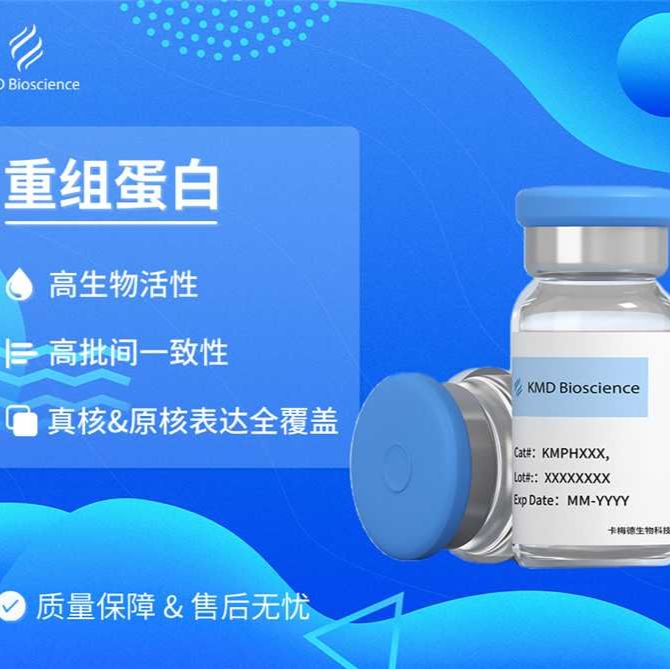
- ¥520
- 卡梅德/KMD Bioscience
- 天津
- KRP468
- 2025年12月29日

企业认证
相关产品推荐更多 >
万千商家帮你免费找货
0 人在求购买到急需产品
- 详细信息
- 文献和实验
- 技术资料
- 保存条件:
Store the product under sterile conditions after opening at -80℃ for 12 months. Store the lyophilized powder at -20℃. Avoid repeated freeze-thaw cycles.
- 英文名:
Recombinant Mouse FSTL1/FRP Protein, C-His Tag
- 库存:
999
- 供应商:
卡梅德生物科技(天津)有限公司
- 规格:
20ug///50ug/// 100ug///200ug///1mg
产品名称:Recombinant Mouse FSTL1/FRP Protein, C-His Tag
产品编号:KRP468
产品描述:Mouse Fstl1(19-306 aa)
分子名称:Fstl1
物种:Mouse
表达系统:HEK293F Cells
规格:20ug, 50ug, 100ug, 200ug, 1mg
纯度:≥95%
缓冲体系:Supplied in PBS
保存条件:Store the product under sterile conditions after opening at -80℃ for 12 months. Store the lyophilized powder at -20℃. Avoid repeated freeze-thaw cycles.
运输条件:This product is shipped on ice packs or dry ice.
产品声明:该产品仅供科研使用,不可直接用于人体或注射。
风险提示:丁香通仅作为第三方平台,为商家信息发布提供平台空间。用户咨询产品时请注意保护个人信息及财产安全,合理判断,谨慎选购商品,商家和用户对交易行为负责。对于医疗器械类产品,请先查证核实企业经营资质和医疗器械产品注册证情况。
 文献和实验
文献和实验干货 | CUT and Tag 核心酶 Hyperactive PA/PG-Tn5 Transposase 大解密
CUT&Tag(Cleavage Under Targets and Tagmentation)是蛋白-DNA 互作的一大革新技术,它不需要使用甲醛交联以及免疫共沉淀,而是通过针对靶蛋白(如转录因子、染色质重塑蛋白)的抗体和 Protein A/G 的介导,使得与 Protein A/G 融合的 Tn5 酶(Tagmentase)在切割 DNA 片段的同时在序列两端加上测序接头,经 PCR 扩增后即可形成用于高通量测序的文库(见图 1 )。CUT &Tag 技术具有细胞投入量低、信噪
内源性FSTL1 通过激活钠‐钾泵引起膜超极化调节痛觉信息传递
组织中的表达丰度。芯片结果显示FSTL1 是DRG 表达丰度最高的分子之一。随后,研究者用Northern blotting 和Westernblotting 的方法分别检测FSTL1 的mRNA 和蛋白表达水平,结果与芯片结果一致。FSTL1 在DRG 表达量较高,但在别的组织表达量较低。 对脊髓背角进行蔗糖密度梯度离心实验,取相同体积的不同比重组份做Western blotting,结果显示FSTL1 主要存在于清亮小泡中。体外培养大鼠DRG 神经元检测培养基中FSTL1 的含量,结果显示在没有刺激
Translocation Assays of Protein Kinase C Activation
The protein kinase C (PKC) family members include at least 11 different isoforms that, based on their different requirements for activation, have been divided into three subfamilies, the Ca2+ -dependent (cPKCα, (βI , βII
 技术资料
技术资料暂无技术资料 索取技术资料

