

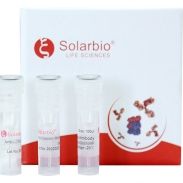
- ¥480 - 1600
- Solarbio|ActivAb
- 北京
- K114789P
- 2025年08月22日
- WB
- Rabbit
- Human

企业认证
相关产品推荐更多 >
万千商家帮你免费找货
0 人在求购买到急需产品
- 详细信息
- 文献和实验
- 技术资料
- 免疫原:
A synthetic peptide of human HLA-DRB1/HLA-DRB5/HLA-DRB4/HLA-DRB3
- 亚型:
IgG
- 保存条件:
Store at -20℃. Avoid freeze / thaw cycles.
- 克隆性:
Polyclonal Antibody
- 标记物:
Biotin,Cy3,Cy3.5,Cy5,Cy5.5,Cy7,FITC,HRP,RBITC,Solar Fluor 350,Solar Fluor 405,Solar Fluor 488,Solar Fluor 532,Solar Fluor 555,Solar Fluor 568,Solar Fluor 594,Solar Fluor 633,Solar Fluor 640,Solar Fluor 647,Solar Fluor 660,Solar Fluor 680,Solar Fluor 750
- 适应物种:
Human
- 抗原来源:
A synthetic peptide of human HLA-DRB1/HLA-DRB5/HLA-DRB4/HLA-DRB3
- 目录编号:
3123/3127/3126/3125
- 级别:
实验级别
- 库存:
现询
- 供应商:
北京索莱宝科技有限公司
- 宿主:
Rabbit
- 应用范围:
WB
- 浓度:
WB 1:1000-3000.
- 靶点:
HLA-DRB1/HLA-DRB5/HLA-DRB4/HLA-DRB3
- 抗体英文名:
Anti-HLA-DRB1/HLA-DRB5/HLA-DRB4/HLA-DRB3 Polyclonal Antibody
- 抗体名:
HLA类组织相容性抗原,DRB1/DRB5/DRB4/DPB1链
- 规格:
20ul/100ul/50ul
| 规格: | 20ul | 产品价格: | ¥480.0 |
|---|---|---|---|
| 规格: | 100ul | 产品价格: | ¥1600.0 |
| 规格: | 50ul | 产品价格: | ¥960.0 |
| 基本信息 | |
| 英文名称 | Anti-HLA-DRB1/HLA-DRB5/HLA-DRB4/HLA-DRB3 Polyclonal Antibody |
| 中文名称 | HLA类组织相容性抗原,DRB1/DRB5/DRB4/DPB1链 |
| 宿主 | Rabbit |
| 克隆类型 | Polyclonal Antibody |
| 亚型 | IgG |
| 交叉反应 | Human |
| 预测交叉反应 | Dog(86.7%) |
| 应用 | WB |
| 稀释比例 | WB 1:1000-3000. |
| 密度 | |
| 靶标 | HLA-DRB1/HLA-DRB5/HLA-DRB4/HLA-DRB3 |
| 别名 | HLA-DRB1-2B1F_HUMAN; DR1; DR16; DR5; DR8; DRB1; DRw10; DW2.2/DR2.2; FLJ75017; FLJ76359; HLA class II antigen beta chain; HLA class II histocompatibility antigen, DR-1 beta chain; HLA class II histocompatibility antigen, DRB1-15 beta chain; HLA-DR-beta 1; HLA-DR1B; HLA-DRB; HLA-DRB1; human leucocyte antigen DRB1; Leucocyte antigen DR beta 1 chain; leucocyte antigen DRB1; lymphocyte antigen DRB1; major histocompatibility complex, class II, DR beta 1; MHC class II antigen; MHC class II antigen DRB1*15; MHC class II antigen HLA-DR13; MHC class II HLA-DR beta 1 chain; MHC class II HLA-DR-beta cell surface glycoprotein; MHC class II HLA-DRw10-beta; SS1; HLA-DRB3; HLA-DRB5-HLA class II histocompatibility antigen, DR beta 5 chain;DR beta-5;DR2-beta-2;Dw2;MHC class II antigen DRB5;HLA-DRB5;HLA-DRB4-HLA class II histocompatibility antigen, DR beta 4 chain;MHC class II antigen DRB4;HLA-DRB4;HLA-DRB3-DR beta 3 chain; DR7; DRB3_HUMAN; HLA class II histocompatibility antigen; HLA class II histocompatibility antigen DR beta 3 chain; HLA class II histocompatibility antigen DRB1 7 beta chain; HLA DR3B; HLA-DRB3; Human leucocyte antigen DRB3; Major histocompatibility complex class II DR beta 3; MGC117330; MHC class II antigen DR beta 3 chain; MHC class II antigen DRB3; MHC class II HLA DR beta 3 chain; HLA-DRB1;HLA-DRB; |
| 背景说明 | HLA-DRB1-HLA-DRB1 belongs to the HLA class II beta chain paralogs. The class II molecule is a heterodimer consisting of an alpha (DRA) and a beta chain (DRB); both anchored in the membrane. It plays a central role in the immune system by presenting peptides derived from extracellular proteins. Class II molecules are expressed in antigen presenting cells (APC: B lymphocytes; dendritic cells; macrophages). The beta chain is approximately 26-28 kDa. It is encoded by 6 exons. Exon one encodes the leader peptide; exons 2 and 3 encode the two extracellular domains; exon 4 encodes the transmembrane domain; and exon 5 encodes the cytoplasmic tail. Within the DR molecule the beta chain contains all the polymorphisms specifying the peptide binding specificities. Hundreds of DRB1 alleles have been described and typing for these polymorphisms is routinely done for bone marrow and kidney transplantation. DRB1 is expressed at a level five times higher than its paralogs DRB3; DRB4 and DRB5. DRB1 is present in all individuals. Allelic variants of DRB1 are linked with either none or one of the genes DRB3; DRB4 and DRB5. There are 4 related pseudogenes: DRB2; DRB6; DRB7; DRB8 and DRB9. [provided by RefSeq; Jul 2008] HLA-DRB5-Binds peptides derived from antigens that access the endocytic route of antigen presenting cells (APC) and presents them on the cell surface for recognition by the CD4 T-cells. The peptide binding cleft accommodates peptides of 10-30 residues. The peptides presented by MHC class II molecules are generated mostly by degradation of proteins that access the endocytic route; where they are processed by lysosomal proteases and other hydrolases. Exogenous antigens that have been endocytosed by the APC are thus readily available for presentation via MHC II molecules; and for this reason this antigen presentation pathway is usually referred to as exogenous. As membrane proteins on their way to degradation in lysosomes as part of their normal turn-over are also contained in the endosomal/lysosomal compartments; exogenous antigens must compete with those derived from endogenous components. Autophagy is also a source of endogenous peptides; autophagosomes constitutively fuse with MHC class II loading compartments. In addition to APCs; other cells of the gastrointestinal tract; such as epithelial cells; express MHC class II molecules and CD74 and act as APCs; which is an unusual trait of the GI tract. To produce a MHC class II molecule that presents an antigen; three MHC class II molecules (heterodimers of an alpha and a beta chain) associate with a CD74 trimer in the ER to form a heterononamer. Soon after the entry of this complex into the endosomal/lysosomal system where antigen processing occurs; CD74 undergoes a sequential degradation by various proteases; including CTSS and CTSL; leaving a small fragment termed CLIP (class-II-associated invariant chain peptide). The removal of CLIP is facilitated by HLA-DM via direct binding to the alpha-beta-CLIP complex so that CLIP is released. HLA-DM stabilizes MHC class II molecules until primary high affinity antigenic peptides are bound. The MHC II molecule bound to a peptide is then transported to the cell membrane surface. In B-cells; the interaction between HLA-DM and MHC class II molecules is regulated by HLA-DO. Primary dendritic cells (DCs) also to express HLA-DO. Lysosomal microenvironment has been implicated in the regulation of antigen loading into MHC II molecules; increased acidification produces increased proteolysis and efficient peptide loading. HLA-DRB4-Calreticulin is a multifunctional protein that acts as a major Ca(2+)-binding (storage) protein in the lumen of the endoplasmic reticulum. It is also found in the nucleus; suggesting that it may have a role in transcription regulation. Calreticulin binds to the synthetic peptide KLGFFKR; which is almost identical to an amino acid sequence in the DNA-binding domain of the superfamily of nuclear receptors. Calreticulin binds to antibodies in certain sera of systemic lupus and Sjogren patients which contain anti-Ro/SSA antibodies; it is highly conserved among species; and it is located in the endoplasmic and sarcoplasmic reticulum where it may bind calcium. The amino terminus of calreticulin interacts with the DNA-binding domain of the glucocorticoid receptor and prevents the receptor from binding to its specific glucocorticoid response element. Calreticulin can inhibit the binding of androgen receptor to its hormone-responsive DNA element and can inhibit androgen receptor and retinoic acid receptor transcriptional activities in vivo; as well as retinoic acid-induced neuronal differentiation. Thus; calreticulin can act as an important modulator of the regulation of gene transcription by nuclear hormone receptors. HLA-DRB3-HLA-DRB3 belongs to the HLA class II beta chain paralogues. This class II molecule is a heterodimer consisting of an alpha (DRA) and a beta (DRB) chain; both anchored in the membrane. It plays a central role in the immune system by presenting peptides derived from extracellular proteins. Class II molecules are expressed in antigen presenting cells (APC: B lymphocytes; dendritic cells; macrophages). The beta chain is approximately 26-28 kDa and its gene contains 6 exons. Exon one encodes the leader peptide; exons 2 and 3 encode the two extracellular domains; exon 4 encodes the transmembrane domain and exon 5 encodes the cytoplasmic tail. Within the DR molecule the beta chain contains all the polymorphisms specifying the peptide binding specificities. Typing for these polymorphisms is routinely done for bone marrow and kidney transplantation. DRB1 is expressed at a level five times higher than its paralogues DRB3; DRB4 and DRB5. The presence of DRB3 is linked with allelic variants of DRB1; otherwise it is omitted. There are 4 related pseudogenes: DRB2; DRB6; DRB7; DRB8 and DRB9. |
| Swiss Prot | P01911/Q30154/P13762/P79483 |
| Gene ID | 3123/3127/3126/3125 |
| 亚细胞定位 | Cytoplasm Cell membrane |
| 免疫原 | A synthetic peptide of human HLA-DRB1/HLA-DRB5/HLA-DRB4/HLA-DRB3 |
| Public Immunogen Range | 50-100/266aa |
| 理论分子量 | 29/30kDa |
| 实际分子量 | 29kDa |
| EC | |
| 纯化方法 | Affinity purification |
| 储存液 | PBS with 50% Glycerol, 0.03% Proclin300, 0.5% BSA, pH 7.3. |
| 储存条件 | Store at -20℃. Avoid freeze / thaw cycles. |
风险提示:丁香通仅作为第三方平台,为商家信息发布提供平台空间。用户咨询产品时请注意保护个人信息及财产安全,合理判断,谨慎选购商品,商家和用户对交易行为负责。对于医疗器械类产品,请先查证核实企业经营资质和医疗器械产品注册证情况。
 文献和实验
文献和实验monoclonal anti-HA 16B12 (MMS101R, BAbCo, used at 1:200 to 1:1000 dilution) mouse monoclonal anti-HA 12CA5 (12CA5, Boehringer, used at 1:200 dilution) rabbit polyclonal anti-HA (RS1010C, BAbCo, used at 1:200 dilution) Cy3-conjugated affinity
until examination. Antibodies mouse monoclonal anti-HA 16B12 (MMS101R, BAbCo, used at 1:200 to 1:1000 dilution) mouse monoclonal anti-HA 12CA5 (12CA5, Boehringer, used at 1:200 dilution) rabbit polyclonal anti-HA (RS1010C, BAbCo, used
Preparation and Characterization of Anti-phage Serum
This chapter describes a method for the generation of polyclonal antibodies against bacteriophages and how these may be assayed immunochemically and biologically.
 技术资料
技术资料暂无技术资料 索取技术资料

