

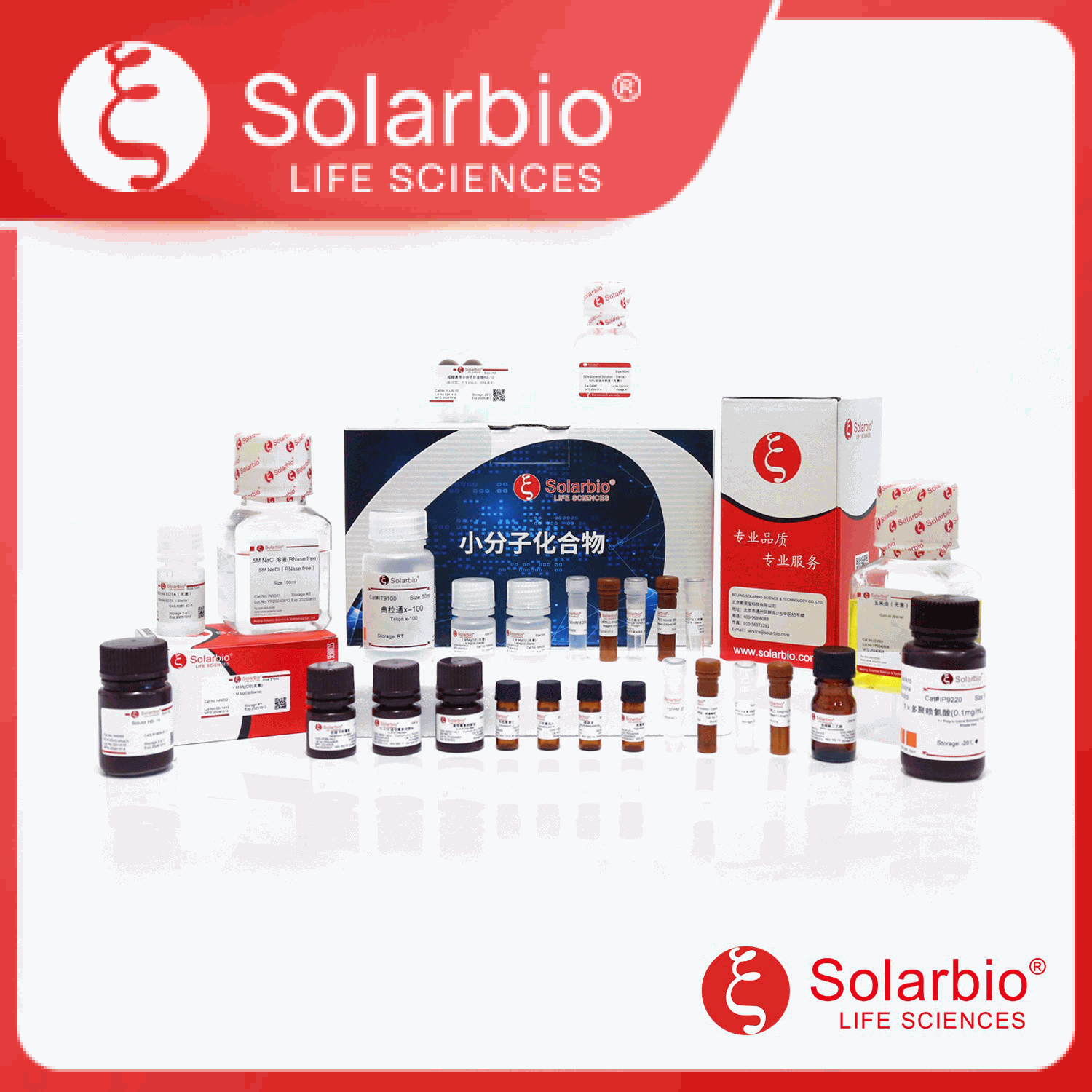
- ¥530
- Solarbio

- 北京
- IS00401
- 2026年08月14日

企业认证
相关产品推荐更多 >
万千商家帮你免费找货
0 人在求购买到急需产品
相关阅读
细胞污染识别与处理全攻略:5 种常见类型+关键误区Cytoscape 教程来了!快速实现顶刊同款通路网络图五大应用案例:Mustang Q 膜层析应用全解析1 个小工具,一次性搞定流程图、质粒图谱和信号通路图- 详细信息
- 文献和实验
- 技术资料
- 保存条件:
Store at -20℃,6 months.
- 保质期:
Store at -20℃,6 months.
- 英文名:
Sanguinarine Chloride(10mM in DMSO,Sterile)
- 库存:
999
- 供应商:
北京索莱宝科技有限公司
- CAS号:
5578-73-4
- 规格:
1ml
| CAS | 5578-73-4 |
| 中文名称 | 氯化血根碱(10mM in DMSO,无菌) |
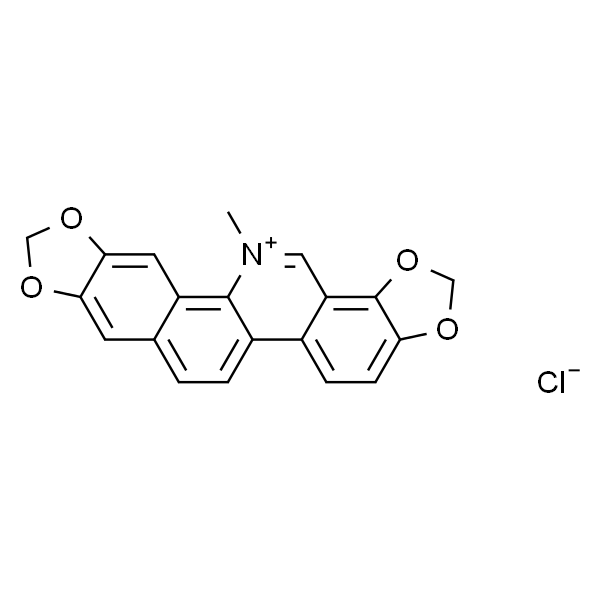
| 英文名称 | Sanguinarine Chloride(10mM in DMSO,Sterile) |
| 分子式 | C20H14NO4Cl |
| 分子量 | 367.78 |
| 规格 | 1ml |
| 溶解性 | 请根据自己的实验要求使用。 |
| 外观(性状) | 无菌溶液 |
| 储存条件 | Store at -20℃,6 months. |
| 运输条件 | 冷冻运输 |
| EC | 621-641-8 |
| MDL | MFCD00012126 |
| SMILES | C[N+]1=C2C(=C3C=CC4=C(C3=C1)OCO4)C=CC5=CC6=C(C=C52)OCO6.[Cl-] |
| InChIKey | GIZKAXHWLRYMLE-UHFFFAOYSA-M |
| InChI | InChI=1S/C20H14NO4.ClH/c1-21-8-15-12(4-5-16-20(15)25-10-22-16)13-3-2-11-6-17-18(24-9-23-17)7-14(11)19(13)21;/h2-8H,9-10H2,1H3;1H/q+1;/p-1 |
| PubChem CID | 68635 |
| 靶点 | Apoptosis |
| 通路 | Apoptosis |
| 背景说明 | Sanguinarine Chloride是一种生物碱,可通过激活活性氧 (ROS) 的产生来刺激细胞凋亡。诱导的细胞凋亡与 JNK 和 NF-κB 的活化有关。 |
| 生物活性 | Sanguinarine (Sanguinarin) chloride, a benzophenanthridine alkaloid derived from the root of Sanguinaria Canadensis, can stimulate apoptosis via activating the production of reactive oxygen species (ROS). Sanguinarine-induced apoptosis is associated with the activation of JNK and NF-κB.[1] |
| In Vitro | Sanguinarine (SANG)-induced apoptosis is associated with the activation of JNK and NF-κB signal pathways.To determine the effects of Sanguinarine on cell viability, 22B-cFluc cells are stimulated with different concentrations of Sanguinarine for 24 h, and then a CKK-8 assay is performed. The treatment with Sanguinarine decreases the proliferation of 22B cells in a dose-dependent manner. Meanwhile, the cytosolic extracts of 22B-cFluc cells treated with different dose of Sanguinarine are measured to detect cellular caspase-3 activity using Ac-DEVD-pNA, which is a validated caspase-3 substrate. The absorbance at 450 nm increases in a dose-dependent manner, indicating increased caspase-3 activity stimulated by Sanguinarine[1]. |
| In Vivo | To evaluate the apoptosis induced by Sanguinarine (SANG) in vivo, 22B-cFluc cells are inoculated subcutaneously into one flank of nude mice and xenograft models are allowed to establish. Mice are treated intravenously with 10 mg/kg of Sanguinarine. At 24, 48 and 72 h after treatment, bioluminescent imaging is performed after i.p. injection of mice with 150 mg/kg of D-luciferin substrate. Sanguinarine treatment induces an obvious increase of luminescent signal as early as 48 h after initial treatment. A sustained bioluminescent imaging (BLI) intensity increased is observed throughout the course of experiment. At 72 h after treatment, the tumors are collected and subjected to TUNEL staining for evaluating apoptosis. Compared with the control tumors, the group treated with Sanguinarine exhibits significantly more cell apoptosis, indicated by the increased green signals from the sporadic apoptotic cells[1]. |
| 细胞实验 | The cell viability of Sanguinarine is determined by CCK-8 assay using a cell counting kit-8. Briefly, 22B-cFluc cells are seeded in a 96-well plate (5×10³ cells/well) and treated with different concentrations of Sanguinarine (0.5 μM, 1 μM, 2 μM, 4 μM) for 24 h. Then 10 mL CKK-8 is added to each well for 4 h and the absorbance at 450 nm is measured with a microplate reader. The optical density (OD) values are determined to reflect the viable cell populations from each well[1]. |
| 动物实验 | Mice[1] Xenografted tumor models are prepared by injection of 1×10⁷ 22B-cFluc cells suspended in PBS into nude mouse (n=6). After tumors reach a volume of approximately 100 mm3, Sanguinarine (10 mg/kg) is i.v. injected into mice. After injection for 24 h, 48 h and 72 h, mice are given a single i.p. dose of 150 mg/kg D-luciferin and bioluminescence imaging are performed using a Xenogen Lumina II system. The signal intensity in the region of interest is expressed using the Living Image software 4.1. For the anti-tumor therapy studies, one group of tumor-bearing mice (n=6) receive intravenously 10 mg/kg of Sanguinarine every other day throughout the experimental period, while the control group of mice (n=6) receive DMSO only. Tumor growth measurement is calculated[1]. |
| 激酶实验 | The caspase-3 activity is measured using a caspase-3 activity assay kit. Briefly, the cells treated by different concentrations of Sanguinarine (0.5 μM, 1 μM, 2 μM, 4 μM) or control DMSO are collected, washed and lysed in a lysis buffer for 30 min on ice. The supernatants are then collected by centrifuging at 1,2000 rpm for 10 min. The Ac-DEVD-pNA (2 mM) is added to each sample and incubated at 37°C for 1 h. The optical density (OD) of each sample is finally quantified at a wavelength of 405 nm using a spectrophotometer. The p-NA standard is used to calibrate the caspase-3 activity of each sample[1]. |
| 数据来源文献 | [1]. Wang Y, Noninvasive bioluminescence imaging of the dynamics of sanguinarine induced apoptosis via activation of reactive oxygen species. Oncotarget. 2016 Apr 19;7(16):22355-67. |
| 单位 | 瓶 |
风险提示:丁香通仅作为第三方平台,为商家信息发布提供平台空间。用户咨询产品时请注意保护个人信息及财产安全,合理判断,谨慎选购商品,商家和用户对交易行为负责。对于医疗器械类产品,请先查证核实企业经营资质和医疗器械产品注册证情况。
 文献和实验
文献和实验商品化试剂和培养基均经过严格的质量控制以保证其无菌,但它们在操作过程中可能被污染。请遵循以下指导原则进行无菌操作,避免污染。请始终使用适当的灭菌方法(如高压灭菌器、除菌过滤器)对实验室中配制的任何试剂、培养基或溶液进行灭菌。 无菌操作 请始终用 70% 乙醇擦拭双手和工作区。 将容器、培养瓶、培养板和培养皿放入细胞培养通风橱之前,先用 70% 乙醇擦拭其外部。 不要直接从试剂瓶或培养瓶中倾倒培养基和试剂。 使用无菌玻璃或一次性塑料移液管和移液器操作液体时,每只移液管只能使用一次,以避免
培养基经高压灭菌后,用经过灭菌的工具(如接种针和吸管等)在无菌条件下接种含菌材料(如样品、菌苔或菌悬液等)于培养基上,这个过程叫做无菌接种操作。在实验室检验中的各种接种必须是无菌操作。 实验台面不论是什么材料,一律要求光滑、水平。光滑是便于用消毒剂擦洗;水平是倒琼脂培养基时利于培养皿内平板的厚度保持一致。在实验台上方,空气流动应缓慢,杂菌应尽量减少,其周围杂菌也应越少越好。为此,必须清扫室内,关闭实验室的门窗,并用消毒剂进行空气消毒处理,尽可能地减少杂菌的数量
工业级-DMSO用途: 主要用于无水有机化学合成反应和医药及中间体合成反应溶剂,使用该溶剂能提高化学反应速度,提高反应物的了收率,缩短反应时间,使合成反应变得更加顺利。 试剂级-DMSO用途: DMSO用作液体层析溶剂,同时用作测试物质紫外消光值上时用作参照物,存在于液体形态。 (责任编辑:大汉昆仑王)
 技术资料
技术资料暂无技术资料 索取技术资料

