
- ¥5000
- 苏州艾洛蒙生物
- ARD0052
- 苏州
- 2025年12月15日
- human

企业认证
相关产品推荐更多 >


万千商家帮你免费找货
0 人在求购买到急需产品
- 详细信息
- 技术资料
- 抗体名:
Anbenitamab
- 抗体英文名:
Anti-Human HER2 x HER2 antibody
- 靶点:
ERBB2 (epidermal growth factor receptor 2, receptor tyrosine-protein kinase erbB-2, EGFR2, HER2, HER-2, p185c-erbB2, NEU, CD340) [Homo sapiens] biparatopic tetravalent
- 适应物种:
human
- 保质期:
12 months
- 目录编号:
CAS:2367012-88-0
- 级别:
Research Grade
- 供应商:
苏州艾洛蒙
- 标记物:
无
- 克隆性:
单克隆
- 保存条件:
Store at -20°C for 12 months (Avoid repeated freezing and thawing)
- 形态:
Liquid
- 亚型:
Human IgG1, κ
- 规格:
1mg
Anbenitamab (KN-026) 是一种双特异性抗体,同时靶向人 HER2的胞外结构域 II 和 IV。Anbenitamab 阻断配体依赖性和配体非依赖性 HER2 信号通路。Anbenitamab 的 IgG1Fc 片段结合 FcRγIIIa 介导有效的抗体依赖性细胞介导的细胞毒性 (ADCC) 并抑制肿瘤细胞增殖。Anbenitamab 具有用于 HER2 阳性转移性乳腺癌 (MBC) 研究的潜力。
Anbenitamab (KN-026) is a bispecific antibody that targets extracellular domains II and IV of human HER2, blocking both ligand-dependent and independent signaling pathways. Its IgG1 Fc fragment activates FcRγIIIa, triggering strong antibody-dependent cell-mediated cytotoxicity (ADCC) and suppressing tumor cell growth. Anbenitamab shows promise for research in HER2-positive metastatic breast cancer (MBC).anbenitamab An engineered Fc-based heterodimeric bispecific monoclonal antibody, derived from trastuzumab and pertuzumab, directed against two distinct epitopes of the extracellular dimerization domain of the tumor-associated antigen (TAA) human tyrosine kinase receptor epidermal growth factor receptor 2 (HER2; ErbB2; HER-2), with potential immunomodulating and antineoplastic activities. Upon administration, anbenitamab simultaneously targets and binds to two separate, non-overlapping epitopes of HER-2, thereby inhibiting HER-2 heterodimerization and prevents the activation of HER-2 signaling pathways. By binding to HER-2, KN026 induces an antibody-dependent cell-mediated cytotoxicity (ADCC) against tumor cells that overexpress HER-2. This results in tumor cell apoptosis and inhibits tumor cell proliferation of HER-2-overexpressing tumor cells. HER-2, overexpressed on a variety of tumor cell types, plays an important role in proliferation, differentiation and survival.
anti-HER-2 bispecific antibody KN026
anti-HER2 heterodimeric antibody KN026
HER2 bispecific antibody KN026
KN 026
KN-026
KN026
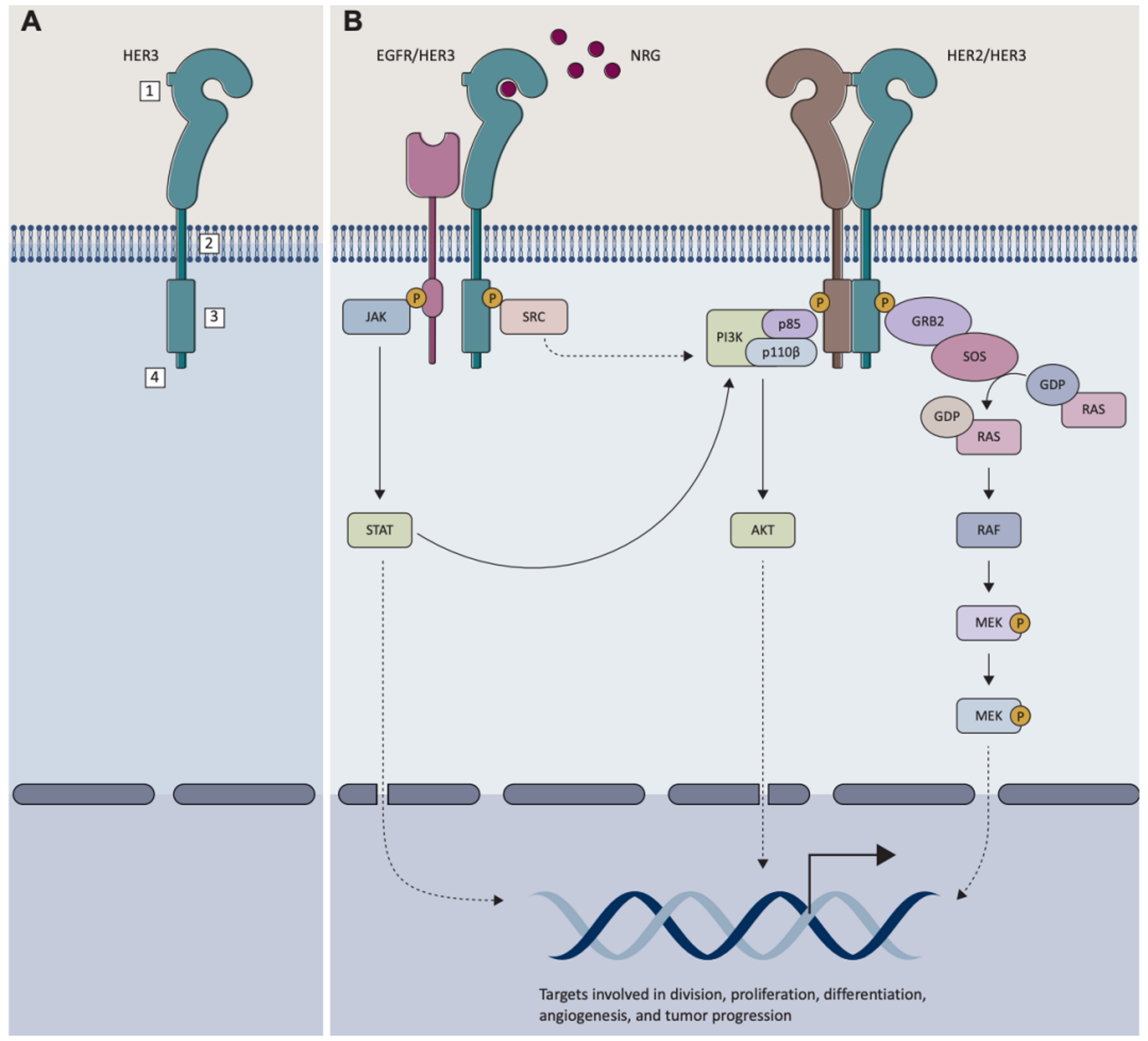
HER3 is a unique EGFR family member with no or little intracellular tyrosine kinase activity. Compared with the other EGFR family members, HER3 diverges at critical residues in the kinase domain locking it in an inactive-like conformation . Although HER3 has been reported to have some kinase activity, it is suggested to be 1000-fold weaker than the kinase activity of the fully activated EGFR . Since HER3 is unable to form homodimers, its activation depends on heterodimerization with another receptor in order to induce the downstream C-terminal phosphorylation events .
The HER3 gene localizes in the long arm of chromosome 12 (12q13.2), encoding a 180 kDa protein . The extracellular domain of HER3 is divided into four subdomains (I–IV): subdomains I and III are leucine-rich β-helical areas responsible for the ligand binding, whereas subdomains II and IV are cysteine-rich regions. Subdomain II also contains a dimerization arm necessary for the interaction with other receptors. The transmembrane domain is followed by an intracellular domain enclosing a flexible juxtamembrane region, kinase domain, and the C-terminal tail. In absence of a ligand, binding between subdomains II and IV keeps HER3 in an inactive state . Upon ligand binding, the dimerization partner’s kinase domain trans-phosphorylates the tyrosine residues in the C-terminal tail of HER3 .
Upon ligand binding, HER3 preferentially dimerizes with EGFR or HER2 inducing a conformational change in the receptor pair. The conformational change leads into transphosphorylation event in the intracellular kinase tail, where the C-terminal tail of HER3 acts as an acceptor for multiple phosphorylations. This induces activation of signaling cascades promoting cell survival and proliferation. EGFR: Epidermal growth factor receptor, EGF: Epidermal growth factor, HER2: Human epidermal growth factor receptor 2, HER3: Human epidermal growth factor receptor 3, NRG: Neuregulin, p85: 85kDa regulator subunit of phosphoinositide 3-kinase, p110: 110kDa catalytic subunit of phosphoinositide 3-kinase, AKT: protein kinase B, SHC: SHC-transforming protein 1, GRB2: growth factor receptor bound protein 2, SOS: Son of sevenless, RAS: RAS GTPase, RAF: Raf kinase, MAPK: Mitogen-activated protein kinase.
HER3 is a unique EGFR family member with no or little intracellular tyrosine kinase activity. Compared with the other EGFR family members, HER3 diverges at critical residues in the kinase domain locking it in an inactive-like conformation . Although HER3 has been reported to have some kinase activity, it is suggested to be 1000-fold weaker than the kinase activity of the fully activated EGFR . Since HER3 is unable to form homodimers, its activation depends on heterodimerization with another receptor in order to induce the downstream C-terminal phosphorylation events .
The HER3 gene localizes in the long arm of chromosome 12 (12q13.2), encoding a 180 kDa protein . The extracellular domain of HER3 is divided into four subdomains (I–IV): subdomains I and III are leucine-rich β-helical areas responsible for the ligand binding, whereas subdomains II and IV are cysteine-rich regions. Subdomain II also contains a dimerization arm necessary for the interaction with other receptors. The transmembrane domain is followed by an intracellular domain enclosing a flexible juxtamembrane region, kinase domain, and the C-terminal tail. In absence of a ligand, binding between subdomains II and IV keeps HER3 in an inactive state . Upon ligand binding, the dimerization partner’s kinase domain trans-phosphorylates the tyrosine residues in the C-terminal tail of HER3 .
Upon ligand binding, HER3 preferentially dimerizes with EGFR or HER2 inducing a conformational change in the receptor pair. The conformational change leads into transphosphorylation event in the intracellular kinase tail, where the C-terminal tail of HER3 acts as an acceptor for multiple phosphorylations. This induces activation of signaling cascades promoting cell survival and proliferation. EGFR: Epidermal growth factor receptor, EGF: Epidermal growth factor, HER2: Human epidermal growth factor receptor 2, HER3: Human epidermal growth factor receptor 3, NRG: Neuregulin, p85: 85kDa regulator subunit of phosphoinositide 3-kinase, p110: 110kDa catalytic subunit of phosphoinositide 3-kinase, AKT: protein kinase B, SHC: SHC-transforming protein 1, GRB2: growth factor receptor bound protein 2, SOS: Son of sevenless, RAS: RAS GTPase, RAF: Raf kinase, MAPK: Mitogen-activated protein kinase.
风险提示:丁香通仅作为第三方平台,为商家信息发布提供平台空间。用户咨询产品时请注意保护个人信息及财产安全,合理判断,谨慎选购商品,商家和用户对交易行为负责。对于医疗器械类产品,请先查证核实企业经营资质和医疗器械产品注册证情况。
 技术资料
技术资料暂无技术资料 索取技术资料