

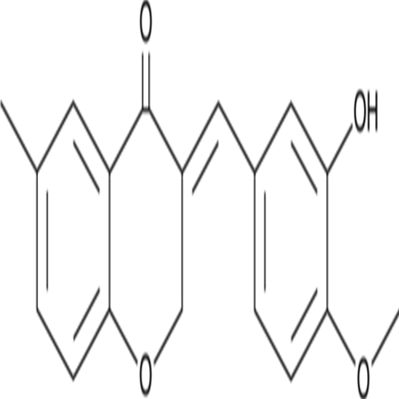
- ¥600 - 3200
- 上海莼试
- CS-01Y76414
- 国产
- 2025年07月14日
企业认证
相关产品推荐更多 >
万千商家帮你免费找货
0 人在求购买到急需产品
- 详细信息
- 文献和实验
- 技术资料
- 库存:
25
- 英文名:
IMS 2186
- CAS号:
1031206-36-6
- 供应商:
上海莼试
- 保存条件:
Store at -20°C
- 规格:
5 mg 10 mg 25 mg
| 产品名称 | IMS 2186 | 产品货号 | CS-01Y76414 |
| 规格 | 5 mg 10 mg 25 mg | CAS号 | 1031206-36-6 |
| 含量 | >98.00% | 分子式 | C18H16O4 |
| 分子量 | 296.3 | 用途 | 仅供科研研究使用 |

IMS 2186规格:5 mg 10 mg 25 mg
CAS:1031206-36-6
别名:N/A
化学名:N/A
分子式:C18H16O4
分子量:296.3
溶解度:DMSO: 5 mg/ml,Ethanol: 1 mg/ml
储存条件:Store at -20°C
General tips:For obtaining a higher solubility , please warm the tube at 37 ℃ and shake it in the ultrasonic bath for a while.
Shipping Condition: Evaluation sample solution : ship with blue ice All other available size: ship with RT , or blue ice upon request
产品描述:
IMS 2186 is an anti-choroidal neovascularization agent.1 It inhibits proliferation of NIH3T3 mouse and IMR-90 human fibroblasts (IC50s = 0.5-3 μM), as well as in a panel of eight human cancer cell lines, including ovarian, lung, colon, and pancreatic cancer cells (IC50s = 0.3-3 μM). IMS 2186 (10 μM) decreases migration of THP-1 macrophages in wound healing and chamber assays. Subcutaneous administration of IMS 2186 (20 μg/animal) inhibits VEGF-induced blood vessel formation in a MatrigelTM plug assay in mice. It reduces ocular leakage, as well as cellular proliferation and infiltration in a rat model of laser-induced choroidal neovascularization when administered intravitreally at a dose of 100 μg/eye.1.Falkenstein, I.A., Cheng, L., Wong-Staal, F., et al.Toxicity and intraocular properties of a novel long-acting anti-proliferative and anti-angiogenic compound IMS2186Curr. Eye Res.33(7)599-609(2008)
使用方法:
1. 常用筛选浓度
注意:用来筛选稳转株的工作浓度需要根据细胞类型,培养基,生长条件和细胞代谢率而变化,推荐使用浓度为50-1000μg/mL。对于第一次使用的实验体系建议通过建立杀灭曲线(kill curve),即剂量反应性曲线,来确定最佳筛选浓度。
一般而言,哺乳动物细胞50-500μg/mL;细菌/植物细胞20-200μg/mL;真菌300-1000μg/mL。
2. 杀灭曲线的建立
注意:为了筛选得到稳定表达目的蛋白的细胞株,需要确定能够杀死未转染宿主细胞的抗生素浓度,可通过建立杀灭曲线(剂量反应曲线)来实现,至少选择5个浓度。
1) 第一天:未转化的细胞按照20-25%的细胞密度铺在合适的培养板上,37℃,CO2培养过夜;注:对于需要更高密度来检测活力的细胞,可增加接种量。
2) 根据细胞类型,设定合适范围内的浓度梯度。以哺乳动物细胞为例,可设定50,100,250,500,750,1000μg/mL。先用去离子水或者PBS buffer按照1:10的比例将母液稀释到5 mg/ml,然后按照下表稀释到相应浓度的工作液。
3) 第二天:替换旧的培养基,换用新鲜配制的含有相应浓度药物的培养基。每个浓度做三个平行孔。
4) 接下来每3-4天更换新的含药物培养基。
5) 按照固定的周期(如每2天)进行活细胞计数来确定阻止未转染细胞生长的恰当浓度。选择在理想的天数(通常是7-10天)内能够杀死绝大多数细胞的浓度为稳定转染细胞筛选用的工作浓度。
3. 稳定转染细胞的筛选
1) 转染48h后,用含有适当浓度的潮霉素B筛选培养基来传代细胞(直接传代或者稀释后传代)。
注意:细胞处于活跃分裂状态时抗生素的杀伤。则当细胞过于稠密,其效率会降低。为了得到较好的筛选效果,最好将细胞稀释至丰度不超过25%
2) 每隔3-4天更换含有药物的筛选培养液。
3) 筛选7天后观察并评估细胞克隆(集落)的形成情况。集落的形成可能还需要一周或者更多的时间,这取决于宿主细胞类型,转染,以及筛选效果。
4) 挑取并转移5-10个抗性克隆于35mm细胞培养板,继续用含药物的筛选培养液维持培养7天。
5) 之后更换正常培养基培养即可。
公司正在出售的产品:
| Paeonol | Halofantrine hydrochloride (SKF-102886) |
| DDD107498 | 可溶性肌球蛋白重链2(sMHC-2)检测试剂盒 |
| 16,16-dimethyl Prostaglandin A1 | 可溶性肌球蛋白重链1(sMHC-1)试剂盒elisa |
| Lincomycin hydrochloride hydrate (Lincomycin hydrochloride m | 血管紧张素转化酶(ACE)检测试剂盒 |
| Bombinin-Like Peptide BLP-1 | 粘蛋白/粘液素5AC(MUC5AC)检测试剂盒elisa |
| Ajugol | 血管紧张素Ⅱ(ANG-Ⅱ)试剂盒ELISA |
| Anidulafungin | 角化细胞内分泌因子(KAF)/双调蛋白(AR)ELISA检测试剂盒 |
| Epitetracycline (hydrochloride) | Syntaxin 3(STX3)ELISA Kit |
| Metronidazole Benzoate | 可溶性CD30(sCD30)ELISA检测试剂盒 |
| Nonacosane | 溶酶(LZM)试剂盒ELISA |
| Gepotidacin S enantiomer | 肺部活化调节趋化因子(PARC/CCL18)检测试剂盒 |
| Spectinomycin dihydrochloride | 巨噬细胞炎性蛋白1δ(MIP-1δ/CCL15)检测试剂盒elisa |
| Oleandomycin | IMS 2186胰岛素样生长因子结合蛋白6(IGFBP-6)试剂盒elisa |
| rac-Desethyl Oxybutynin (hydrochloride) | 骨成型蛋白4(BMP-4)检测试剂盒 |
| 活化素A(ACV-A)检测试剂盒 | 骨成型蛋白2(BMP-2)ELISA检测试剂盒 |
蛋白酶抑制剂混合物实验步骤:
(1)实验开始前将RNA提取液于65℃水浴锅中预热,离心管中加入ME(巯基乙醇),(10mL加80ul,50mL中加入300ul)
(2)取约0.8g菌丝体(液体培养获得的菌丝用真空抽滤即可!固体培养就更好说了),在液氮中迅速磨成精细粉末,装入50mL离心管,按1g材料8mL的量加入预热的RNA提取液,颠倒混匀
(3)65℃水浴3-10 min,期间混匀2-3次
(4)加入等体积的酚(注意是酸酚pH4.5)::yi戊醇(25:24:1)抽提(10,000rpm,4℃,5 min)
(5)取上清,等体积的yi戊醇(24:1)抽提(10,000rpm,4℃,5 min)
(6)加入1/4V体积10M LiCl溶液,4℃放置6h以上(或过夜)
(7)10,000rpm,4℃离心20min
(8)弃上清,用500ul SSTE溶解沉淀
(9)酚::yi戊醇(25:24:1)抽提两次,:yi戊醇(24:1)抽提1次(10,000rpm,4℃,5min)
(10)加2V体积的无水乙醇,在-70℃冰箱沉淀30min以上
(11)12,000rpm,4℃离心20 min
(12)弃上清.沉淀用70%酒精漂洗一次,干燥
(13)加200ul的DEPC处理水溶解
(14)用非变性琼脂糖凝胶电泳和紫外分光光度计扫描检测RNA的质量(在抽提过程中,若蛋白质含量或其它的杂质还较多,可以增加抽提次数)
风险提示:丁香通仅作为第三方平台,为商家信息发布提供平台空间。用户咨询产品时请注意保护个人信息及财产安全,合理判断,谨慎选购商品,商家和用户对交易行为负责。对于医疗器械类产品,请先查证核实企业经营资质和医疗器械产品注册证情况。
 文献和实验
文献和实验Matrix-assisted laser desorption/ionization (MALDI)-imaging mass spectrometry (IMS, also referred to as mass spectrometry imaging [MSI]) enables visualization of the distribution of biomolecules with varied and vast structures in tissue
Lipid Geographical Analysis of the Primate Macula by Imaging Mass Spectrometry
Imaging mass spectrometry (IMS) provides a unique method to probe for chemical distributions within tissue sections with high chemical specificity. The direct analysis of tissue sections by mass spectrometry, which is the field of IMS
Preparation of Single Cells for Imaging Mass Spectrometry
Characterizing the molecular contents of individual cells is critical for understanding fundamental mechanisms of biological processes. Imaging mass spectrometry (IMS) of biological systems has been steadily gaining popularity for its ability
 技术资料
技术资料暂无技术资料 索取技术资料

