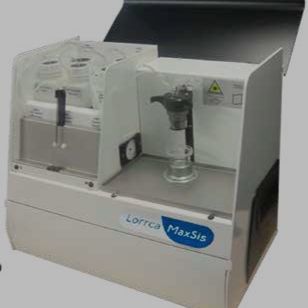
- ¥800000 - 950000
- Lorrca®
- Lorrca
- The Netherlands
- 2026年01月06日

企业认证
相关产品推荐更多 >

万千商家帮你免费找货
0 人在求购买到急需产品
- 详细信息
- 询价记录
- 文献和实验
- 技术资料
- 保修期:
1 year
- 规格:
Lorrca
Laser Optical Rotational Red Cell Analyzer
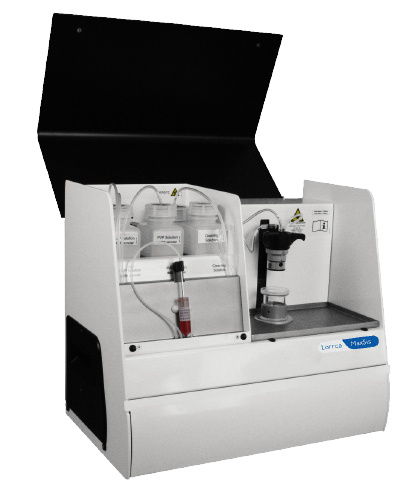
Lorrca Maxsis osmoscan (Lorrca®) is a unique instrument which combines Red Blood Cell (RBC) deformability by ektacytometry, osmoscan and aggregometry; all temperature controlled. It is capable of fully automated measurement and calculation of various phenomena of RBC’s by analysis of their rheological behavior. The technique accurately detects deformability as a function of shear stress, pre-hemolytic stability and aggregation of the RBC’s and is of added value for hematology analysis.
-
Scope
Possible measurements of the instrument
Evaluation of the rheology of blood in different parts of the body is a very specific task, therefore it is important to have a technique available that can accurately measure the RBC properties. Lorrca incorporates a variety of techniques to perform these specific measurements:• Deformability: Laser diffraction ektacytometry, Parameterization of deformation curve, Cell- and cell membrane stability
• Osmoscan: Deformability under an osmotic gradient, Osmotic Resistance Test
• Aggregation & dis-aggregation: Syllectometry – Extent of aggregation, aggregation kinetics and tendency
• Oxygenscan; Measuring the relative oxygen pressure at the critical point the red blood cells start to sickle -
-
Deformability
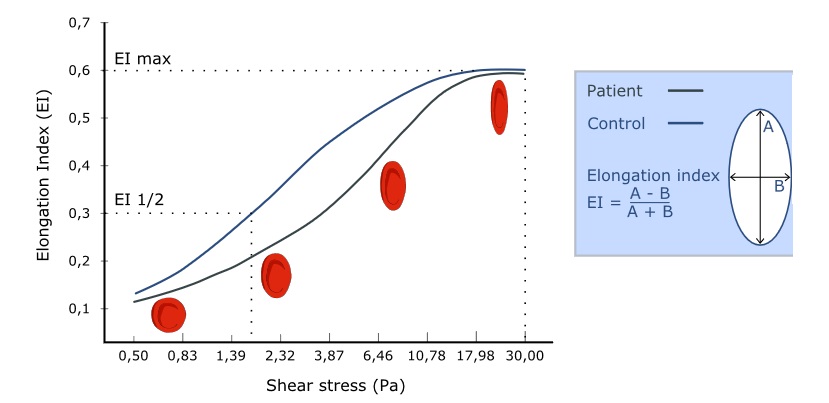
Red blood cell deformability, expressed as the Elongation Index (El), is presented in a deformability curve. A thin layer of RBC’s, suspended in PVP, is sheared between two concentric cylinders. A known shear stress is applied to the cells, resulting in the elongation (deformation) of the RBC’s. This process is measured by a laser beam diffraction pattern; captured with a video camera and analyzed by a computer.
RBC deformability curve
Osmoscan
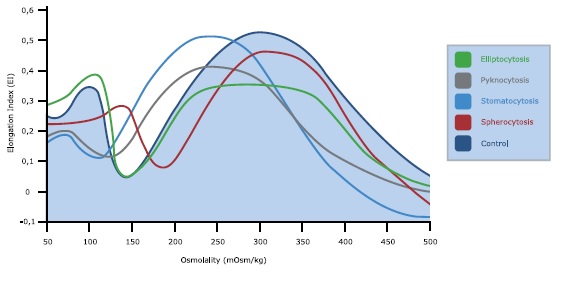
The osmoscan measures the RBC deformability under various osmotic conditions. This results in a continuous curve.
Osmoscan
® Osmoscan" height="292" src="https://img1.dxycdn.com/p/s14/2024/0426/924/2703219283073273871.jpg" width="503">
Typical osmoscan curves
Aggregation & dis-aggregation
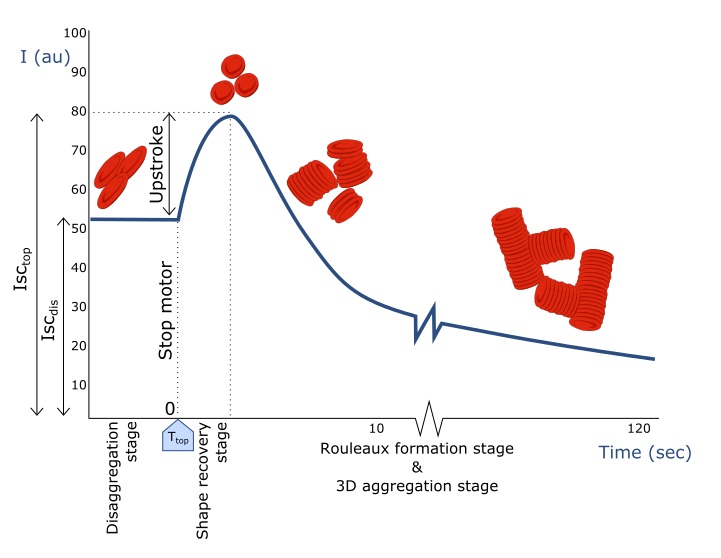
Lorrca measures the speed at which rouleaux formation occurs and is presented in a syllectogram. By means of a photodiode (which measures the change in light absorption) the tendency and kinetics of aggregation are displayed, as well as the minimal shear rate (threshold) needed to prevent RBC aggregation.
RBC Syllectrogram
问:我可以用Lorrca做什么测试?
答: Lorrca激光衍射红细胞变形分析仪 从最小的静脉血测量红细胞 或 红细胞(RBC)在剪切应力下的伸长。
在Lorrca平台上可以进行大量的RBC测量。它测试:
-
红细胞可变形性; 延伸率是剪切应力的函数
-
RBC Osmoscan; 延伸率作为渗透压的函数
-
RBC Oxygenscan; 延伸作为脱氧和随后的复氧的功能
-
红细胞聚集&反聚集; 聚合是时间/剪切速率的函数
问:什么是氧合扫描?
答:氧合扫描是在添加pO2Scan后,可以在Lorrca ektacytometer平台上进行的测量。它测量红细胞在受控脱氧和复氧过程中的伸长。
问:所有的Lorrca仪器都能通过Lorrca Po2Scan进行创新吗?
答:从2012年开始使用的Lorrca MaxSis Osmoscan仪器可以与PO2Scan互补。
问:如果你已经将Lorrca和po2扫描结合起来进行氧合扫描,你还能使用Lorrca进行其他的红细胞检查吗?
答: 是的,当PO2Scan安装在仪器上时,还可以进行变形性测试、渗透测试和聚集&反聚集测试。
问:每次考试需要多长时间?
变形能力测试需要1分钟。渗透扫描测试需要app. 6分钟,氧扫描测试需要app. 20分钟(见Lorrca信息)。
问:Lorrca使用什么类型的血液样本?
答:完整的EDTA或ACD(柠檬酸葡萄糖酸)血样可用于Lorrca检测。
问:我需要在什么时间内验血?
答:这是实验室的规定,要根据试验情况而定。我们建议储存和运输冷冻(2-8°C)的血样。一般情况下,Lorrca检测在抽血后48小时内进行。
问:我正在研究红细胞疾病;Lorrca被用于哪些研究或医学领域?
答:查看研究页面
问:不同测试的样本量是多少?
答:变形能力测试是25 ul血液样本。渗透压试验为200 ul,氧合扫描试验为50 ul(参见Lorrca信息)。
问:Lorrca的监管状况如何?
答:目前,Lorrca只有研究用途(RUO)状态;然而,一些实验室在临床环境中使用Lorrca(例如辛辛那提儿童医院)。我们正在申请CE/IVD和FDA认证。
问:这个仪器在我的实验室里很占地方吗?
答:这个仪器有桌面大小;宽47厘米,高40厘米,高63厘米,深30厘米。
问:仪器的使用是如何安排的?
答:保修期一年有效。
风险提示:丁香通仅作为第三方平台,为商家信息发布提供平台空间。用户咨询产品时请注意保护个人信息及财产安全,合理判断,谨慎选购商品,商家和用户对交易行为负责。对于医疗器械类产品,请先查证核实企业经营资质和医疗器械产品注册证情况。
- 作者
- 内容
- 询问日期
 文献和实验
文献和实验测量红细胞的变形性是临床血液流变学的一项重要指标,最常用的测量方法是微孔滤膜筛滤法和激光衍射法。这些方法测出的是大量红细胞的平均结果。但是,在微循环中即使只有2~3%的红细胞变形性很差,也会严重影响红细胞通过毛细血管的流动。早在80年代中期,国际血液学标准化委员会血液流变学专家组“关于血液粘度及红细胞变形性测定的指导意见”中就指出:“这种少数的异常细胞对于体内血液有不成比例的作用,它在体外孔道滤过实验中也可能对结果有决定性的影响。为了研究红细胞变形性的这一方面问题,有必要发展相应的仪器
【参考值】 微孔滤过法(亦称微孔筛法):各试验室有不同正常值,各试验室应建立自己正常值。 粘度测量法:TK值为0.93±0.11,TK为红细胞硬度指标。根据所用粘度计不同,各试验室应建立自己正常值。 激光衍射法(BL-88-B型)微机电脑测定:DI(红细胞变形指数)0.35~0.45、目测测定:0.45~0.55.根据仪器型号厂家不同,各试验室应建立自己正常值医学教育网搜集|整理。 【临床意义】 红细胞变形性是指红细胞在外力作用下,改变自身形态的能力。红细胞变形能力对血流
红细胞变形性测定的参考值及临床意义是医学检验技士考试所涉及的内容,医学教育|网整理如下,供广大医学检验技士考试考生参考学习。 微孔滤过法(亦称微孔筛法):各试验室有不同正常值,各试验室应建立自己正常值。 粘度测量法:TK值为0.93±0.11,TK为红细胞硬度指标。根据所用粘度计不同,各试验室应建立自己正常值。 激光衍射法(BL-88-B型)微机电脑测定:DI(红细胞变形指数)0.35~0.45、目测测定:0.45~0.55.根据仪器型号厂家不同,各试验室应建立
 技术资料
技术资料需要更多技术资料 索取更多技术资料