


- ¥1900
- Biorigin
- BN40730R
- 2026年02月01日
- WB,
- Human,Mouse,Rat,Pig,Cow,Horse,Rabbit,

企业认证
相关产品推荐更多 >
万千商家帮你免费找货
0 人在求购买到急需产品
- 详细信息
- 文献和实验
- 技术资料
- 适应物种:
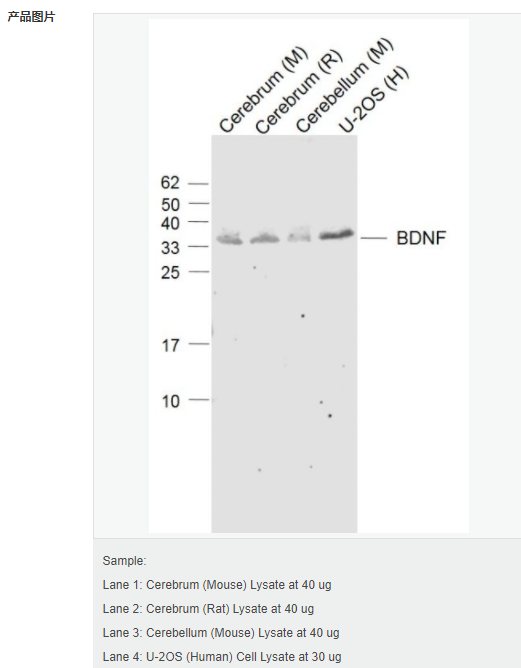
Human,Mouse,Rat,Pig,Cow,Horse,Rabbit,
- 应用范围:
WB,
- 抗体英文名:
BDNF
- 规格:
100ul
| 英文名称 | BDNF |
| 中文名称 | 脑源神经营养因子抗体 |
| 别 名 | Abrineurin; BDNF; BDNF; BDNF_HUMAN; Brain Derived Neurotrophic Factor; Brain-derived neurotrophic factor; MGC34632; MGC34632; Neurotrophin. |
| 研究领域 | 细胞生物 神经生物学 信号转导 生长因子和激素 转录调节因子 细胞因子 |
| 抗体来源 | Rabbit |
| 克隆类型 | Polyclonal |
| 交叉反应 | Human, Mouse, Rat, (predicted: Pig, Cow, Horse, Rabbit, ) |
| 产品应用 | WB=1:500-2000 ELISA=1:5000-10000 IHC-P=1:100-500 IHC-F=1:100-500 ICC=1:100-500 IF=1:100-500 (石蜡切片需做抗原修复) not yet tested in other applications. optimal dilutions/concentrations should be determined by the end user. |
| 分 子 量 | 13/27kDa |
| 细胞定位 | 细胞核 分泌型蛋白 |
| 性 状 | Liquid |
| 浓 度 | 1mg/ml |
| 免 疫 原 | Recombinded human BDNF protein:129-247/247 |
| 亚 型 | IgG |
| 纯化方法 | affinity purified by Protein A |
| 储 存 液 | 0.01M TBS(pH7.4) with 1% BSA, 0.03% Proclin300 and 50% Glycerol. |
| 保存条件 | Shipped at 4℃. Store at -20 °C for one year. Avoid repeated freeze/thaw cycles. |
| PubMed | PubMed |
| 产品介绍 | Neurotrophins function to regulate naturally occurring cell death of neurons during development. The prototype neurotrophin is nerve growth factor (NGF), originally discovered in the 1950s as a soluble peptide promoting the survival of, and neurite outgrowth from, sympathetic ganglia. More recently, three additional structurally homologous neurotrophic factors have been identified. These include brain-derived neurotrophic factor (BDNF), neurotrophin-3 (NT-3) and neurotrophin-4 (NT-4), also designated NT-5. These various neurotrophins stimulate the in vitro survival of distinct but partially overlapping populations of neurons. The Trk A receptor is the preferential receptor for NGF, but also binds NT-3 and NT-4. The Trk B receptor binds equally well to both BDNF and NT-4 and to a lesser extent NT-3, while the Trk C receptor only binds NT-3. BDNF promotes the survival of neuronal populations that are all located either in the central nervous system or directly connected to it. Belongs to the NGF-beta family. Function: During development, promotes the survival and differentiation of selected neuronal populations of the peripheral and central nervous systems. Participates in axonal growth, pathfinding and in the modulation of dendritic growth and morphology. Major regulator of synaptic transmission and plasticity at adult synapses in many regions of the CNS. The versatility of BDNF is emphasized by its contribution to a range of adaptive neuronal responses including long-term potentiation (LTP), long-term depression (LTD), certain forms of short-term synaptic plasticity, as well as homeostatic regulation of intrinsic neuronal excitability. Subunit: Monomers and homodimers. Binds to NTRK2/TRKB. Subcellular Location: Secreted. Tissue Specificity: Brain. Highly expressed in hippocampus, amygdala, cerebral cortex and cerebellum. Also expressed in heart, lung, skeletal muscle, testis, prostate and placenta. Post-translational modifications: The propeptide is N-glycosylated and glycosulfated. DISEASE: Defects in BDNF are a cause of congenital central hypoventilation syndrome (CCHS) [MIM:209880]; also known as congenital failure of autonomic control or Ondine curse. CCHS is a rare disorder characterized by abnormal control of respiration in the absence of neuromuscular or lung disease, or an identifiable brain stem lesion. A deficiency in autonomic control of respiration results in inadequate or negligible ventilatory and arousal responses to hypercapnia and hypoxemia. CCHS is frequently complicated with neurocristopathies such as Hirschsprung disease that occurs in about 16% of CCHS cases. Similarity: Belongs to the NGF-beta family. SWISS: P23560 Gene ID: 627 Database links: Entrez Gene: 627 Human Entrez Gene: 12064 Mouse Omim: 113505 Human SwissProt: P23560 Human SwissProt: P21237 Mouse Unigene: 502182 Human Unigene: 1442 Mouse Unigene: 11266 Rat Important Note: This product as supplied is intended for research use only, not for use in human, therapeutic or diagnostic applications. |
风险提示:丁香通仅作为第三方平台,为商家信息发布提供平台空间。用户咨询产品时请注意保护个人信息及财产安全,合理判断,谨慎选购商品,商家和用户对交易行为负责。对于医疗器械类产品,请先查证核实企业经营资质和医疗器械产品注册证情况。
 文献和实验
文献和实验Sci Adv:湘雅戴茹萍团队揭示 proBDNF 信号在系统性红斑狼疮中的作用
重要致病以及干预靶点作用。 戴茹萍教授课题组一直致力于脑源性神经营养因子前体(Bain-derived neurotrophic factor precursor, proBDNF)的免疫功能研究。以往 proBDNF 被认为在神经系统中发挥作用,课题组前期研究开拓性地发现 proBDNF 介导多种免疫炎症性疾病发生发展,包括脓毒症相关脑病 (Journal of Neuroinflammmation, 2020)、主动脉夹层疾病 (FASEB J, 2020) 和多发
脂肪燃烧的指令从哪里来?Nature 揭示神经免疫互作如何与
-mesenchymal units control ILC2 and obesity via a brain–adipose circuit 的研究性文章。通过一系列复杂的实验,研究人员报道了一种神经-间充质单元,它可以通过脑-脂肪回路调控 ILC2s、脂肪组织生理学、代谢和肥胖。首次将神经系统与肥胖相关的免疫功能联系在一起,为将来减少内脏脂肪提供了新的治疗途径。图片来源:Nature主要研究内容神经-间充质单元调控脂肪 ILC2s首先,研究人员对小鼠的内脏脂肪进行了观察,发现其存在以酪氨酸羟化酶表达为特征的致密
人神经营养因子3 (NT -3 ) 酶联免疫分析(ELISA ) 试剂盒使用说明书 本试剂仅供研究使用 目的:本试剂盒用于测定人血清,血浆及相关液体样本中 神经营养因子3 (NT -3 ) 的 含量。 实验原理: 本试剂盒应用双抗体夹心法测定标本中 人 脑源性神经营养因子(BDNF ) 水平。用纯化的 抗 - 脑源性神经营养因子(BDNF ) 抗体包被微孔板,制成固相抗体,往包被单抗的微孔中依次
 技术资料
技术资料暂无技术资料 索取技术资料

