

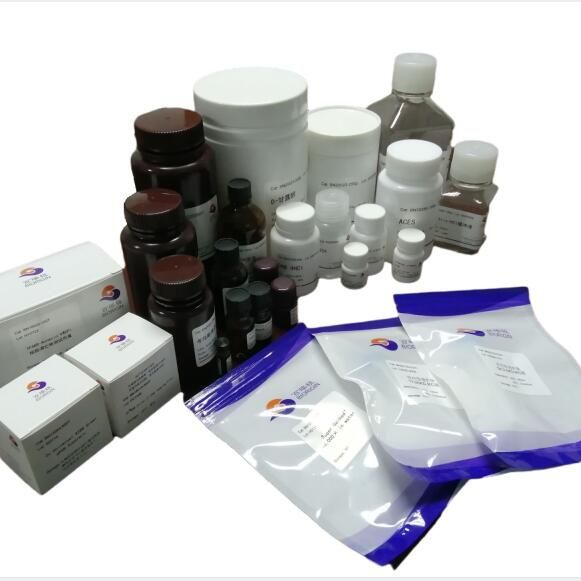
- ¥1900
- Biorigin
- BN40592R
- 2025年12月09日
- WB,
- Human,

企业认证
相关产品推荐更多 >

万千商家帮你免费找货
0 人在求购买到急需产品
- 详细信息
- 文献和实验
- 技术资料
- 适应物种:
Human,
- 应用范围:
WB,
- 抗体英文名:
LYVE-1
- 规格:
100ul
| 英文名称 | LYVE-1 |
| 中文名称 | 淋巴管内皮透明质酸受体抗体 |
| 别 名 | LYVE1; lymphalic vessel endotheilial hyaluronan receptor 1; CRSBP 1; CRSBP1; extracellular link domain containing 1; extracellular link domain-containing 1; HAR; hyaluronic acid receptor; Cell surface retention sequence-binding protein 1; CRSBP-1; extracellular link domain-containing 1; Extracellular link domain-containing protein 1; Lymphatic vessel endothelial hyaluronic acid receptor 1; LYVE1_MOUSE; Lymphatic endothelium specific hyaluronan receptor; LYVE 1; LYVE-1; XLKD1. |
| 研究领域 | 心血管 细胞生物 免疫学 细胞类型标志物 |
| 抗体来源 | Rabbit |
| 克隆类型 | Polyclonal |
| 交叉反应 | Human, Mouse, |
| 产品应用 | WB=1:500-2000 ELISA=1:5000-10000 not yet tested in other applications. optimal dilutions/concentrations should be determined by the end user. |
| 分 子 量 | 32kDa |
| 细胞定位 | 细胞膜 细胞外基质 |
| 性 状 | Liquid |
| 浓 度 | 1mg/ml |
| 免 疫 原 | KLH conjugated synthetic peptide derived from human LYVE-1:141-250/322 <Extracellular> |
| 亚 型 | IgG |
| 纯化方法 | affinity purified by Protein A |
| 储 存 液 | Preservative: 15mM Sodium Azide, Constituents: 1% BSA, 0.01M PBS, pH 7.4 |
| 保存条件 | Shipped at 4℃. Store at -20 °C for one year. Avoid repeated freeze/thaw cycles. |
| PubMed | PubMed |
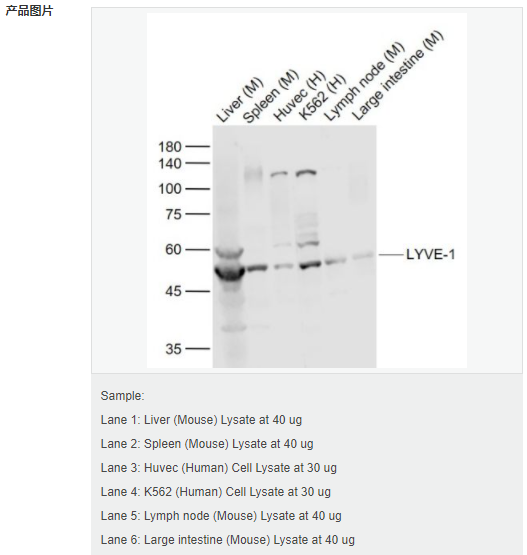
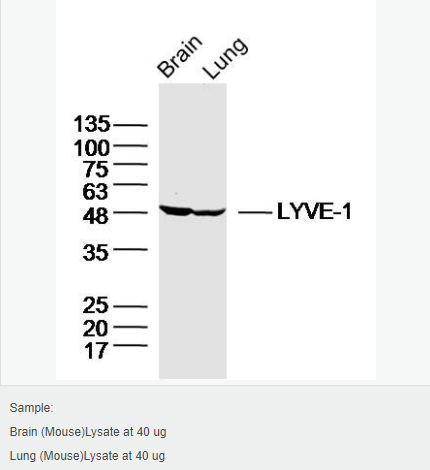
| 产品介绍 | The lymphatic vasculature forms a second circulatory system that drains extracellular fluid from the tissues and provides an exclusive environment in which immune cells can encounter and respond to foreign antigen. Recently a number of interesting molecules have been identified that may be exploited as markers for lymphatic endothelium, including the hyaluronan receptor LYVE1, PALE, VEGFR3, podoplanin. LYVE1 has been identified as a major receptor for HA (extracellular matrix glycosaminoglycan hyaluronan) on the lymph vessel wall. The deduced amino acid sequence of LYVE1 predicts a 322-residue type I integral membrane polypeptide 41% similar to the CD44 HA receptor with a 212-residue extracellular domain containing a single Link module the prototypic HA binding domain of the Link protein superfamily. Like CD44, the LYVE1 molecule binds both soluble and immobilized HA. However, unlike CD44, the LYVE1 molecule colocalizes with HA on the luminal face of the lymph vessel wall and is completely absent from blood vessels. Hence, LYVE1 is the first lymph-specific HA receptor to be characterized and is a uniquely powerful marker for lymph vessels themselves. Function: Ligand-specific transporter trafficking between intracellular organelles (TGN) and the plasma membrane. Plays a role in autocrine regulation of cell growth mediated by growth regulators containing cell surface retention sequence binding (CRS). May act as an hyaluronan (HA) transporter, either mediating its uptake for catabolism within lymphatic endothelial cells themselves, or its transport into the lumen of afferent lymphatic vessels for subsequent re-uptake and degradation in lymph nodes. Subunit: Homodimer; disulfide-linked. Interacts with PDGFB and IGFBP3. Forms a transient ternary complex with PDGFB and PDGFRB in TGN. Subcellular Location: Membrane; Single-pass type I membrane protein. Note=Localized to the plasma membrane and in vesicles near extranuclear membranes which may represent trans-Golgi network (TGN) and endosomes/prelysosomeal compartments. Undergoes ligand-dependent internalization and recycling at the cell surface. Post-translational modifications: O-glycosylated. Similarity: Contains 1 Link domain. SWISS: Q9Y5Y7 Gene ID: 114332 Database links: Entrez Gene: 10894 Human Entrez Gene: 114332 Mouse Omim: 605702 Human SwissProt: Q9Y5Y7 Human SwissProt: Q8BHC0 Mouse Unigee: 246769 Human Unigene: 655332 Human Unigene: 396078 Mouse Important Note: This product as supplied is intended for research use only, not for use in human, therapeutic or diagnostic applications. 淋巴管标志物 LYVE-1是一种特异性氨基葡聚糖透明质酸受体,均匀分布在淋巴管的管腔面和基底膜,目前多用于肿瘤淋巴转移方面的研究。 淋巴管内皮细胞透明质酸受体1(LYVE1)LYVE1是位于淋巴管内皮细胞上的含有322个氨基酸残基的膜蛋白。与CD44糖蛋白同源,均匀分布于淋巴管内外腔面,可与细胞外基质的葡萄糖胺聚糖透明质酸结合,具有从组织摄取透明质酸盐并转运至淋巴液的作用。 |
风险提示:丁香通仅作为第三方平台,为商家信息发布提供平台空间。用户咨询产品时请注意保护个人信息及财产安全,合理判断,谨慎选购商品,商家和用户对交易行为负责。对于医疗器械类产品,请先查证核实企业经营资质和医疗器械产品注册证情况。
 文献和实验
文献和实验内保护细菌生长繁殖的能力,因此,与侵袭力有关。 (三)鼠毒素(Murine toxin) 鼠疫杆菌产生的外毒素(毒性蛋白质),主要作用是抑制辅酶还原,损害心肌细胞内线粒体呼吸,毒害末稍血管系统及淋巴管内皮细胞,造成血压下降及休克,又可使肝、肾及心肌组织变性、出血、坏死。鼠毒素抗原性强,可制成类毒素。 (四)内毒素 与一般革兰氏阴性杆菌的内毒素性质相同,但毒性较强,耐热,能引起发热、弥漫性血管内凝血,和中毒性休克。 (五)杀菌素(Pesticin I) 有杀死其他菌的作用,侵袭
作用,并有在细胞内保护细菌生长繁殖的能力,因此,与侵袭力有关。 (三)鼠毒素(Murine toxin)鼠疫杆菌产生的外毒素(毒性蛋白质),主要作用是抑制辅酶还原,损害心肌细胞内线粒体呼吸,毒害末稍血管系统及淋巴管内皮细胞,造成血压下降及休克,又可使肝、肾及心肌组织变性、出血、坏死。鼠毒素抗原性强,可制成类毒素。 (四)内毒素与一般革兰氏阴性杆菌的内毒素性质相同,但毒性较强,耐热,能引起发热、弥漫性血管内凝血,和中毒性休克。 (五)杀菌素(Pesticin I)有杀死其他菌的作用,侵袭
 技术资料
技术资料暂无技术资料 索取技术资料

