

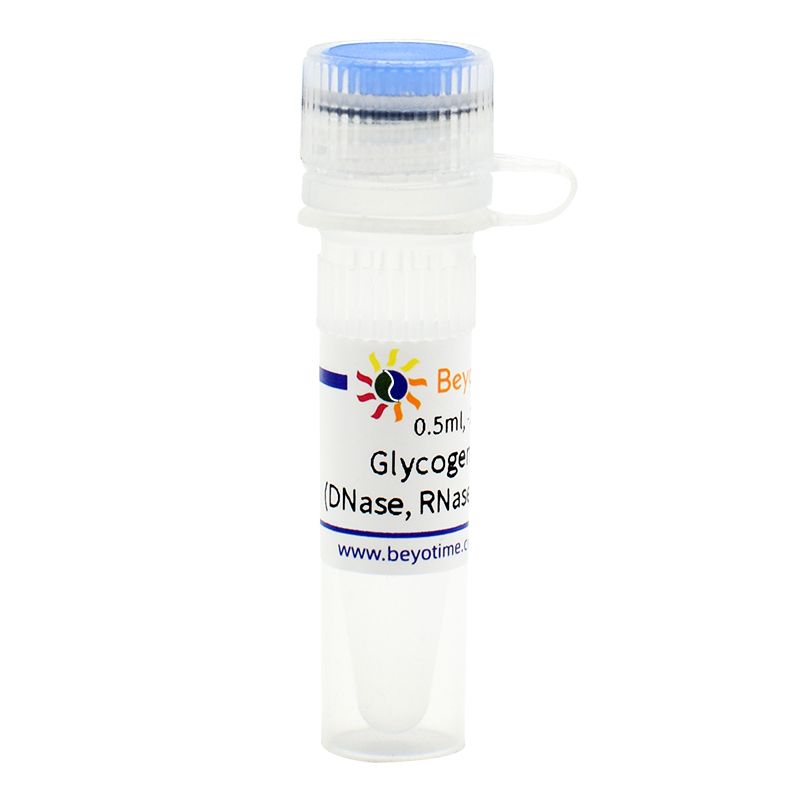
- ¥651 - 9622
- 碧云天(beyotime)

- D0816
- 2026年01月22日

企业认证
相关产品推荐更多 >


万千商家帮你免费找货
0 人在求购买到急需产品
- 详细信息
- 文献和实验
- 技术资料
- 规格:
0.5ml/2ml/10ml
| 规格: | 0.5ml | 产品价格: | ¥651.0 |
|---|---|---|---|
| 规格: | 2ml | 产品价格: | ¥2265.0 |
| 规格: | 10ml | 产品价格: | ¥9622.0 |
| 产品编号 | 产品名称 | 产品包装 | 产品价格 |
| D0816-0.5ml | Glycogen (DNase, RNase & Protease free) | 0.5ml | 651.00元 |
| D0816-2ml | Glycogen (DNase, RNase & Protease free) | 2ml | 2265.00元 |
| D0816-10ml | Glycogen (DNase, RNase & Protease free) | 10ml | 9622.00元 |
本产品为分子生物学级Glycogen(糖原),来源为牡蛎糖原,即oyster glycogen。不含DNase,不含RNase,不含蛋白酶,可以用作沉淀DNA或RNA的辅助沉淀剂(used as a carrier for the precipitation of DNA or RNA)。
本产品经过了严格的DNase, RNase & Protease free质检,确保没有DNase、RNase和蛋白酶污染。
作为DNA或RNA的辅助沉淀剂,大多数情况下glycogen比tRNA或超声处理过的DNA效果更好。由于glycogen中不含DNA和RNA,因此用glycogen作为辅助沉淀剂沉淀下来的核酸更适合于后续的PCR、RT-PCR以及内切酶等核酸酶反应。而tRNA或超声处理过的DNA作为辅助沉淀剂有时会干扰PCR、RT-PCR以及内切酶等核酸酶反应。
据文献报道,连接反应产物用glycogen沉淀后对于后续的细菌转化没有干扰,0.001mg/ml glycogen不会抑制TdT,浓度不大于2mg/ml的glycogen不会影响反转录酶的活力,0.02mg/ml glycogen不会抑制T4 RNA ligase。Glycogen会干扰DNA和蛋白的相互作用。
通常1微升Glycogen (20mg/ml)即可把少至皮克(pg)级的DNA或RNA从1毫升的溶液体系中沉淀出来。0.5ml、2ml、10ml包装的本产品至少足够沉淀500个,2000个,10000个常规量的DNA或RNA样品。
包装清单:| 产品编号 | 产品名称 | 包装 |
| D0816-0.5ml | Glycogen (20mg/ml, DNase, RNase & Protease free) | 0.5ml |
| D0816-2ml | Glycogen (20mg/ml, DNase, RNase & Protease free) | 2ml |
| D0816-10ml | Glycogen (20mg/ml, DNase, RNase & Protease free) | 10ml |
| — | 说明书 | 1份 |
-20℃保存,至少一年有效。
注意事项:通常每个样品加入1微升Glycogen (20mg/ml)即可,对于已知糖原可能对后续反应有干扰的情况,可以适当减少糖原用量,或使用tRNA等作为辅助沉淀剂。
本产品仅限于专业人员的科学研究用,不得用于临床诊断或治疗,不得用于食品或药品,不得存放于普通住宅内。
为了您的安全和健康,请穿实验服并戴一次性手套操作。
风险提示:丁香通仅作为第三方平台,为商家信息发布提供平台空间。用户咨询产品时请注意保护个人信息及财产安全,合理判断,谨慎选购商品,商家和用户对交易行为负责。对于医疗器械类产品,请先查证核实企业经营资质和医疗器械产品注册证情况。
 文献和实验
文献和实验Ribonuclease A (RNase A), DNase-free
FeatureThe RNase A is free of DNase activity. It is not necessary to heat it before use.DescriptionThe Ribonuclease A (RNase A) is an endoribonuclease that specifically degrades single-stranded RNA at C and U residues. It cleaves the phosphodiester
Preparation of RNase-Free DNase by Alkylation
with electrophoresis. DNase treatment makes the mixture more soluble, even if DNA degradation is only partial.
Clonality - X Chromosome Inactivation Assay
can utilize X chromosome inactivation (methylation) to determine the clonality status of a tumor or premalignant lesion in females. The technique is based on a methylation-sensitive restriction enzyme and analysis of a polymorphic locus on the X chromosome


