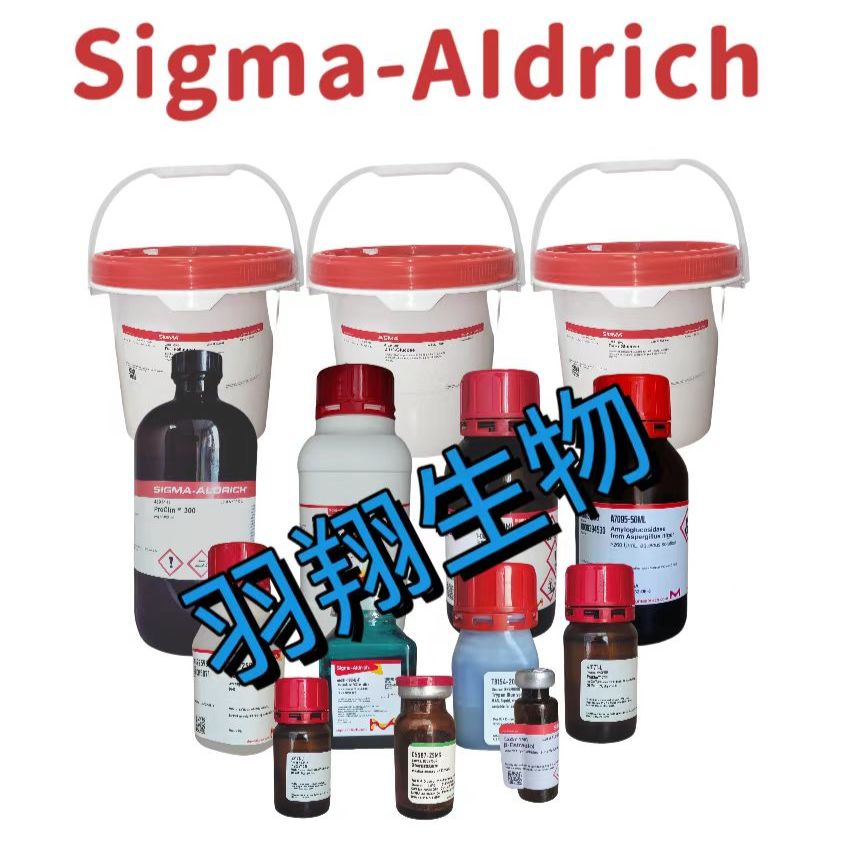
- ¥2032
- Sigma-Aldrich
- 进口
- T2577-25MG
- 2025年08月19日

企业认证
相关产品推荐更多 >
万千商家帮你免费找货
0 人在求购买到急需产品
- 详细信息
- 文献和实验
- 技术资料
- 保存条件:
2-8°C
- 保质期:
根据瓶身LOT号查询
- 英文名:
Temozolomide
- 库存:
有现货
- 供应商:
浙江羽翔生物科技有限公司
- CAS号:
85622-93-1
- 规格:
25MG
属性
Product Name
替莫唑胺, ≥98% (HPLC)
质量水平
100
方案
≥98% (HPLC)
表单
powder
颜色
white to light brown
溶解性
DMSO: 10 mg/mL, clear
H2O: insoluble
创始人
Schering Plough
储存温度
2-8°C
SMILES字符串
CN1N=Nc2c(ncn2C1=O)C(N)=O
InChI
1S/C6H6N6O2/c1-11-6(14)12-2-8-3(4(7)13)5(12)9-10-11/h2H,1H3,(H2,7,13)
InChI key
BPEGJWRSRHCHSN-UHFFFAOYSA-N
说明
一般描述
应用
生化/生理作用
制备说明
风险提示:丁香通仅作为第三方平台,为商家信息发布提供平台空间。用户咨询产品时请注意保护个人信息及财产安全,合理判断,谨慎选购商品,商家和用户对交易行为负责。对于医疗器械类产品,请先查证核实企业经营资质和医疗器械产品注册证情况。
 文献和实验
文献和实验Bevacizumab plus radiotherapy-temozolomide for newly diagnosed glioblastoma.
Standard therapy for newly diagnosed glioblastoma is radiotherapy plus temozolomide. In this phase 3 study, we evaluated the effect of the addition of bevacizumab to radiotherapy-temozolomide for the treatment of newly diagnosed glioblastoma. We randomly assigned patients with supratentorial glioblastoma to receive intravenous bevacizumab (10 mg per kilogram of body weight every 2 weeks) or placebo, plus radiotherapy (2 Gy 5 days a week; maximum, 60 Gy) and oral temozolomide (75 mg per square meter of body-surface area per day) for 6 weeks. After a 28-day treatment break, maintenance bevacizumab (10 mg per kilogram intravenously every 2 weeks) or placebo, plus temozolomide (150 to 200 mg per square meter per day for 5 days), was continued for six 4-week cycles, followed by bevacizumab monotherapy (15 mg per kilogram intravenously every 3 weeks) or placebo until the disease progressed or unacceptable toxic effects developed. The coprimary end points were investigator-assessed progression-free survival and overall survival. A total of 458 patients were assigned to the bevacizumab group, and 463 patients to the placebo group. The median progression-free survival was longer in the bevacizumab group than in the placebo group (10.6 months vs. 6.2 months; stratified hazard ratio for progression or death, 0.64; 95% confidence interval [CI], 0.55 to 0.74; P<0.001). The benefit with respect to progression-free survival was observed across subgroups. Overall survival did not differ significantly between groups (stratified hazard ratio for death, 0.88; 95% CI, 0.76 to 1.02; P=0.10). The respective overall survival rates with bevacizumab and placebo were 72.4% and 66.3% at 1 year (P=0.049) and 33.9% and 30.1% at 2 years (P=0.24). Baseline health-related quality of life and performance status were maintained longer in the bevacizumab group, and the glucocorticoid requirement was lower. More patients in the bevacizumab group than in the placebo group had grade 3 or higher adverse events (66.8% vs. 51.3%) and grade 3 or higher adverse events often associated with bevacizumab (32.5% vs. 15.8%). The addition of bevacizumab to radiotherapy-temozolomide did not improve survival in patients with glioblastoma. Improved progression-free survival and maintenance of baseline quality of life and performance status were observed with bevacizumab; however, the rate of adverse events was higher with bevacizumab than with placebo. (Funded by F. Hoffmann-La Roche; ClinicalTrials.gov number, NCT00943826.).
 技术资料
技术资料暂无技术资料 索取技术资料