

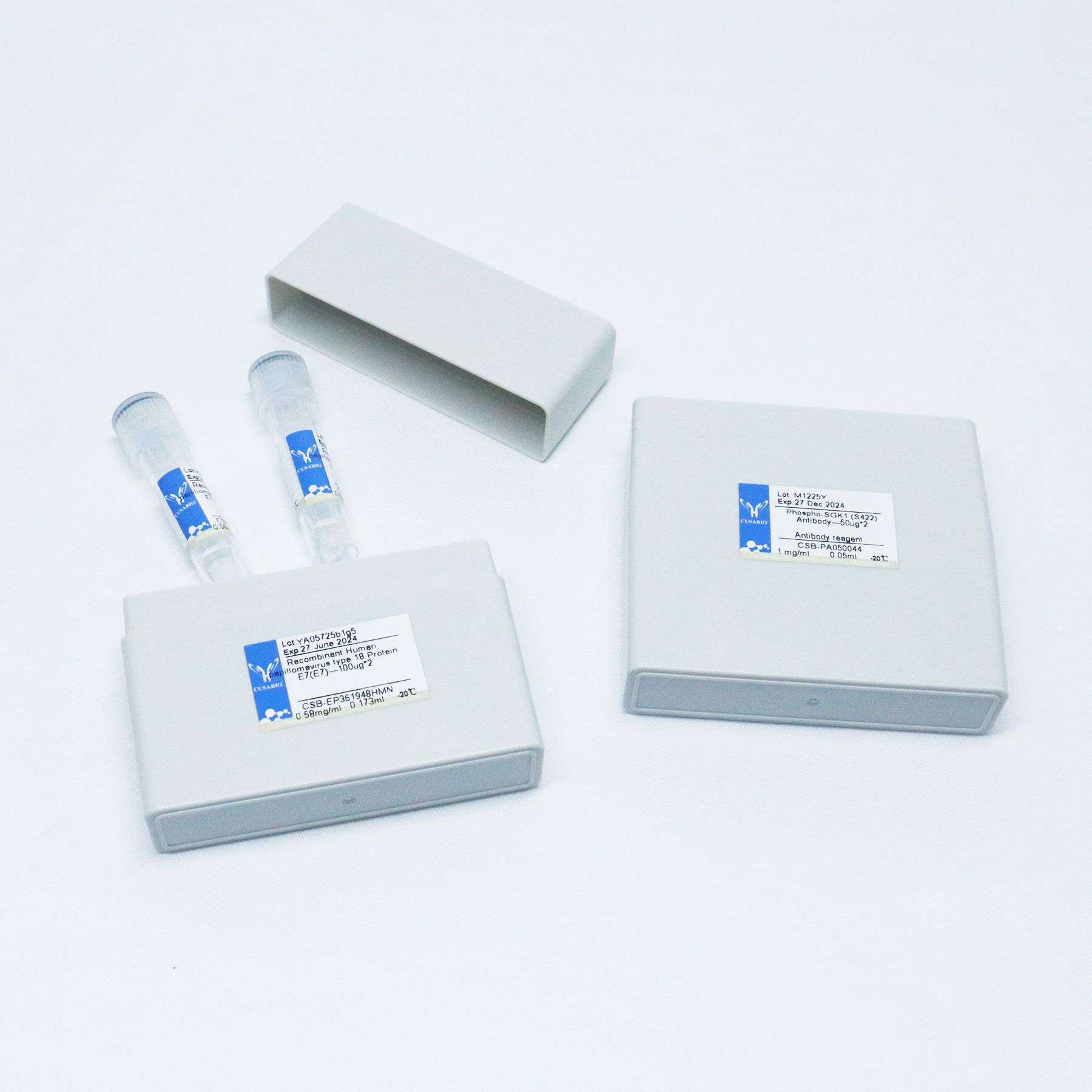
果蝇RpII215重组蛋白DNA-directed RNA
polymerase III largest subunitDrosophila melanogaster DNA-directed RNA polymerase II subunit RPB1(RpII215)蛋白- ¥2616
- CUSABIO

- CN
- CSB-YP018327DLU
- 2026年01月20日

企业认证
相关产品推荐更多 >

Recombinant-Human-ADP-ribosylation-factor-like-protein-6-interacting-protein-1ARL6IP1ADP-ribosylation factor-like protein 6-interacting protein 1; ARL-6-interacting protein 1; Aip-1
¥10584
Recombinant-Vampyressa-melissa-NADH-ubiquinone-oxidoreductase-chain-4LMT-ND4LNADH-ubiquinone oxidoreductase chain 4L EC= 1.6.5.3 Alternative name(s): NADH dehydrogenase subunit 4L
¥9646
Recombinant-Xanthomonas-axonopodis-pv-citri-Membrane-protein-insertase-YidCyidCMembrane protein insertase YidC Alternative name(s): Foldase YidC Membrane integrase YidC Membrane protein YidC
¥13888![Fxn/Fxn蛋白/FxnFrataxin; mitochondrial; Fxn; EC 1.16.3.1) [Cleaved into: Frataxin intermediate form; Frataxin mature form]蛋白/Recombinant Rat Frataxin, mitochondrial (Fxn)重组蛋白](https://img1.dxycdn.com/p/s14/2024/0807/676/2114596367123901281.jpg!wh200)
Fxn/Fxn蛋白/FxnFrataxin; mitochondrial; Fxn; EC 1.16.3.1) [Cleaved into: Frataxin intermediate form; Frataxin mature form]蛋白/Recombinant Rat Frataxin, mitochondrial (Fxn)重组蛋白
¥69
Recombinant-Human-Olfactory-receptor-11A1OR11A1Olfactory receptor 11A1 Alternative name(s): Hs6M1-18 Olfactory receptor 11A2 Olfactory receptor OR6-30
¥11578
万千商家帮你免费找货
0 人在求购买到急需产品
相关阅读
细胞污染识别与处理全攻略:5 种常见类型+关键误区Cytoscape 教程来了!快速实现顶刊同款通路网络图五大应用案例:Mustang Q 膜层析应用全解析1 个小工具,一次性搞定流程图、质粒图谱和信号通路图- 详细信息
- 文献和实验
- 技术资料
- 保存条件:
We recommend to add 5-50% of glycerol (final concentration) and aliquot for long-term storage at -20℃/-80℃.
- 保质期:
Generally, the shelf life of liquid form is 6 months at -20℃/-80℃. The shelf life of lyophilized form is 12 months at -20℃/-80℃.
- 英文名:
Recombinant Drosophila melanogaster DNA-directed RNA polymerase II subunit RPB1 (RpII215), partial
- 库存:
200
- 供应商:
武汉华美生物工程有限公司
- 规格:
20μg
英文名称:
Recombinant Drosophila melanogaster DNA-directed RNA polymerase II subunit RPB1 (RpII215), partial品名简称:
Recombinant Drosophila melanogaster RpII215 protein, partial货号:
CSB-YP018327DLU规格:
20μg价格:
2616LC-MS/Western Blot:
/SDS-PAGE:
(Tris-Glycine gel) Discontinuous SDS-PAGE (reduced) with 5% enrichment gel and 15% separation gel.纯度:
Greater than 90% as determined by SDS-PAGE.内毒素:
Not test生物活性:
/基因名:
RpII215Uniprot No.:
P04052别名:
DNA-directed RNA polymerase III largest subunit种属:
Drosophila melanogaster (Fruit fly)蛋白长度:
Partial来源:
Yeast分子量:
33.6 kDa表达区域:
1579-1881aa氨基酸序列:
YSPTSPNYTASSPGGASPNYSPSSPNYSPTSPLYASPRYASTTPNFNPQSTGYSPSSSGYSPTSPVYSPTVQFQSSPSFAGSGSNIYSPGNAYSPSSSNYSPNSPSYSPTSPSYSPSSPSYSPTSPCYSPTSPSYSPTSPNYTPVTPSYSPTSPNYSASPQYSPASPAYSQTGVKYSPTSPTYSPPSPSYDGSPGSPQYTPGSPQYSPASPKYSPTSPLYSPSSPQHSPSNQYSPTGSTYSATSPRYSPNMSIYSPSSTKYSPTSPTYTPTARNYSPTSPMYSPTAPSHYSPTSPAYSPSSPT蛋白标签:
N-terminal 6xHis-tagged产品提供形式:
Liquid or Lyophilized powder缓冲液:
If the delivery form is liquid, the default storage buffer is Tris/PBS-based buffer, 5%-50% glycerol. If the delivery form is lyophilized powder, the buffer before lyophilization is Tris/PBS-based buffer, 6% Trehalose, pH 8.0.储存条件:
We recommend that this vial be briefly centrifuged prior to opening to bring the contents to the bottom. Please reconstitute protein in deionized sterile water to a concentration of 0.1-1.0 mg/mL.We recommend to add 5-50% of glycerol (final concentration) and aliquot for long-term storage at -20℃/-80℃. Our default final concentration of glycerol is 50%. Customers could use it as reference.保质期:
The shelf life is related to many factors, storage state, buffer ingredients, storage temperature and the stability of the protein itself. Generally, the shelf life of liquid form is 6 months at -20℃/-80℃. The shelf life of lyophilized form is 12 months at -20℃/-80℃.货期:
3-7 business days注意事项:
Repeated freezing and thawing is not recommended. Store working aliquots at 4℃ for up to one week.功能1:
DNA-dependent RNA polymerase catalyzes the transcription of DNA into RNA using the four ribonucleoside triphosphates as substrates. Largest and catalytic component of RNA polymerase II which synthesizes mRNA precursors and many functional non-coding RNAs. Forms the polymerase active center together with the second largest subunit. Pol II is the central component of the basal RNA polymerase II transcription machinery. It is composed of mobile elements that move relative to each other. RPB1 is part of the core element with the central large cleft, the clamp element that moves to open and close the cleft and the jaws that are thought to grab the incoming DNA template. At the start of transcription, a single-stranded DNA template strand of the promoter is positioned within the central active site cleft of Pol II. A bridging helix emanates from RPB1 and crosses the cleft near the catalytic site and is thought to promote translocation of Pol II by acting as a ratchet that moves the RNA-DNA hybrid through the active site by switching from straight to bent conformations at each step of nucleotide addition. During transcription elongation, Pol II moves on the template as the transcript elongates. Elongation is influenced by the phosphorylation status of the C-terminal domain (CTD) of Pol II largest subunit (RPB1), which serves as a platform for assembly of factors that regulate transcription initiation, elongation, termination and mRNA processing功能2:
DNA-dependent RNA polymerase catalyzes the transcription of DNA into RNA using the four ribonucleoside triphosphates as substrates. Largest and catalytic component of RNA polymerase II which synthesizes mRNA precursors and many functional non-coding RNAs. Forms the polymerase active center together with the second largest subunit. Pol II is the central component of the basal RNA polymerase II transcription machinery. It is composed of mobile elements that move relative to each other. RPB1 is part of the core element with the central large cleft, the clamp element that moves to open and close the cleft and the jaws that are thought to grab the incoming DNA template. At the start of transcription, a single-stranded DNA template strand of the promoter is positioned within the central active site cleft of Pol II. A bridging helix emanates from RPB1 and crosses the cleft near the catalytic site and is thought to promote translocation of Pol II by acting as a ratchet that moves the RNA-DNA hybrid through the active site by switching from straight to bent conformations at each step of nucleotide addition. During transcription elongation, Pol II moves on the template as the transcript elongates. Elongation is influenced by the phosphorylation status of the C-terminal domain (CTD) of Pol II largest subunit (RPB1), which serves as a platform for assembly of factors that regulate transcription initiation, elongation, termination and mRNA processing (By similarity).文献:
"Analysis of the gene encoding the largest subunit of RNA polymerase II in Drosophila."Jokerst R.S., Weeks J.R., Zehring W.A., Greenleaf A.L.Mol. Gen. Genet. 215:266-275(1989)研究领域:
Others请点击“在线询价”找客服索取产品说明书及引用文献目录,产品实时更新参数、价格信息、更多文献信息可以查看cusabio官网
风险提示:丁香通仅作为第三方平台,为商家信息发布提供平台空间。用户咨询产品时请注意保护个人信息及财产安全,合理判断,谨慎选购商品,商家和用户对交易行为负责。对于医疗器械类产品,请先查证核实企业经营资质和医疗器械产品注册证情况。
 文献和实验
文献和实验感应miRNA双链体的不对称性。不象Dcr-2的PAZ结构域从正规序列漂移而来,Dcr-1含有正规的PAZ结构域。人们认为PAZ基序与单链RNA结合[211-214],因此Dcr-1可能捕捉更具单链特性的miRNA双链体末端。Dcr-1可能存在有待鉴定的双链RNA结合伴侣。Pasha,一种R2D2样的蛋白与Drosha共纯化,Drosha是核糖核酸酶III中一员,将pre-miRNA的原始转录体切割成pre-miRNA并限定了miRNA两端的一端[215-218]。但是Drosha和Pasha
果蝇胚胎在植物组织中的细胞增殖;缺少RNAi蛋白Dicer(一种RNA酶III家族的酶,参与RNAi过程中对RNA的剪切)的小鼠会缺少干细胞的某些分化系(swaths of stem cells),在出生前就夭折;小鼠中特定的小RNA能帮助引导干细胞生成胚胎的血细胞系统。 此外,有些RNAi现象能在DNA编码不变的情况下传代,甚至在一些物种中对基因组进行调整,有人形象地比喻它为“引导基因组的手”,生动体现了小RNA源于基因组但对基因组所具有的强大反馈作用。
) 所發展,此方式利用特殊限制脢 (Fok I 及 Nla III) 及聯結子 (linkers) 以形成一連串的聯結序列 (serial link tags),然後使用對聯結子具專一性的引子 (primer) 進行聚合脢聯鎖反應。 最後將這些增殖的基因片段作定序的工作。藉由許多聯結子所包圍產生之九個核甘酸 cDNA 序列出現的機率,可用來估計基因表現的程度。 (c) DNA 晶片 (chip) 方法 (19-21),其概念源自寡核脢酸陣列 (oligonucleotide arrays),為九○年代
 技术资料
技术资料暂无技术资料 索取技术资料

