


- 询价
- Agrisera
- AS06 141
- 瑞典
- 2026年08月15日
- Immunogold (IG), Western blot (WB)
- Rabbit
- Arabidops thaliana, Brassica juncea, Heliantus annuus, Hordeum vulgare, Nicotiana tabacum, Oryza sativa, Pisum sativum, Spinacia oleracea, Solanum tuberosum, Zea mays

企业认证
相关产品推荐更多 >

万千商家帮你免费找货
0 人在求购买到急需产品
相关阅读
细胞污染识别与处理全攻略:5 种常见类型+关键误区Cytoscape 教程来了!快速实现顶刊同款通路网络图五大应用案例:Mustang Q 膜层析应用全解析1 个小工具,一次性搞定流程图、质粒图谱和信号通路图- 详细信息
- 文献和实验
- 技术资料
- 抗体名:
PC | Plastocyanin
- 抗体英文名:
PC | Plastocyanin
- 靶点:
Plastocyanin (PC) is a small Cu protein and a mobile electron carrier in the lumen of the thylkoids. PC interacts with the B/F complex and Photosystem I. Alternative name: DNA-damage-repair/toleration protein DRT112.
- 应用范围:
Immunogold (IG), Western blot (WB)
- 宿主:
Rabbit
- 适应物种:
Arabidops thaliana, Brassica juncea, Heliantus annuus, Hordeum vulgare, Nicotiana tabacum, Oryza sativa, Pisum sativum, Spinacia oleracea, Solanum tuberosum, Zea mays
- 抗原来源:
P00289
- 级别:
Serum
- 供应商:
Agrisera AB
- 克隆性:
单克隆
- 保存条件:
Store lyophilized/reconstituted at -20°C; once reconstituted make aliquots to avoid repeated freeze-thaw cycles. Please, remember to spin tubes briefly prior to opening them to avoid any losses that might occur from lyophilized material adhering to the ca
- 形态:
Lyophilized
- 免疫原:
Purified native plastocyanin from Spinacia oleracea UniProt: P00289
- 规格:
50 µl
Application example 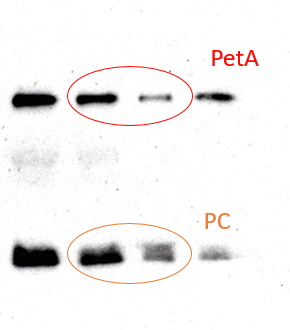 Thylakoid membranes (10 µg of total chlorophyll) extracted freshly from Hordeum vulgareleaves with 100 mM HEPES-KOH (pH 7.5), 0.3 M sorbitol, 2 mM EDTA, and 1mM MgCl2 and denatured with a Laemmli buffer at 80°C for 5 min were separated on 12% SDS-PAGE and blotted 1 h to nitrocellulose (pore size of 0.2 um), using semi-dry transfer. Blot was blocked with 4% milk for 2 h/RT with agitation. Blot was incubated in the primary antibody at a dilution of 1:3000 (PC and PetA, simultaneous western blot detection for both antibodies at the same time) for 1 h/RT with agitation in PBS-T. The antibody solution was decanted and the blot was rinsed briefly, then washed 3 times for 5 min in PBS-T at RT with agitation. Blot was incubated in Agrisera matching secondary antibody (anti-rabbit IgG horse radish peroxidase conjugated) diluted to 1:25000 in for 1 h/RT with agitation. The blot was washed as above and developed for 5 min with chemiluminescent detection reagent according to manufactures recommendations. Exposure time was 30 seconds. Simultaneous western blot detection can be applied if MW of detected proteins differs in min. 20 kDa.
|
|
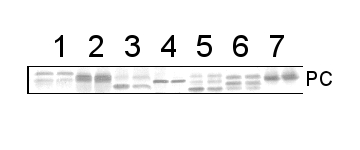
| Application examples: | 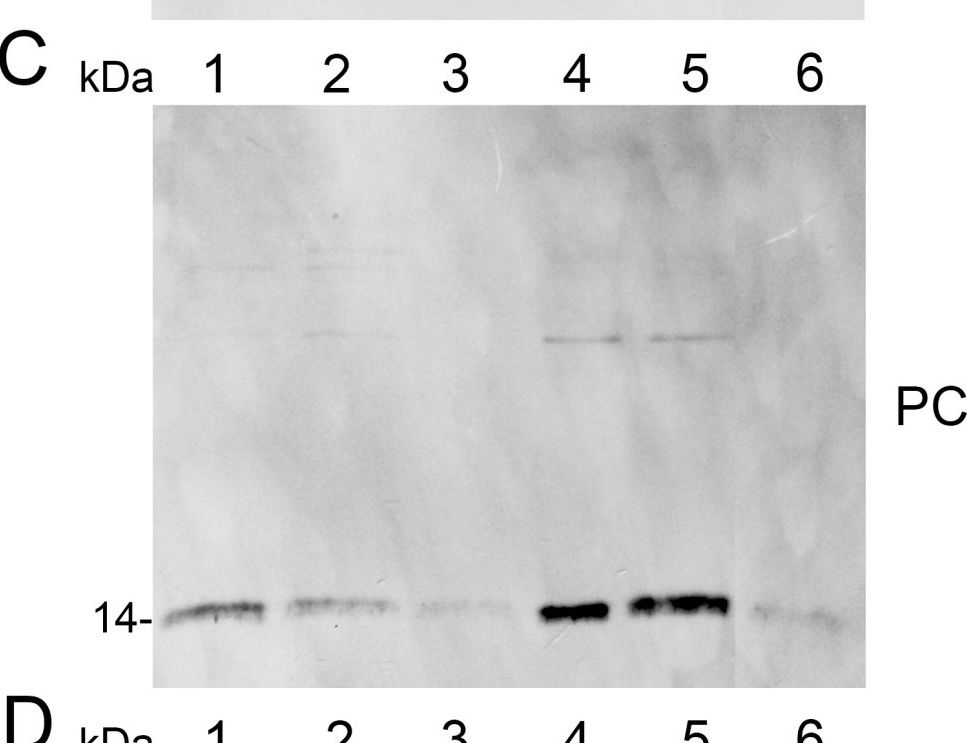 Reactant: Malus domestica (Apple) Application: Western Blotting Pudmed ID: 23886449 Journal: Plant Methods Figure Number: 2C Published Date: 2013-07-28 First Author: Sikorskaite, S., Rajamäki, M. L., et al. Impact Factor: 5.139 Open PublicationAnalysis of protein fractions from different steps of nuclei isolation. The protein fractions obtained following the main steps of the procedure used for isolation of nuclei from leaves of apple are shown. Equal amounts of proteins (4 ?g) from each fraction were loaded on the gel. A) Lumenal-binding protein 2 (BiP2), B) histone H3 and C) plastocyanin (PC) were detected with specific antibodies by western blot analysis. D) Coomassie blue staining of the fractionated proteins separated by polyacrylamide gel electrophoresis. Lane 1: crude extract of proteins from homogenized leaf tissue; lane 2: resuspended pellet of the whole cell lysate obtained following treatment with Triton X-100 and centrifugation; lane 3: nuclei collected from the 60% Percoll layer (see nuclear fraction in Figure 1B); lane 4: the interface fraction of 60% Percoll and 2.5 M sucrose layers in the density gradient containing chloroplasts and unbroken cells (see 60% P/2.5 M S interface in Figure 1B); lane 5: sucrose layer of the density gradient (see 2.5 M sucrose layer in Figure 1B); lane 6: nuclei purified by centrifugation on a 35% Percoll cushion. 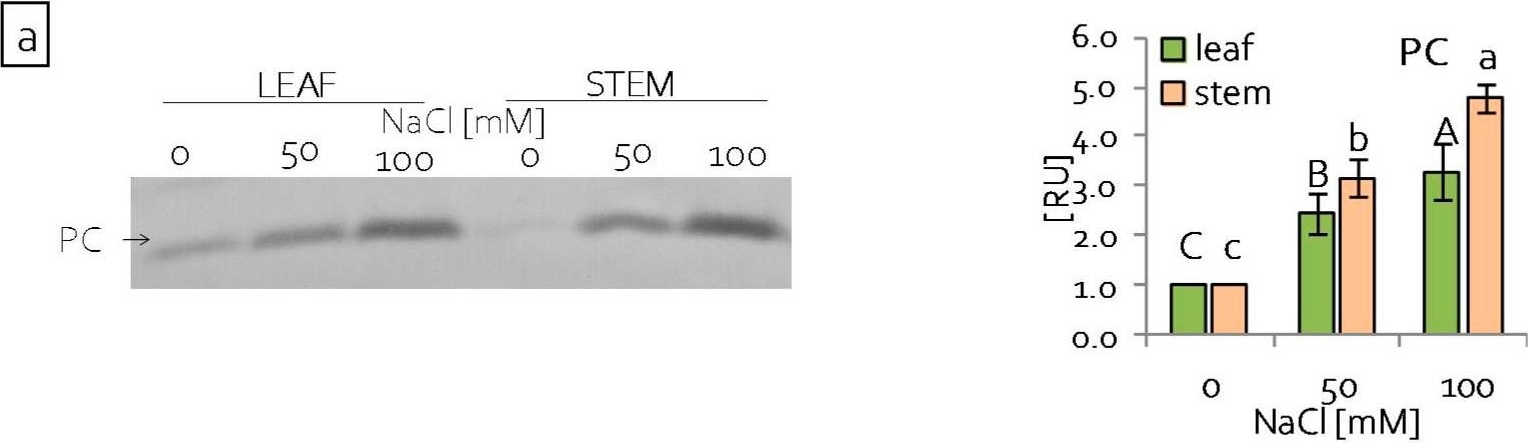 Reactant: Pisum sativum (Pea) Application: Western Blotting Pudmed ID: 33445673 Journal: Int J Mol Sci Figure Number: 6A Published Date: 2021-01-12 First Author: Tokarz, K. M., Weso?owski, W., et al. Impact Factor: 5.542 Open PublicationContent of (a) plastocyanin (PC) and (b) large subunit of RuBisCo (RbcL) of grass pea leaf and stem photosynthetic apparatus under salinity; content of proteins expressed as relative units [RU]; different letters—statistically significant differences within each organ (leaf-uppercase, stem-lowercase) at p ? 0.05; (n = 3). |
风险提示:丁香通仅作为第三方平台,为商家信息发布提供平台空间。用户咨询产品时请注意保护个人信息及财产安全,合理判断,谨慎选购商品,商家和用户对交易行为负责。对于医疗器械类产品,请先查证核实企业经营资质和医疗器械产品注册证情况。
 文献和实验
文献和实验| Selected references: | Tokarz et al. (2021). Stem Photosynthesis-A Key Element of Grass Pea (Lathyrus sativus L.) Acclimatisation to Salinity. Int J Mol Sci. 2021 Jan 12;22(2):685. doi: 10.3390/ijms22020685. PMID: 33445673; PMCID: PMC7828162. Viola et al. (2021) In vivo electron donation from plastocyanin and cytochrome c6 to PSI in Synechocystis sp. PCC6803. Biochim Biophys Acta Bioenerg. 2021 May 15;1862(9):148449. doi: 10.1016/j.bbabio.2021.148449. Epub ahead of print. PMID: 34004195. Furutani et al. (2021) The difficulty of estimating the electron transport rate at photosystem I. J Plant Res. 2021 Nov 15. doi: 10.1007/s10265-021-01357-6. Epub ahead of print. PMID: 34778922. Wang et al. (2020) Rerouting of ribosomal proteins into splicing in plant organelles. BioRxiv, DOI: 10.1101/2020.03.03.974766 . Galvis et al. (2020). H+ transport by K+ EXCHANGE ANTIPORTER3 promotes photosynthesis and growth in chloroplast ATP synthase mutants. Plant Physiol. pp.01561.2019. doi: 10.1104/pp.19.01561. Simakawa et al. (2020). Near-infrared in Vivo Measurements of Photosystem I and Its Lumenal Electron Donors With a Recently Developed Spectrophotometer. Photosynth Res. , 144 (1), 63-72 Cha et al. (2019). Arabidopsis GIGANTEA negatively regulates chloroplast biogenesis and resistance to herbicide butafenacil. Plant Cell Rep. 2019 Jul;38(7):793-801. doi: 10.1007/s00299-019-02409-x. Mermod et al. (2019). SQUAMOSA promoter-binding protein-like 7 mediates copper deficiency response in the presence of high nitrogen in Arabidopsis thaliana. Plant Cell Rep. 2019 May 15. doi: 10.1007/s00299-019-02422-0. Balyan et al. (2017). Identification of miRNA-mediated drought responsive multi-tiered regulatory network in drought tolerant rice, Nagina 22. Sci Rep. 2017 Nov 13;7(1):15446. doi: 10.1038/s41598-017-15450-1. Perea-García et al. (2017). Arabidopsis copper transport protein COPT2 participates in the cross talk between iron deficiency responses and low-phosphate signaling. Plant Physiol. 2013 May;162(1):180-94. doi: 10.1104/pp.112.212407. Yoshida et al. (2016). Hisabori T1.Two distinct redox cascades cooperatively regulate chloroplast functions and sustain plant viability. Proc Natl Acad Sci U S A. 2016 Jul 5;113(27):E3967-76. doi: 10.1073/pnas.1604101113. Epub 2016 Jun 22. Kropat et al. (2015). Copper economy in Chlamydomonas: Prioritized allocation and reallocation of copper to respiration vs. photosynthesis. Proc Natl Acad Sci U S A. 2015 Feb 2. pii: 201422492. Sook Seok et al. (2013). AtFKBP16-1, a chloroplast lumenal immunophilin, mediates response to photosynthetic stress by regulating PsaL stability. Physiologia Plantarum, DOI: 10.1111/ppl.12116. Perera-Garcia et al. (2013). Arabidopsis copper transport protein COPT2 participates in the crosstalk between iron deficiency responses and low phosphate signaling. |
位于类囊体膜内表面的含有铜原子的蛋白质。是光合链中的重要成员。传递电子,氧化还原电位约为 0.36伏,氧化态为蓝色,还原态无色,是 P700的电子供体。用超声波处理膜,很易丢失。
+ (4-20)4.质蓝素 质蓝素(plastocyanin,PC)是位于类囊体膜内侧表面的含铜的蛋白质,氧化时呈蓝色。它是介于Cyt b6/f复合体与PSⅠ之间的电子传递成员。通过蛋白质中铜离子的氧化还原变化来传递电子。高等植物PSⅠ复合体存在类囊体非堆叠的部分,PSⅡ复合体存在堆叠部分,而Cyt b6/f 比较均匀地分布在膜中,因而推测PC通过在类囊体腔内扩散移动来传递电子。5.PSⅠ复合体 PSⅠ的生理功能是吸收光能,进行光化学反应,产生强的还原剂,用于还原NADP+,实现PC到NADP+的电子
 技术资料
技术资料暂无技术资料 索取技术资料

