

- 询价
- Agrisera
- Sweden
- AS12 2365
- 2026年04月08日
- ImmunoGold (IG), Western blot (WB)
- Rabbit
- Arabidopsis thaliana, Nicotiana tabacum, Petunia hybrida, Solanum lycopersicum

企业认证
相关产品推荐更多 >

Goat anti-Mouse IgM (µ chain), FITC conjugated
询价Goat anti-Mouse IgG (H&L), Biotin conjugated, min, cross-reactivity to human IgG/serum
询价Goat anti-Rabbit IgG (H&L), Affinity purified, Unconjugated, min, cross-reactivity to human serum
询价
Anti-mStrawberry
询价RPN11 | 26S proteasome regulatory subunit RPN11
询价
万千商家帮你免费找货
0 人在求购买到急需产品
- 详细信息
- 文献和实验
- 技术资料
- 免疫原:
KLH-conjugated synthetic peptide derived from Arabidopsis thaliana CNX1 UniProt: P29402 TAIR: AT5G61790, CNX2 UniProt: Q38798, TAIR: AT5G07340. This peptide is NOT present in calreticulins.
- 形态:
Immunogen affinity purified serum in PBS pH 7.4.
- 保存条件:
Aliquite upon arrival to avoid repeated freeze-thaw cycles and store -20°C; Please remember to spin the tubes briefly prior to opening them to avoid any losses that might occur from material adhering to the cap or sides of the tube.
- 克隆性:
Polyclonal
- 适应物种:
Arabidopsis thaliana, Nicotiana tabacum, Petunia hybrida, Solanum lycopersicum
- 供应商:
Agrisera
- 宿主:
Rabbit
- 应用范围:
ImmunoGold (IG), Western blot (WB)
- 靶点:
Anti-CNX1/2 | CALNEXIN HOMOLOG 1/2
- 抗体英文名:
Anti-CNX1/2 | CALNEXIN HOMOLOG 1/2
- 抗体名:
Anti-CNX1/2 | CALNEXIN HOMOLOG 1/2
- 规格:
50 µg
| Immunogen: | KLH-conjugated synthetic peptide derived from Arabidopsis thaliana CNX1 UniProt: P29402TAIR: AT5G61790, CNX2 UniProt: Q38798, TAIR: AT5G07340. This peptide is NOT present in calreticulins. |
| Host: | Rabbit |
| Clonality: | Polyclonal |
| Purity: | Immunogen affinity purified serum in PBS pH 7.4. |
| Format: | Liquid |
| Quantity: | 50 µg |
| Storage: | Aliquite upon arrival to avoid repeated freeze-thaw cycles and store -20°C; Please remember to spin the tubes briefly prior to opening them to avoid any losses that might occur from material adhering to the cap or sides of the tube. |
| Tested applications: | Western blot (WB) |
| Recommended dilution: | 1 : 2500 (WB) |
| Expected | apparent MW: | CNX1 60.5 kD, processing aa 1-20, mature peptide 58.1 kD CNX2 60.5/61.4 kD, processing aa 1-25, mature peptides 57.6/58.6 kD |
Application example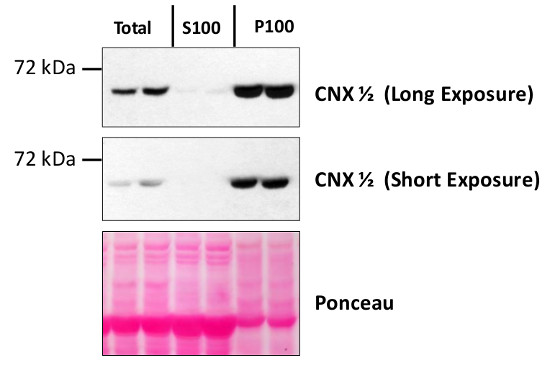 Total protein from Col-0 (wild-type) Arabidopsis thaliana were extracted with 50mM HEPES-KOH buffer containing 250 mM sucrose, 5% glycerol, 50 mM NaPP, 1 mM NaMo, 25 mM NaF, 10mM EDTA, 0.5% PVP, 3mM DTT, 1mM PMSF, 10uM Leupeptin & 10nM Calyculin, and then fractionated by ultracentrifugation at 100,000 x gravity for 30 min at 4°C into soluble (S100) and microsomal (P100) proteins as described in LaMontagne et al. (2016). Isolation of Microsomal Membrane Proteins from Arabidopsis thaliana. Current Protocols in Plant Biology 1:1-18. doi: 10.1002/cppb.20020. 30 µg proteins of total, S100 and P100 fractions were denatured at 37°C for 5 min, separated on a 7.5 % SDS-PAGE and blotted 1h to nitrocellulose using tank transfer. Blots were blocked with 1x PBS (from Fisher Scientific BP665-1) + 0.1 %Tween 20 (PBS-T) + 5% milk for 1h at room temperature (RT) with agitation. Blot was incubated in the primary antibody at a dilution of 1: 2500 overnight at 4°C with agitation in 1x PBS-T + 5% milk. The antibody solution was decanted, and the blot was rinsed briefly once, then washed four times for 7 min in 1x PBS-T at RT with agitation. Blot was incubated in secondary antibody (anti-rabbit IgG horse radish peroxidase conjugated) diluted to 1:10 000 in 1x PBS-T + 5% milk for 2 hrs at RT with agitation. The blot was washed as above and developed for 4 min with Amersham ECL (RPN2106). Exposure time was 30 seconds and 2 min Courtesy of Erica LaMontagne & Dr. Antje Heese (Division of Biochemistry, Interdisciplinary Plant Group (IPG) - University of Missouri; Columbia, MO, USA) |
|
| Application examples: | 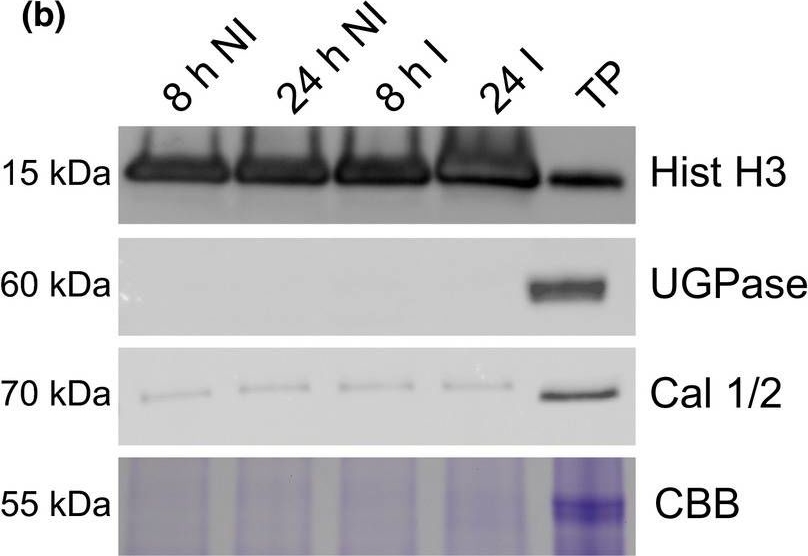 Reactant: Nicotiana benthamiana Application: Western Blotting Pudmed ID: 28394025 Journal: New Phytol Figure Number: 1B Published Date: 2017-07-01 First Author: Howden, A. J. M., Stam, R., et al. Impact Factor: 7.96 Open PublicationA simple workflow combining nuclear enrichment with quantitative mass spectrometry allows the study of host nuclear processes during infection. (a) Method overview. Detached leaves from 4?wk?old tomato plants were spray?inoculated with Phytophthora capsici zoospores at a concentration of 500 000 spores ml?1, or water as a control (i). Leaves were harvested 8 and 24 h post?infection and subject to nuclear enrichment (ii). Nuclear protein extracts were generated and fractionated in?gel and digested with trypsin (iii). Peptide samples were subjected to liquid chromatography?tandem mass spectrometry (LC?MSMS) analysis and peptide identification and label?free quantification was carried out using the maxquant and perseus software packages, to identify proteins that were differentially expressed during infection. Nuclear predictions were performed using prediction software on our in?house Galaxy server as described in the Methods. Subsequent data filtering was completed using the r software package (iv and v). Three independent biological replicates were generated. I, infected samples; NI, noninfected samples (v). (b) Successful enrichment of nuclear proteins demonstrated by western blotting with anti?histone H3 antibody and subcellular markers. Protein extracts from enriched nuclear samples were compared to a total protein extract (TP) from tomato leaves. Protein concentrations were adjusted for equal loading. Nonnuclear contamination was assessed by probing with anti?UDP?glucose pyrophosphorylase (UGPase) antibody (cytoplasm) and calnexin homologue 1/2 antibody (endoplasmic reticulum). Samples were also run on gels and stained with Coomassie brilliant blue (CBB) to assess protein loading and Rubisco abundance. The figure shows the results from a single biological replicate. Blots for all three replicates are provided in Supporting Information Fig. S2. |
风险提示:丁香通仅作为第三方平台,为商家信息发布提供平台空间。用户咨询产品时请注意保护个人信息及财产安全,合理判断,谨慎选购商品,商家和用户对交易行为负责。对于医疗器械类产品,请先查证核实企业经营资质和医疗器械产品注册证情况。
 文献和实验
文献和实验| Selected references: | Ekanayake et al. (2021) A. DYNAMIN-RELATED PROTEIN DRP1A functions with DRP2B in plant growth, flg22-immune responses, and endocytosis. Plant Physiol. 2021 Feb 3:kiab024. doi: 10.1093/plphys/kiab024. Epub ahead of print. PMID: 33564884. Ekanayake et al. (2021) A. DYNAMIN-RELATED PROTEIN DRP1A functions with DRP2B in plant growth, flg22-immune responses, and endocytosis. Plant Physiol. 2021 Feb 3:kiab024. doi: 10.1093/plphys/kiab024. Epub ahead of print. PMID: 33564884. Kramer et al. (2020). N6-methyladenosine and RNA secondary structure affect transcript stability and protein abundance during systemic salt stress in Arabidopsis. Plant Direct . 2020 Jul 24;4(7):e00239.doi: 10.1002/pld3.239. Collins et al. (2020). EPSIN1 Modulates the Plasma Membrane Abundance of FLAGELLIN SENSING2 for Effective Immune Responses . Plant Physiol. 2020 Feb 24. pii: pp.01172.2019. doi: 10.1104/pp.19.01172 Butler et al. (2019). Soybean resistance locus Rhg1 confers resistance to multiple cyst nematodes in diverse plant species. Phytopathology. 2019 Aug 12. doi: 10.1094/PHYTO-07-19-0225-R. Howden et al. (2017), Quantitative analysis of the tomato nuclear proteome during Phytophthora capsici infection unveils regulators of immunity. New Phytol. 2017 Jul;215(1):309-322. doi: 10.1111/nph.14540. Foley et al. (2017). A Global View of RNA-Protein Interactions Identifies Post-transcriptional Regulators of Root Hair Cell Fate.Dev Cell. 2017 Apr 24;41(2):204-220.e5. doi: 10.1016/j.devcel.2017.03.018. LaMontagne et al. (2016). Isolation of Microsomal Membrane Proteins from Arabidopsis thaliana. Curr. Protoc. Plant Biol. 1:217-234. doi: 10.1002/cppb.20020. |
[资源] 所有的看家基因(housekeeping genes)列表+引物设计服务
sapiens ras homolog gene family, member A (ARHA), mRNA 4050 NM_003166 Homo sapiens sulfotransferase family, cytosolic, 1A, phenol-preferring, member 3 (SULT1A3), mRNA 461 NM_001746 Homo sapiens calnexin (CANX), mRNA 1923 NM_001662 Homo sapiens ADP
) A431 cells. At 48 h after infection, these cells were stained with ten different primary antibodies (5 g/ml) specific for different cell surface markers: anti-CD15 (clone 2F3; BD, PharMingen, San Diego, CA), anti-ERBB-2 (clone SP77; ref. 5), anti-ERBB
Studies of the Ubiquitin Proteasome System
phosphatase inhibitors and 50 µM MG132 (or lactacystin) Anti‐E3 or anti‐substrate antibody Nondenaturing Triton X‐100 wash buffer (see recipe ) Tris‐buffered saline (TBS


