

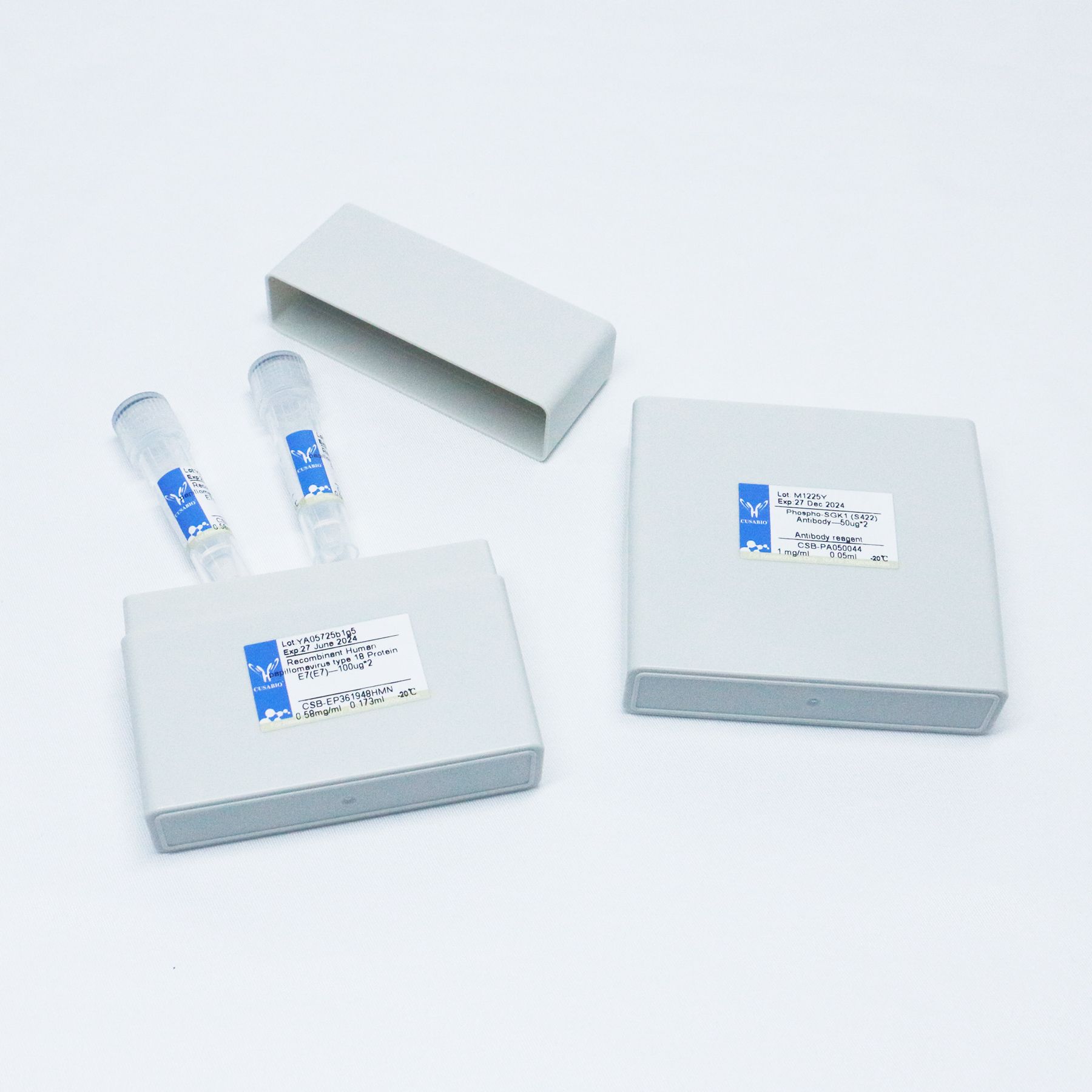
人CRABP1重组蛋白Cellular retinoic a
cid-binding protein I;CRABP-IHuman Cellular retinoic acid-binding protein 1(CRABP1)蛋白- ¥1344
- CUSABIO

- CN
- CSB-EP005935HU
- 2026年05月21日

企业认证
相关产品推荐更多 >
人FRMD5重组蛋白FRMD5Human FERM domain containing 5(FRMD5)蛋白
¥1536
Recombinant-Xenopus-laevis-Endoplasmic-reticulum-Golgi-intermediate-compartment-protein-3ergic3Endoplasmic reticulum-Golgi intermediate compartment protein 3
¥12236
Recombinant-Neisseria-meningitidis-serogroup-B-Macrolide-export-ATP-bindingpermease-protein-MacBmacBMacrolide export ATP-binding/permease protein MacB EC= 3.6.3.-
¥14504
Recombinant-Rhizobium-loti-Lipoprotein-signal-peptidaselspALipoprotein signal peptidase EC= 3.4.23.36 Alternative name(s): Prolipoprotein signal peptidase Signal peptidase II; SPase II
¥10276
小鼠Nppc重组蛋白Nppc;CnpMouse C-type natriuretic peptide(Nppc)蛋白
¥1536
万千商家帮你免费找货
0 人在求购买到急需产品
相关阅读
香烟烟雾如何加速声带纤维化?CD44-透明质酸轴是关键通路Takara 秋促来袭,提取+反转录+定量套装仅 1200 元abinScience 体内级抗体 全年锁价 低至 ¥1200阿拉丁 22万+ 科研级产品现货速发,品质严控、科研无忧- 详细信息
- 文献和实验
- 技术资料
- 保存条件:
We recommend to add 5-50% of glycerol (final concentration) and aliquot for long-term storage at -20℃/-80℃.
- 保质期:
Generally, the shelf life of liquid form is 6 months at -20℃/-80℃. The shelf life of lyophilized form is 12 months at -20℃/-80℃.
- 英文名:
Recombinant Human Cellular retinoic acid-binding protein 1 (CRABP1)
- 库存:
200
- 供应商:
武汉华美生物工程有限公司
- 规格:
20μg
英文名称:
Recombinant Human Cellular retinoic acid-binding protein 1 (CRABP1)品名简称:
Recombinant Human CRABP1 protein货号:
CSB-EP005935HU规格:
20μg价格:
1344LC-MS/Western Blot:
/SDS-PAGE:
(Tris-Glycine gel) Discontinuous SDS-PAGE (reduced) with 5% enrichment gel and 15% separation gel.纯度:
Greater than 90% as determined by SDS-PAGE.内毒素:
Not test生物活性:
/基因名:
CRABP1Uniprot No.:
P29762别名:
Cellular retinoic acid-binding protein I ;CRABP-I种属:
Homo sapiens (Human)蛋白长度:
Full Length of Mature Protein来源:
E.coli分子量:
42.5 kDa表达区域:
2-137aa氨基酸序列:
PNFAGTWKMRSSENFDELLKALGVNAMLRKVAVAAASKPHVEIRQDGDQFYIKTSTTVRTTEINFKVGEGFEEETVDGRKCRSLPTWENENKIHCTQTLLEGDGPKTYWTRELANDELILTFGADDVVCTRIYVRE蛋白标签:
N-terminal GST-tagged产品提供形式:
Liquid or Lyophilized powder缓冲液:
If the delivery form is liquid, the default storage buffer is Tris/PBS-based buffer, 5%-50% glycerol. If the delivery form is lyophilized powder, the buffer before lyophilization is Tris/PBS-based buffer, 6% Trehalose, pH 8.0.储存条件:
We recommend that this vial be briefly centrifuged prior to opening to bring the contents to the bottom. Please reconstitute protein in deionized sterile water to a concentration of 0.1-1.0 mg/mL.We recommend to add 5-50% of glycerol (final concentration) and aliquot for long-term storage at -20℃/-80℃. Our default final concentration of glycerol is 50%. Customers could use it as reference.保质期:
The shelf life is related to many factors, storage state, buffer ingredients, storage temperature and the stability of the protein itself. Generally, the shelf life of liquid form is 6 months at -20℃/-80℃. The shelf life of lyophilized form is 12 months at -20℃/-80℃.货期:
13-23 business days注意事项:
Repeated freezing and thawing is not recommended. Store working aliquots at 4℃ for up to one week.功能1:
Cytosolic CRABPs may regulate the access of retinoic acid to the nuclear retinoic acid receptors.功能2:
Cytosolic CRABPs may regulate the access of retinoic acid to the nuclear retinoic acid receptors.文献:
Structures of cellular retinoic acid binding proteins I and II in complex with synthetic retinoids.Chaudhuri B.N., Kleywegt G.J., Broutin-L'Hermite I., Bergfors T., Senn H., Le Motte P., Partouche O., Jones T.A.Acta Crystallogr. D 55:1850-1857(1999)研究领域:
Transport请点击“在线询价”找客服索取产品说明书及引用文献目录,产品实时更新参数、价格信息、更多文献信息可以查看cusabio官网
风险提示:丁香通仅作为第三方平台,为商家信息发布提供平台空间。用户咨询产品时请注意保护个人信息及财产安全,合理判断,谨慎选购商品,商家和用户对交易行为负责。对于医疗器械类产品,请先查证核实企业经营资质和医疗器械产品注册证情况。
 文献和实验
文献和实验Fluorescence-Based Technique for Analyzing Retinoic Acid
retinoic acid-binding protein I (CRABP-I), a protein that binds RA with high affinity and specificity, as a “read-out” for its ligand. Replacing 28 Leu of CRABP-I with a Cys residue allows for covalently attaching an environmentally sensitive
Reverse Transcriptase-Polymerase Chain Reaction (RT-PCR) for Cellular Retinoid-Binding Proteins
Cellular retinoid-binding proteins were first identified in the mid-1970s (1 ). Subsequent studies established the existence of two forms of cellular retinoic acid-binding proteins (CRABPI and II) (2 , 3 ) and two forms of cellular retinol
Antisense methodologies have been used extensively to inhibit the expression of specific genes with a view to elucidating their role in particular cellular processes ( 1 ). The technique is based on the ability of mRNA to bind
 技术资料
技术资料暂无技术资料 索取技术资料

