

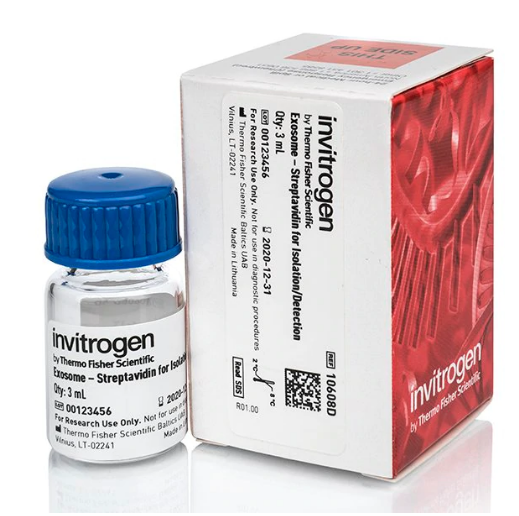
- ¥4025
- Invitrogen
- 10608D
- 美国
- 2026年05月29日

企业认证
相关产品推荐更多 >



万千商家帮你免费找货
0 人在求购买到急需产品
相关阅读
细胞污染识别与处理全攻略:5 种常见类型+关键误区Cytoscape 教程来了!快速实现顶刊同款通路网络图五大应用案例:Mustang Q 膜层析应用全解析1 个小工具,一次性搞定流程图、质粒图谱和信号通路图- 详细信息
- 文献和实验
- 技术资料
- 库存:
6
- 英文名:
Exosome-Streptavidin Isolation/Detection Reagent
- 供应商:
上海觅拓
- 保存条件:
Store at 2 to 8 °C
- 规格:
3ml
描述
Exosome-Streptavidin Isolation/Detection Reagent, when combined with your choice of biotinylated primary antibody, enables the purification of exosomes (also called extracellular vesicles and multi-vesicular bodies) from pre-enriched samples. These exosomes can then be detected using techniques such as flow cytometry, electron microscopy, or Western blotting. The exosomes must be pre-enriched before isolation. This can be done by ultracentrifugation, or by using the fast and efficient Total Exosome Isolation (from cell culture media) reagent.
• Maximum flexibility with your choice of biotinylated antibody
• "See" your sample during handling
• Easily scalable protocol
• Detect exosomes via flow cytometry, in less than 1 hour
Isolation and detection of exosomes has been a tedious, non-specific, and difficult process. Exosome - Streptavidin for Isolation/Detection utilizes the well-known Dynabeads® magnetic separation technology. When combined with the biotinylated antibody of your choice, this technology allows you to easily purify pre-enriched exosomes from cell culture media and then move on to detect the purified exosomes via techniques such as flow cytometry, electron microscopy, or Western blotting.
Detect by Flow Cytometry
Because free exosomes alone are too small to be detected by flow cytometry, one of the major advantages of employing magnetic separation technology is that the purified, bead-bound exosomes can be easily visualized by flow cytometry. The monodispersed and relatively large Dynabeads® (4.5 µm in diameter) allow for a clear and defined FFC/SSC, typically in less than 1 hour.
"See" Your Sample
Not only are the superparamagnetic Dynabeads® known for their sensitivity, reproducibility, and stability, but the magnetic handling also allows you to "see" your sample due to the light brown color of the beads. When the sample tube is placed on the magnet, the bead-bound exosomes are pulled to the side of the tube, allowing for easy separation and purification. In addition, the sample and bead volume can be easily scaled up or down according to your sample size or downstream applications.
Good Mixing is Critical
For successful exosome isolation it is important to use a mixer that tilts and rotates to ensure that the beads do not settle in the tube. Avoid end-over end rotation for small sample volumes (e.g., 100 µl). Please see user manual below for more guidelines.
风险提示:丁香通仅作为第三方平台,为商家信息发布提供平台空间。用户咨询产品时请注意保护个人信息及财产安全,合理判断,谨慎选购商品,商家和用户对交易行为负责。对于医疗器械类产品,请先查证核实企业经营资质和医疗器械产品注册证情况。
 文献和实验
文献和实验Western blotting using ECL reagent
diluted 1:8000 in TBS-T + 1.5% gelatin for 1 hour.6. Repeat step # 4 (wash)7. Prepare ECL solution for detection: mix equal volume of ECL reagent 1 and 2, (1:1) with final volume regarding of 0.125 ml/cm2 (for a mini gel- 4 ml of each reagent).8. Remove
Extraction of DNA using DNAzol® Reagent
material. This process is recommended in order to minimize RNA carry-over into the DNA. 3. DNA Precipitation: Precipitate DNA from the lysate/homogenate by the addition of 0.5 ml of 100% ethanol per 1 ml of DNAzol® Reagent used for the isolation
Analysis of Viral MicroRNA Exchange via Exosomes In Vitro and In Vivo
and purify exosomes, how we extract the (small) RNA content, how to analyze copy numbers, and finally how to measure exosome-mediated transfer of these molecules into recipient cells. Our techniques have been optimized for the detection of Epstein–Barr virus
 技术资料
技术资料暂无技术资料 索取技术资料

