


- ¥1580 - 2480
- gelatins
- jlcR12450
- 国内
- 2025年07月12日
- WB,ELISA等
- 人/动物/植物

企业认证
相关产品推荐更多 >


万千商家帮你免费找货
0 人在求购买到急需产品
- 详细信息
- 文献和实验
- 技术资料
- 供应商:
江西江蓝纯生物试剂有限公司
- 库存:
180
- 克隆性:
单克隆
- 保质期:
1年
- 抗体英文名:
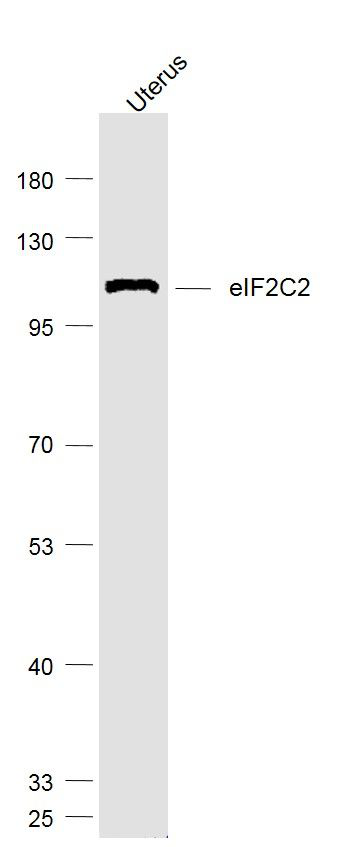
eIF2C2
- 抗体名:
真核翻译起始因子2C2抗体
- 适应物种:
人/动物/植物
- 应用范围:
WB,ELISA等
- 浓度:
1mg/ml
- 保存条件:
-20 °
- 规格:
100ul/200ul
| 规格: | 100ul | 产品价格: | ¥1580.0 |
|---|---|---|---|
| 规格: | 200ul | 产品价格: | ¥2480.0 |
英文名称 : eIF2C2
中文名称 : 真核翻译起始因子2C2抗体
别 名 : Ago 2; AGO2_HUMAN; Argonaute 2; Argonaute2; dAgo2; eIF 2C 2; eIF-2C 2; eIF2C 2; Eif2c2; Eukaryotic translation initiation factor 2C 2; hAgo2; MGC3183; PAZ Piwi domain protein; PPD; Protein argonaute-2; Protein slicer; Q10; Slicer protein.
研究领域 : 细胞生物 染色质和核信号 表观遗传学
抗体来源 : Rabbit
克隆类型 : Polyclonal
交叉反应 : Human, Mouse, Rat, Dog, Pig, Cow, Horse, Sheep,
产品应用 : WB=1:500-2000 ELISA=1:500-1000 IHC-P=1:400-800 IHC-F=1:400-800 ICC=1:100-500 IF=1:100-500 (石蜡切片需做抗原修复)
not yet tested in other applications.
optimal dilutions/concentrations should be determined by the end user.
分 子 量 : 97kDa
细胞定位 : 细胞核 细胞浆
性 状 : Lyophilized or Liquid
浓 度 : 1mg/ml
免 疫 原 : KLH conjugated synthetic peptide derived from human eIF2C2/Ago2:431-530/859
亚 型 : IgG
纯化方法 : affinity purified by Protein A
储 存 液 : 0.01M TBS(pH7.4) with 1% BSA, 0.03% Proclin300 and 50% Glycerol.
保存条件 : Store at -20 °C for one year. Avoid repeated freeze/thaw cycles. The lyophilized antibody is stable at room temperature for at least one month and for greater than a year when kept at -20°C. When reconstituted in sterile pH 7.4 0.01M PBS or diluent of antibody the antibody is stable for at least two weeks at 2-4 °C.
PubMed : PubMed
产品介绍 : Eukaryotic translation initiation factor 2C (eIF2C) proteins (argonaute family) influence RNA interference (RNAi) as components of the RNA-inducible silencing complex (RISC) or microRNA (miRNA)-containing ribonucleoprotein particle (miRNP). Small RNAs, including small interfering RNAs (siRNAs) and miRNAs, can silence target genes through mechanisms that utilize RISC or miRNP particles. eIF2C1 (argonaute 1, AGO1, eIF2C, GERP95, Q99) and Dicer1 play a coordinated role in siRNA-mediated gene silencing. eIF2C2 (Slicer, argonaute 2, AGO2, Q10) is a RISC component that can concentrate in cytoplasmic processing bodies (P-bodies) and catalyze mRNA cleavage. Mammalian P-bodies contain mRNAs and have an association with miRNA-induced translational silencing and siRNA-induced mRNA degradation. Additional eIF2C proteins include eIF2C3 (argonaute 3, AGO3), eIF2C4 (argonaute 4, AGO4) and meIF2c5 (mouse argonaute 5).
Function:
Required for RNA-mediated gene silencing (RNAi) by the RNA-induced silencing complex (RISC). The 'minimal RISC' appears to include EIF2C2/AGO2 bound to a short guide RNA such as a microRNA (miRNA) or short interfering RNA (siRNA). These guide RNAs direct RISC to complementary mRNAs that are targets for RISC-mediated gene silencing. The precise mechanism of gene silencing depends on the degree of complementarity between the miRNA or siRNA and its target. Binding of RISC to a perfectly complementary mRNA generally results in silencing due to endonucleolytic cleavage of the mRNA specifically by EIF2C2/AGO2. Binding of RISC to a partially complementary mRNA results in silencing through inhibition of translation, and this is independent of endonuclease activity. May inhibit translation initiation by binding to the 7-methylguanosine cap, thereby preventing the recruitment of the translation initiation factor eIF4-E. May also inhibit translation initiation via interaction with EIF6, which itself binds to the 60S ribosomal subunit and prevents its association with the 40S ribosomal subunit. The inhibition of translational initiation leads to the accumulation of the affected mRNA in cytoplasmic processing bodies (P-bodies), where mRNA degradation may subsequently occur. In some cases RISC-mediated translational repression is also observed for miRNAs that perfectly match the 3' untranslated region (3'-UTR). Can also upregulate the translation of specific mRNAs under certain growth conditions. Binds to the AU element of the 3'-UTR of the TNF (TNF-alpha) mRNA and upregulates translation under conditions of serum starvation. Also required for transcriptional gene silencing (TGS), in which short RNAs known as antigene RNAs or agRNAs direct the transcriptional repression of complementary promoter regions.
Subunit:
Interacts with DICER1 through its Piwi domain and with TARBP2 during assembly of the RNA-induced silencing complex (RISC). Together, DICER1, EIF2C2/AGO2 and TARBP2 constitute the trimeric RISC loading complex (RLC), or micro-RNA (miRNA) loading complex (miRLC). Within the RLC/miRLC, DICER1 and TARBP2 are required to process precursor miRNAs (pre-miRNAs) to mature miRNAs and then load them onto EIF2C2/AGO2. EIF2C2/AGO2 bound to the mature miRNA constitutes the minimal RISC and may subsequently dissociate from DICER1 and TARBP2. Note however that the term RISC has also been used to describe the trimeric RLC/miRLC. The formation of RISC complexes containing siRNAs rather than miRNAs appears to occur independently of DICER1. Interacts with EIF2C1/AGO1. Also interacts with DDB1, DDX5, DDX6, DDX20, DHX30, DHX36, DDX47, DHX9, EIF6, ELAVL, FXR1, GEMIN4, HNRNPF, IGF2BP1, ILF3, IMP8, MATR3, MOV10, PABPC1, PRMT5, P4HA1, P4HB, RBM4, SART3, TNRC6A, TNRC6B, UPF1 and YBX1. Interacts with the P-body components DCP1A and XRN1. Associates with polysomes and messenger ribonucleoproteins (mNRPs). Interacts with RBM4; the interaction is modulated under stress-induced conditions, occurs under both cell proliferation and differentiation conditions and in a RNA-and phosphorylation-independent manner. Interacts with LIMD1, WTIP and AJUBA. Interacts with TRIM71.
Subcellular Location:
Cytoplasm > P-body. Nucleus. Translational repression of mRNAs results in their recruitment to P-bodies. Translocation to the nucleus requires IMP8.
Post-translational modifications:
Hydroxylated. 4-hydroxylation appears to enhance protein stability but is not required for miRNA-binding or endonuclease activity.
Similarity:
Belongs to the argonaute family. Ago subfamily.
Contains 1 PAZ domain.
Contains 1 Piwi domain.
SWISS:
Q9UKV8
Gene ID:
27161
Important Note:
This product as supplied is intended for research use only, not for use in human, therapeutic or diagnostic applications.
产品图片
风险提示:丁香通仅作为第三方平台,为商家信息发布提供平台空间。用户咨询产品时请注意保护个人信息及财产安全,合理判断,谨慎选购商品,商家和用户对交易行为负责。对于医疗器械类产品,请先查证核实企业经营资质和医疗器械产品注册证情况。
 文献和实验
文献和实验控的作用。但若二极结构位于AUG的近下游,(最佳距离为14 nt),将会使移动的40亚基停靠在AUG位点,增强起始反应。真核的系列翻译起始因子可使二极结构解链,使翻译复合体顺利通过原二级结构区,继续其肽链的延伸,而不会起阻碍作用。在这种情况下二极结构又起到了正调控的作用。 MRNA 3′端的poly(A)不仅和mRNA穿越核膜的能力有关,而且影响到mRNA的稳定性和翻译效率。有ploy(A)的mRNA其翻译效率明显高于无poly(A)的mRNA ,Poly A长度和翻译效率有关。有人将poly
人白细胞抗原(human leukocyte antigen,HLA)
,DZ/DO,DP;补体蛋白质提供了第三类MHC,基因座位于S区,其编码的蛋白 质是血清的组成成分,负责同抗原—抗体复合物作用以引起细胞的裂解。 人的MHC基因座又称HLA,位于第6号染色体短臂,长约4 000kb。HLA—I区有A、B、C三个基因座,每个基因座又各自有几十到200多个等位基因。在I类区里还发现有正、F、G、H、J等基因座,称为I类样基因(class I—likegenes)。HLA—Ⅱ类区内有DQ、DR、DP基因座,每个基因座也分别有几个到100多个等位基因。HLA-Ⅲ类区里
传递,人的Ⅱ类区称为HLA-D,又可分为4个亚区,排列顺序为DR,DQ,DZ/DO,DP;补体蛋白质提供了第三类MHC,基因座位于S区,其编码的蛋白 质是血清的组成成分,负责同抗原—抗体复合物作用以引起细胞的裂解。 人的MHC基因座又称HLA,位于第6号染色体短臂,长约4 000kb。HLA—I区有A、B、C三个基因座,每个基因座又各自有几十到200多个等位基因。在I类区里还发现有正、F、G、H、J等基因座,称为I类样基因(class I—likegenes)。HLA—Ⅱ类区内
 技术资料
技术资料暂无技术资料 索取技术资料

