


- ¥1580
- gelatins
- jlcR18799
- 国内
- 2025年07月13日
- WB,ELISA等
- 人/动物/植物

企业认证
相关产品推荐更多 >


万千商家帮你免费找货
0 人在求购买到急需产品
- 详细信息
- 文献和实验
- 技术资料
- 供应商:
江西江蓝纯生物试剂有限公司
- 库存:
99
- 克隆性:
单克隆
- 保质期:
1年
- 抗体英文名:
phospho-Met (Tyr1356)
- 抗体名:
磷酸化原癌基因c-Met抗体
- 适应物种:
人/动物/植物
- 应用范围:
WB,ELISA等
- 浓度:
1mg/ml
- 保存条件:
-20 °
- 规格:
100ul
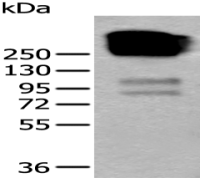
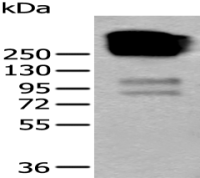
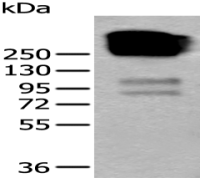
英文名称 : phospho-Met (Tyr1356)
中文名称 : 磷酸化原癌基因c-Met抗体
别 名 : Met (c-Met) (phospho Y1356); Met (phospho Y1356); c-Met (phospho Y1356); AUTS9; c met; cmet; D249; Hepatocyte growth factor receptor; Hepatocyte growth factor receptor Precursor; HGF; HGF receptor; HGF SF receptor; HGF/SF receptor; HGFR; MET; Met proto oncogene tyrosine kinase; Met proto-oncogene (hepatocyte growth factor receptor); Met proto-oncogene; Met protooncogene; MET_HUMAN; Oncogene MET; Par4; Proto-oncogene c-Met; RCCP2; Renal cell carcinoma papillary 2 gene; Scatter factor receptor; SF receptor; Tyrosine-protein kinase Met.
产品类型 : 磷酸化抗体
研究领域 : 肿瘤 细胞生物 信号转导 激酶和磷酸酶
抗体来源 : Rabbit
克隆类型 : Polyclonal
交叉反应 : Human, Mouse, Rat, Dog, Pig, Cow, Horse, Rabbit, Sheep,
产品应用 : WB=1:500-2000 ELISA=1:500-1000 IHC-P=1:400-800 IHC-F=1:400-800 ICC=1:100-500 IF=1:100-500 (石蜡切片需做抗原修复)
not yet tested in other applications.
optimal dilutions/concentrations should be determined by the end user.
分 子 量 : 153kDa
细胞定位 : 细胞膜
性 状 : Lyophilized or Liquid
浓 度 : 1mg/ml
免 疫 原 : KLH conjugated synthesised phosphopeptide derived from human Met around the phosphorylation site of Tyr1356:AT(p-Y)VN
亚 型 : IgG
纯化方法 : affinity purified by Protein A
储 存 液 : 0.01M TBS(pH7.4) with 1% BSA, 0.03% Proclin300 and 50% Glycerol.
保存条件 : Store at -20 °C for one year. Avoid repeated freeze/thaw cycles. The lyophilized antibody is stable at room temperature for at least one month and for greater than a year when kept at -20°C. When reconstituted in sterile pH 7.4 0.01M PBS or diluent of antibody the antibody is stable for at least two weeks at 2-4 °C.
PubMed : PubMed
产品介绍 : The proto-oncogene MET product is the hepatocyte growth factor receptor and encodes tyrosine-kinase activity. The primary single chain precursor protein is post-translationally cleaved to produce the alpha and beta subunits, which are disulfide linked to form the mature receptor. Various mutations in the MET gene are associated with papillary renal carcinoma. Two transcript variants encoding different isoforms have been found for this gene. [provided by RefSeq, Jul 2008]
Function:
Receptor for hepatocyte growth factor and scatter factor. Has a tyrosine-protein kinase activity. Functions in cell proliferation, scattering, morphogenesis and survival.
Subcellular Location:
Membrane.
Post-translational modifications:
modificationsDephosphorylated by PTPRJ at Tyr-1349 and Tyr-1365.
DISEASE:
Note=Activation of MET after rearrangement with the TPR gene produces an oncogenic protein. Note=Defects in MET may be associated with gastric cancer.
Defects in MET are a cause of hepatocellular carcinoma (HCC) [MIM:114550].
Defects in MET are a cause of renal cell carcinoma papillary (RCCP) [MIM:605074]. It is a subtype of renal cell carcinoma tending to show a tubulo-papillary architecture formed by numerous, irregular, finger-like projections of connective tissue. Renal cell carcinoma is a heterogeneous group of sporadic or hereditary carcinoma derived from cells of the proximal renal tubular epithelium. It is subclassified into common renal cell carcinoma (clear cell, non-papillary carcinoma), papillary renal cell carcinoma, chromophobe renal cell carcinoma, collecting duct carcinoma with medullary carcinoma of the kidney, and unclassified renal cell carcinoma.
Note=A common allele in the promoter region of the MET shows genetic association with susceptibility to autism in some families. Functional assays indicate a decrease in MET promoter activity and altered binding of specific transcription factor complexes. Note=MET activating mutations may be involved in the development of a highly malignant, metastatic syndrome known as cancer of unknown primary origin (CUP) or primary occult malignancy. Systemic neoplastic spread is generally a late event in cancer progression. However, in some instances, distant dissemination arises at a very early stage, so that metastases reach clinical relevance before primary lesions. Sometimes, the primary lesions cannot be identified in spite of the progresses in the diagnosis of malignancies.
Similarity:
Belongs to the protein kinase superfamily.
Tyr protein kinase family.
Contains 3 IPT/TIG domains.
Contains 1 protein kinase domain.
Contains 1 Sema domain.
SWISS:
P08581
Gene ID:
4233
Important Note:
This product as supplied is intended for research use only, not for use in human, therapeutic or diagnostic applications.
风险提示:丁香通仅作为第三方平台,为商家信息发布提供平台空间。用户咨询产品时请注意保护个人信息及财产安全,合理判断,谨慎选购商品,商家和用户对交易行为负责。对于医疗器械类产品,请先查证核实企业经营资质和医疗器械产品注册证情况。
 文献和实验
文献和实验青鸟使者 小弟刚接触细胞信号转导,做VEGFR-2,有个基础的菜鸟问题,VEGFR-2有6个自磷酸化位点,我做的是抑制其磷酸化的小分子抑制剂,观察其对VEGFR-2磷酸化的抑制作用,那western-blot时选哪个磷酸化位点的抗体检测好呢?还是都一样?先谢谢高手相助! xb0810 应该先看看文献,一般下游不同的分支的激活可能与不同的位点磷酸化有关。 shutaozheng_824 还是查
prince1101 非磷酸化抗体是识别总得蛋白的,比如AKT。 P-AKT和AKT其实只差一些磷酸基,分子量稍大点,以前听别人讲P-AKT和AKT之间有shift,有时候WB是可以做出来的。 用的是梯度胶?分子量在68KD左右。应该怎么样来配胶呢?梯度胶的浓度? 谢谢! prince1101 希望高手能赐教! ourlab 某些 AKT抗体,如cell
别小看EGFR的耐药,这可是KEGG上独立的一个信号通路……
,和2)旁路途径的激活。上次说过,EGFR可以通过与HER2或者本身的二聚体,激活下游的JAK/STAT、PI3K/AKT和MAPK信号通路(MAPK信号通路是通过EGFR激活Shc→Grb2后激活的,这个上次漏讲了):常用的抑制剂类药物,吉非替尼和厄洛替尼可以结合并抑制EGFR的活性:但当EGFR氨基酸790位的苏氨酸突变成了甲硫氨酸的话,吉非替尼和厄洛替尼就无法结合上EGFR,也就无法抑制EGFR的下游通路,产生了耐药性。在旁路途径中,常见的还有原癌基因c-Met的激活,会导致Her3的磷酸化,进一步
 技术资料
技术资料暂无技术资料 索取技术资料

