
- ¥1580 - 2480
- gelatins
- jlcR14544
- 国内
- 2025年07月16日
- WB,ELISA等
- 人/动物/植物

企业认证
相关产品推荐更多 >

万千商家帮你免费找货
0 人在求购买到急需产品
- 详细信息
- 询价记录
- 文献和实验
- 技术资料
- 供应商:
江西江蓝纯生物试剂有限公司
- 库存:
48
- 克隆性:
单克隆
- 保质期:
1年
- 抗体英文名:
EIF3S2
- 抗体名:
eIF3β蛋白抗体
- 适应物种:
人/动物/植物
- 应用范围:
WB,ELISA等
- 浓度:
1mg/ml
- 保存条件:
-20 °
- 规格:
100ul/200ul
| 规格: | 100ul | 产品价格: | ¥1580.0 |
|---|---|---|---|
| 规格: | 200ul | 产品价格: | ¥2480.0 |
英文名称 : EIF3S2
中文名称 : eIF3β蛋白抗体
别 名 : eIF-3-beta; eIF3 beta; eIF3 p36; eIF3-beta; eIF3-p36; eIF3i; EIF3I_HUMAN; EIF3S2; EIF3S2, formerly; Eukaryotic translation initiation factor 3 subunit 2; Eukaryotic translation initiation factor 3 subunit 2 beta; Eukaryotic translation initiation factor 3 subunit I; eukaryotic translation initiation factor 3, subunit 2 (beta, 36kD; eukaryotic translation initiation factor 3, subunit 2 beta, 36kDa; eukaryotic translation initiation factor 3, subunit 2, formerly; eukaryotic translation initiation factor 3, subunit I; Predicted protein of HQ2242; PRO2242; TGF beta receptor interacting protein 1; TGF-beta receptor-interacting protein 1; TGFbeta receptor interacting protein 1; TGFbeta receptor-interacting protein 1; TRIP 1; TRIP-1; TRIP1.
研究领域 : 细胞生物 转运蛋白 表观遗传学
抗体来源 : Rabbit
克隆类型 : Polyclonal
交叉反应 : Human, Mouse, Rat, Dog, Pig, Cow, Rabbit,
产品应用 : WB=1:500-2000 ELISA=1:500-1000 IHC-P=1:400-800 IHC-F=1:400-800 ICC=1:100-500 IF=1:100-500 (石蜡切片需做抗原修复)
not yet tested in other applications.
optimal dilutions/concentrations should be determined by the end user.
分 子 量 : 37kDa
细胞定位 : 细胞浆
性 状 : Lyophilized or Liquid
浓 度 : 1mg/ml
免 疫 原 : KLH conjugated synthetic peptide derived from human EIF3S2:161-260/325
亚 型 : IgG
纯化方法 : affinity purified by Protein A
储 存 液 : 0.01M TBS(pH7.4) with 1% BSA, 0.03% Proclin300 and 50% Glycerol.
保存条件 : Store at -20 °C for one year. Avoid repeated freeze/thaw cycles. The lyophilized antibody is stable at room temperature for at least one month and for greater than a year when kept at -20°C. When reconstituted in sterile pH 7.4 0.01M PBS or diluent of antibody the antibody is stable for at least two weeks at 2-4 °C.
PubMed : PubMed
产品介绍 : The initiation of protein synthesis in eukaryotic cells is regulated by interactions between protein initiation factors and RNA molecules. Eukaryotic initiation factors (eIFs) are utilized in a sequence of reactions that lead to 80S ribosomal assembly and, ultimately, translation. The eukaryotic initiation factor-3 (eIF3) scaffolding structure is the largest of the eIF complexes and includes eIF3 alpha, eIF3 beta, eIF3 gamma, eIF3 delta, eIF3 epsilon, eIF3 omega, eIF3 eta, all of which function to control the assembly of the 40S ribosomal subunit. Association of eIF3 proteins with the 40S ribosomal subunit stabilizes eIF2-GTP-Met-tRNAiMet complex association and mRNA binding, and promotes dissociation of 80S ribosomes into 40S and 60S subunits, thereby promoting the assembly of the pre-initiation complex. Overexpression of eIF3 proteins is common in several cancers, suggesting a role for eIF3 proteins in tumorigenesis.
Function:
Component of the eukaryotic translation initiation factor 3 (eIF-3) complex, which is required for several steps in the initiation of protein synthesis. The eIF-3 complex associates with the 40S ribosome and facilitates the recruitment of eIF-1, eIF-1A, eIF-2:GTP:methionyl-tRNAi and eIF-5 to form the 43S preinitiation complex (43S PIC). The eIF-3 complex stimulates mRNA recruitment to the 43S PIC and scanning of the mRNA for AUG recognition. The eIF-3 complex is also required for disassembly and recycling of post-termination ribosomal complexes and subsequently prevents premature joining of the 40S and 60S ribosomal subunits prior to initiation.
Subcellular Location:
Cytoplasm.
Post-translational modifications:
Phosphorylated by TGF-beta type II receptor.
Similarity:
Belongs to the eIF-3 subunit I family.
Contains 5 WD repeats.
SWISS:
Q13347
Gene ID:
8668
Important Note:
This product as supplied is intended for research use only, not for use in human, therapeutic or diagnostic applications.
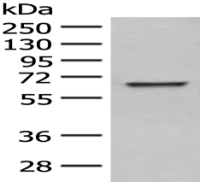
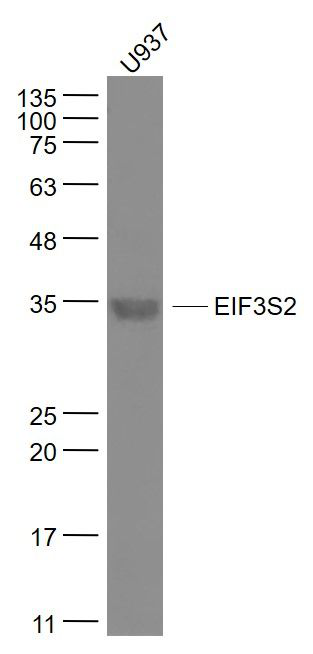
产品图片
风险提示:丁香通仅作为第三方平台,为商家信息发布提供平台空间。用户咨询产品时请注意保护个人信息及财产安全,合理判断,谨慎选购商品,商家和用户对交易行为负责。对于医疗器械类产品,请先查证核实企业经营资质和医疗器械产品注册证情况。
- 作者
- 内容
- 询问日期
 文献和实验
文献和实验Blot往往省略参照,导致结果出现问题时无法分析结果,即便有结果也可能影响结果的分析。 内参即是内部参照(Internal Control),对于哺乳动物细胞表达来说一般是指由管家基因编码表达的蛋白(Housekeeping Proteins),它们在各组织和细胞中的表达相对恒定,在检测蛋白的表达水平变化时常用它来做参照物。在western blotting实验中,除了需要进行蛋白抽提、蛋白定量、等量蛋白上样电泳、转膜、靶蛋白抗体孵育、显色等步骤以外,还需要进行内参的检测,以校正蛋白质定量
物。在Western Blotting 实验中,除了需要进行蛋白抽提、蛋白定量、等量蛋白上样电泳、转膜、靶蛋白抗体孵育、显色等步骤以外,还需要进行内参的检测,以校正蛋白质定量、上样过程中存在的实验误差,保证实验结果的准确性。 实际上内参是最容易被忽略的一项。我们知道,要用Western Blot比较不同条件下或者不同组织中,目的蛋白表达量的相对多少,前提条件是等量的细胞上样,才有比较的基础,特别表达量不高时,上样量的差别就很可能影响结果的分析,所以需要内参。在国外发表的文章中,Western
水平变化时常用它来做参照物。在Western Blotting 实验中,除了需要进行蛋白抽提、蛋白定量、等量蛋白上样电泳、转膜、靶蛋白抗体孵育、显色等步骤以外,还需要进行内参的检测,以校正蛋白质定量、上样过程中存在的实验误差,保证实验结果的准确性。在Western Blotting中使用内参其实就是在WB过程中的另外用内参对应的抗体检测内参,这样在检测目的产物的同时可以检测内参的表达,由于内参在各组织和细胞中的表达相对恒定,借助检测每个样品内参的量就可以用于校正上样误差,这样半定量的结果才更为可信