


- ¥1580 - 2480
- gelatins
- jlcR16642
- 国内
- 2025年07月11日
- WB,ELISA等
- 人/动物/植物

企业认证
相关产品推荐更多 >




万千商家帮你免费找货
0 人在求购买到急需产品
- 详细信息
- 文献和实验
- 技术资料
- 供应商:
江西江蓝纯生物试剂有限公司
- 库存:
98
- 克隆性:
单克隆
- 保质期:
1年
- 抗体英文名:
Influenza A H1N1 Neuraminidase
- 抗体名:
A型H1N1流感病毒神经氨酸酶抗体
- 适应物种:
人/动物/植物
- 应用范围:
WB,ELISA等
- 浓度:
1mg/ml
- 保存条件:
-20 °
- 规格:
100ul/200ul
| 规格: | 100ul | 产品价格: | ¥1580.0 |
|---|---|---|---|
| 规格: | 200ul | 产品价格: | ¥2480.0 |
英文名称 : Influenza A H1N1 Neuraminidase
中文名称 : A型H1N1流感病毒神经氨酸酶抗体
别 名 : Flu N1; Seasonal and Swine H1N1 Neuraminidase; Influenza N1; NRAM_I07A0; Seasonal Influenza A (H1N1) Neuraminidase.
研究领域 : 细菌及病毒
抗体来源 : Rabbit
克隆类型 : Polyclonal
交叉反应 : Influenza A virus
产品应用 : WB=1:500-2000 ELISA=1:500-1000 IHC-P=1:400-800 IHC-F=1:400-800 ICC=1:100-500 IF=1:100-500 (石蜡切片需做抗原修复)
not yet tested in other applications.
optimal dilutions/concentrations should be determined by the end user.
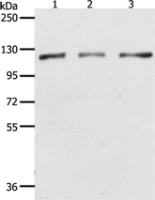
分 子 量 : 52kDa
性 状 : Lyophilized or Liquid
浓 度 : 1mg/ml
免 疫 原 : KLH conjugated synthetic peptide derived from Influenza A H1N1 Neuraminidase:201-300/470
亚 型 : IgG
纯化方法 : affinity purified by Protein A
储 存 液 : 0.01M TBS(pH7.4) with 1% BSA, 0.03% Proclin300 and 50% Glycerol.
保存条件 : Store at -20 °C for one year. Avoid repeated freeze/thaw cycles. The lyophilized antibody is stable at room temperature for at least one month and for greater than a year when kept at -20°C. When reconstituted in sterile pH 7.4 0.01M PBS or diluent of antibody the antibody is stable for at least two weeks at 2-4 °C.
PubMed : PubMed
产品介绍background:
Influenza A virus is a major public health threat, killing more than 30,000 people per year in the USA. Influenza A virus has one of sixteen possible Hemagglutinin (HA) surface proteins and one of nine possible neuraminidase (NA) surface proteins. The Hemagglutinin protein facilitates viral attachment while neuraminidase is involved in viral release. These proteins also elicit immune responses that prevent infection or independently reduce viral replication.
Function:
Catalyzes the removal of terminal sialic acid residues from viral and cellular glycoconjugates. Cleaves off the terminal sialic acids on the glycosylated HA during virus budding to facilitate virus release. Additionally helps virus spread through the circulation by further removing sialic acids from the cell surface. These cleavages prevent self-aggregation and ensure the efficient spread of the progeny virus from cell to cell. Otherwise, infection would be limited to one round of replication. Described as a receptor-destroying enzyme because it cleaves a terminal sialic acid from the cellular receptors. May facilitate viral invasion of the upper airways by cleaving the sialic acid moieties on the mucin of the airway epithelial cells. Likely to plays a role in the budding process through its association with lipid rafts during intracellular transport. May additionally display a raft-association independent effect on budding. Plays a role in the determination of host range restriction on replication and virulence. Sialidase activity in late endosome/lysosome traffic seems to enhance virus replication (By similarity).
Subunit:
Homotetramer (By similarity).
Subcellular Location:
Virion membrane (By similarity). Host apical cell membrane; Single-pass type II membrane protein (By similarity). Note=Preferentially accumulates at the apical plasma membrane in infected polarized epithelial cells, which is the virus assembly site. Uses lipid rafts for cell surface transport and apical sorting. In the virion, forms a mushroom-shaped spike on the surface of the membrane (By similarity).
Post-translational modifications:
N-glycosylated (By similarity).
Similarity:
Belongs to the glycosyl hydrolase 34 family.
Important Note:
This product as supplied is intended for research use only, not for use in human, therapeutic or diagnostic applications.
风险提示:丁香通仅作为第三方平台,为商家信息发布提供平台空间。用户咨询产品时请注意保护个人信息及财产安全,合理判断,谨慎选购商品,商家和用户对交易行为负责。对于医疗器械类产品,请先查证核实企业经营资质和医疗器械产品注册证情况。
 文献和实验
文献和实验而引起香港型流感等世界大流行。病毒抗原由血细胞凝集抗原(数种)和神经氨酸苷酶( 2种)组成,一般认为由于这些抗原的种类和量的配合而出现新的变异株,在 A型中有若干亚型。 B型即使出现新的变异株,抗原的变异是持续的,主要流行于局部地区。使人及猴、豚鼠等各种动物的红细胞凝集。培养主要用发育中鸡卵,在猴、牛等的肾及胎儿培养细胞进行繁殖。感染时经 24— 48小时的潜伏期后发病。 A型病毒除人以外也可从猪、马、鸟等分离出类似的病毒。
对药物oseltamivir具有抵抗力的突变可能对住院病人的健康形成严重的威胁,因为这些患者的免疫系统都很虚弱。 自2008年1月开始,人们观察到携带一种神经氨酸酶H274Y突变基因的对oseltamivir具有抵抗力的A型流感病毒(H1N1)已经在全世界各地出现而且快速地蔓延。人们假定,携带这种突变基因的病毒的危险性较低,而且也不太可能传播。文章的作者写道:“然而,目前出现的对oseltamivir具有抵抗力的A型流感病毒株的广泛流行以及与该病毒株有关的典型的流感症状和病毒
重要作用。类脂层是脂质双层结构,它来自宿主细胞膜或核膜,其中镶嵌的两种糖蛋白向外突出脂质双层形成刺突,构成了流感病毒囊膜的第三层一糖蛋白层。糖蛋白层由两种糖蛋白刺突组成,一种是神经氨酸酶(Neuraminidase NA),一种是血凝素 (Hemagglutinin HA)。 神经氨酸酶是由4条相同的糖基化多肽所组成的蘑菇状四聚体,具有酶活性,可水解宿主细胞表面糖蛋白末端的N-乙酰神经氨酸,有利于成熟病毒的释放(抗神经氨酸酶抗体能抑制病毒从细胞释放,但没有中和作用);神经氨酸酶的抗原结构较易


