


- ¥1580
- gelatins
- jlcR3234
- 国内
- 2026年04月10日
- WB,ELISA等
- 人/动物/植物

企业认证
相关产品推荐更多 >

万千商家帮你免费找货
0 人在求购买到急需产品
相关阅读
源叶生物 十万种现货试剂速发,品质稳、品类全,实验不再等!Takara 秋促来袭,提取+反转录+定量套装仅 1200 元abinScience 体内级抗体 全年锁价 低至 ¥1200阿拉丁 22万+ 科研级产品现货速发,品质严控、科研无忧- 详细信息
- 文献和实验
- 技术资料
- 供应商:
江西江蓝纯生物试剂有限公司
- 库存:
166
- 克隆性:
单克隆
- 保质期:
1年
- 抗体英文名:
phospho-IKK alpha (Tyr463)
- 抗体名:
磷酸化KB抑制蛋白激酶α抗体
- 适应物种:
人/动物/植物
- 应用范围:
WB,ELISA等
- 浓度:
1mg/ml
- 保存条件:
-20 °
- 规格:
100ul
英文名称 : phospho-IKK alpha (Tyr463)
中文名称 : 磷酸化KB抑制蛋白激酶α抗体
别 名 : I Kappa B Kinase Alpha; IKKalpha; IKK alpha; IkappaB kinase; IkB kinase alpha subunit; IKBKA; IKK 1; IKK A; IKK a kinase; IKK1; IKKA; Inhibitor Of Kappa Light Polypeptide Gene Enhancer In B Cells; Inhibitor Of Nuclear Factor Kappa B Kinase Alpha Subunit; NFKBIKA; Nuclear Factor Kappa B Inhibitor Kinase Alpha; Nuclear factor NF kappa B inhibitor kinase alpha; Nuclear factor NFkappaB inhibitor kinase alpha; Nuclear Factor Of Kappa Light Chain Gene Enhancer In B Cells Inhibitor; TCF16; CHUK1; Conserved Helix Loop Helix Ubiquitous Kinase; Conserved helix loop ubiquitous kinase; I Kappa B Kinase 1; IKKA_HUMAN.
产品类型 : 磷酸化抗体
研究领域 : 肿瘤 免疫学 信号转导 转录调节因子 激酶和磷酸酶 细胞粘附分子
抗体来源 : Rabbit
克隆类型 : Polyclonal
交叉反应 : Human, Mouse, Rat, Chicken, Dog, Pig, Cow, Horse, Rabbit, Sheep, Guinea Pig,
产品应用 : ELISA=1:500-1000
not yet tested in other applications.
optimal dilutions/concentrations should be determined by the end user.
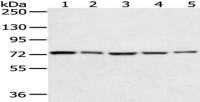
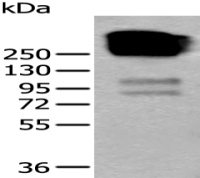
分 子 量 : 85kDa
细胞定位 : 细胞核 细胞浆
性 状 : Lyophilized or Liquid
浓 度 : 1mg/ml
免 疫 : 原KLH conjugated Synthesised phosphopeptide derived from human IKK alpha around the phosphorylation site of Tyr463:NL(p-T)KM
亚 型 : IgG
纯化方法 : affinity purified by Protein A
储 存 液 : 0.01M TBS(pH7.4) with 1% BSA, 0.03% Proclin300 and 50% Glycerol.
保存条件 : Store at -20 °C for one year. Avoid repeated freeze/thaw cycles. The lyophilized antibody is stable at room temperature for at least one month and for greater than a year when kept at -20°C. When reconstituted in sterile pH 7.4 0.01M PBS or diluent of antibody the antibody is stable for at least two weeks at 2-4 °C.
PubMed : PubMed
产品介绍 : Nuclear factor kappa B (NFkB) is a ubiquitous transcription factor and an essential mediator of gene expression during activation of immune and inflammatory responses. NFkB mediates the expression of a great variety of genes in response to extracellular stimuli including IL1, TNF alpha, and bacterial product LPS. NFkB is associated with IkB proteins in the cell cytoplasm, which inhibit NFkB activity. IKK is a serine protein kinase, and the IKK complex contains alpha and beta subunits (IKK alpha and IKK beta). IKK alpha and IKK beta interact with each other and both are essential for NFkB activation. IKK alpha specifically phosphorylates IkBa. IKKa is expressed in variety of human tissues.
Function:
Serine kinase that plays an essential role in the NF-kappa-B signaling pathway which is activated by multiple stimuli such as inflammatory cytokines, bacterial or viral products, DNA damages or other cellular stresses. Acts as part of the canonical IKK complex in the conventional pathway of NF-kappa-B activation and phosphorylates inhibitors of NF-kappa-B on serine residues. These modifications allow polyubiquitination of the inhibitors and subsequent degradation by the proteasome. In turn, free NF-kappa-B is translocated into the nucleus and activates the transcription of hundreds of genes involved in immune response, growth control, or protection against apoptosis. Negatively regulates the pathway by phosphorylating the scaffold protein TAXBP1 and thus promoting the assembly of the A20/TNFAIP3 ubiquitin-editing complex (composed of A20/TNFAIP3, TAX1BP1, and the E3 ligases ITCH and RNF11). Therefore, CHUK plays a key role in the negative feedback of NF-kappa-B canonical signaling to limit inflammatory gene activation. As part of the non-canonical pathway of NF-kappa-B activation, the MAP3K14-activated CHUK/IKKA homodimer phosphorylates NFKB2/p100 associated with RelB, inducing its proteolytic processing to NFKB2/p52 and the formation of NF-kappa-B RelB-p52 complexes. In turn, these complexes regulate genes encoding molecules involved in B-cell survival and lymphoid organogenesis. Participates also in the negative feedback of the non-canonical NF-kappa-B signaling pathway by phosphorylating and destabilizing MAP3K14/NIK. Within the nucleus, phosphorylates CREBBP and consequently increases both its transcriptional and histone acetyltransferase activities. Modulates chromatin accessibility at NF-kappa-B-responsive promoters by phosphorylating histones H3 at 'Ser-10' that are subsequently acetylated at 'Lys-14' by CREBBP. Additionally, phosphorylates the CREBBP-interacting protein NCOA3.
Subunit:
Component of the I-kappa-B-kinase (IKK) core complex consisting of CHUK, IKBKB and IKBKG; probably four alpha/CHUK-beta/IKBKB dimers are associated with four gamma/IKBKG subunits. The IKK core complex seems to associate with regulatory or adapter proteins to form a IKK-signalosome holo-complex. The IKK complex associates with TERF2IP/RAP1, leading to promote IKK-mediated phosphorylation of RELA/p65. Part of a complex composed of NCOA2, NCOA3, CHUK/IKKA, IKBKB, IKBKG and CREBBP. Part of a 70-90 kDa complex at least consisting of CHUK/IKKA, IKBKB, NFKBIA, RELA, IKBKAP and MAP3K14. Directly interacts with IKK-gamma/NEMO and TRPC4AP (By similarity). May interact with TRAF2. Interacts with NALP2. May interact with MAVS/IPS1. Interacts with ARRB1 and ARRB2. Interacts with NLRC5; prevents CHUK phosphorylation and kinase activity. Interacts with PIAS1; this interaction induces PIAS1 phosphorylation.
Subcellular Location:
Cytoplasm. Nucleus. Note=Shuttles between the cytoplasm and the nucleus.
Tissue Specificity:
Widely expressed.
Post-translational modifications:
Phosphorylated by MAP3K14/NIK, AKT and to a lesser extent by MEKK1, and dephosphorylated by PP2A. Autophosphorylated.
Acetylation of Thr-179 by Yersinia yopJ prevents phosphorylation and activation, thus blocking the I-kappa-B signaling pathway.
DISEASE:
Defects in CHUK are the cause of cocoon syndrome (COCOS) [MIM:613630]; also known as fetal encasement syndrome. COCOS is a lethal syndrome characterized by multiple fetal malformations including defective face and seemingly absent limbs, which are bound to the trunk and encased under the skin.
Similarity:
Belongs to the protein kinase superfamily. Ser/Thr protein kinase family. I-kappa-B kinase subfamily.
Contains 1 protein kinase domain.
SWISS:
O15111
Gene ID:
1147
Important Note:
This product as supplied is intended for research use only, not for use in human, therapeutic or diagnostic applications.
风险提示:丁香通仅作为第三方平台,为商家信息发布提供平台空间。用户咨询产品时请注意保护个人信息及财产安全,合理判断,谨慎选购商品,商家和用户对交易行为负责。对于医疗器械类产品,请先查证核实企业经营资质和医疗器械产品注册证情况。
 文献和实验
文献和实验Cell Metab:浙大吕志民团队揭示肿瘤细胞 Warburg 效应促进肿瘤免疫逃逸
2 从线粒体外膜脱落,进入细胞浆中。在细胞浆中,HK2 结合 NF-κB 的抑制因子 IκBα。 重要的是,HK2 发挥了不依赖于其经典代谢功能的新功能,即作为一个蛋白激酶磷酸化 IκBα 的 Thr 291 位点。该磷酸化促进了蛋白酶 μ-calpain 与 IκBα 的结合并进一步降解 IκBα,进而使转录因子 NF-κB 入核,最终促进了 PD-L1 的表达并导致了肿瘤的免疫逃逸。作者还发现,使用己糖激酶的抑制剂与 PD-1 抗体联用治疗小鼠胶质瘤,可以显著提升 PD-1 抗体的治疗
于JNK,而影响细胞的凋亡。 请各位高手指点一下 您所讲的问题即为在氧化应激的过程中JNK通路的“cross-talk”问题。目前研究的比较多的是有关氧化应激的过程中NF-kb通路通过其靶基因XIAP 和 GADD45对JNK起抑制效应(如图)。此外,还有研究指出,在氧化应激引起的凋亡过程中,MAPKs通路本身的一些激酶(如MKP1,3,5,7)也对JNK起抑制作用。 我知道的很有限,欢迎其他战友补充。
ws88523758 小弟对于实验处于纯菜鸟,糊里糊涂的做了半年多了,结果数据参差不齐,临近毕业,焦虑万分,特停高手们指导求救! 我做的是大鼠的系膜细胞,用TNF-α刺激后,再用中药干预24h,测细胞上清中的ikb和NF-KB,用的都是ELISA法。 ikb测值很低,据查当IKBα被磷酸化后分解后,P65和P50才能解离激活。所以,当刺激开始的时候,磷酸化的IKBα上调,IKBα下调。由于P65活化后又可以上调IKBα表达,所以,经过一定时间之后
 技术资料
技术资料需要更多技术资料 索取更多技术资料

