


- ¥480 - 2480
- gelatins
- jlcR0288
- 国内
- 2026年04月09日
- WB,ELISA等
- 人/动物/植物

企业认证
相关产品推荐更多 >



万千商家帮你免费找货
0 人在求购买到急需产品
- 详细信息
- 文献和实验
- 技术资料
- 供应商:
江西江蓝纯生物试剂有限公司
- 库存:
138
- 克隆性:
单克隆
- 保质期:
1年
- 抗体英文名:
TrkB
- 抗体名:
酪氨酸激酶B抗体
- 适应物种:
人/动物/植物
- 应用范围:
WB,ELISA等
- 浓度:
1mg/ml
- 保存条件:
-20 °
- 规格:
20ul/50ul/100ul/200ul
| 规格: | 20ul | 产品价格: | ¥480.0 |
|---|---|---|---|
| 规格: | 50ul | 产品价格: | ¥880.0 |
| 规格: | 100ul | 产品价格: | ¥1580.0 |
| 规格: | 200ul | 产品价格: | ¥2480.0 |
英文名称 : TrkB
中文名称 :酪氨酸激酶B抗体
别 名 : TrkB; Tyrosine Receptor Kinase B; Tyrosine kinase,Pyk2; BDNF tropomyosine receptor kinase B; BDNF/NT 3 growth factors receptor; BDNF/NT-3 growth factors receptor; Brain derived neurotrophic factor receptor; GP145 TrkB; GP145-TrkB; GP145-TrkB/GP95-TrkB; GP95 TrkB; Neurotrophic tyrosine kinase receptor type 2; Neurotrophin receptor tyrosine kinase type 2; NTRK 2; Ntrk2; NTRK2_HUMAN; Obesity, hyperphagia, and developmental delay, included; RATTRKB1; Tkrb; Trk B; Trk-B; TRKB; TrkB tyrosine kinase; TRKB1; tyrosine kinase receptor B; Tyrosine receptor kinase B.
研究领域 : 细胞生物 免疫学 神经生物学 信号转导 细胞凋亡 激酶和磷酸酶 细胞膜受体
抗体来源 : Rabbit
克隆类型 : Polyclonal
交叉反应 : Human, Mouse, Rat,
产品应用 : WB=1:500-2000 ELISA=1:500-1000 IHC-P=1:400-800 (石蜡切片需做抗原修复)
not yet tested in other applications.
optimal dilutions/concentrations should be determined by the end user.
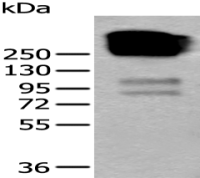
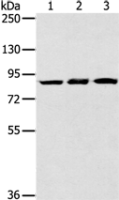
分 子 量 : 90kDa
细胞定位 : 细胞浆
性 状 : Lyophilized or Liquid
浓 度 : 1mg/ml
免 疫 原 : KLH conjugated synthetic peptide derived from human Trk B:32-120/822
亚 型 : IgG
纯化方法 : affinity purified by Protein A
储 存 液 : 0.01M TBS(pH7.4) with 1% BSA, 0.03% Proclin300 and 50% Glycerol.
保存条件 : Store at -20 °C for one year. Avoid repeated freeze/thaw cycles. The lyophilized antibody is stable at room temperature for at least one month and for greater than a year when kept at -20°C. When reconstituted in sterile pH 7.4 0.01M PBS or diluent of antibody the antibody is stable for at least two weeks at 2-4 °C.
PubMed : PubMed
产品介绍 : The Trk family of nerve growth factor receptors includes Trk A(also referfed to as Trk A gp140),Trk B and Trk C. The prototype member of this gene family, Trk A, encodes a 140 kDa cell surface receptor, gp140, the expression of which is restricted in vivo to neurons of the sensory spinal and cranial gangliaof neurocrest origin. Nerve growth factor (NGF) stimulates tyrosine phosphorylation of Trk gp 140 in neural cell lines and in embryonic dorsal root ganglia. By comparison, BDNF and to a lesser extent, NT-3, but not NGF, can induce tyrosine phophorylayion of Trk B gp 145. The third member of the Trk receptor family, Trk C incodes a 140 kDa protein, Trk C gp140, that is preferentially expressed in brain tissue and primarily functions as a receptor for NT-3.An additional component of the Trk receptor complex, NGFR p175, binds to neurotrophic factors with low affinity but is required for efficient signaling. NGFR p175 accelerates Trk activation and may recruit downstream dffector molecules to the ligand-bound receptor complex.
Function:
Receptor tyrosine kinase involved in the development and the maturation of the central and the peripheral nervous systems through regulation of neuron survival, proliferation, migration, differentiation, and synapse formation and plasticity. Receptor for BDNF/brain-derived neurotrophic factor and NTF4/neurotrophin-4. Alternatively can also bind NTF3/neurotrophin-3 which is less efficient in activating the receptor but regulates neuron survival through NTRK2. Upon ligand-binding, undergoes homodimerization, autophosphorylation and activation. Recruits, phosphorylates and/or activates several downstream effectors including SHC1, FRS2, SH2B1, SH2B2 and PLCG1 that regulate distinct overlapping signaling cascades. Through SHC1, FRS2, SH2B1, SH2B2 activates the GRB2-Ras-MAPK cascade that regulates for instance neuronal differentiation including neurite outgrowth. Through the same effectors controls the Ras-PI3 kinase-AKT1 signaling cascade that mainly regulates growth and survival. Through PLCG1 and the downstream protein kinase C-regulated pathways controls synaptic plasticity. Thereby, plays a role in learning and memory by regulating both short term synaptic function and long-term potentiation. PLCG1 also leads to NF-Kappa-B activation and the transcription of genes involved in cell survival. Hence, it is able to suppress anoikis, the apoptosis resulting from loss of cell-matrix interactions. May also play a role in neutrophin-dependent calcium signaling in glial cells and mediate communication between neurons and glia.
Subunit:
Exists in a dynamic equilibrium between monomeric (low affinity) and dimeric (high affinity) structures. Interacts (phosphorylated upon activation by BDNF) with SHC1; mediates SHC1 phosphorylation and activation. Interacts (phosphorylated upon activation by BDNF) with PLCG1 and/or PLCG2; mediates PLCG1 phosphorylation and activation. Interacts with SH2B1 and SH2B2. Interacts with NGFR; may regulate the ligand specificity of the receptor. Interacts (phosphorylated upon ligand-binding) with SH2D1A; regulates NTRK2. Interacts with SQSTM1 and KIDINS220. Interacts (phosphorylated upon ligand-binding) with FRS2; activates the MAPK signaling pathway.
Subcellular Location:
Cell membrane; Single-pass type I membrane protein. Endosome membrane; Single-pass type I membrane protein. Note=Internalized to endosomes upon ligand-binding.
Tissue Specificity:
facial structures, the submaxillary glands, and dorsal root ganglia. Isoform Isoform TrkB is expressed in the central and peripheral nervous system. In the central nervous system (CNS), expression is observed in the cerebral cortex, hippocampus, thalamus, choroid plexus, granular layer of the cerebellum, brain stem, and spinal cord. In the peripheral nervous system, it is expressed in many cranial ganglia, the ophtalmic nerve, the vestibular system, multiple facial structures, the submaxillary glands, and dorsal root ganglia. Isoform TrkB-T1 is mainly expressed in the brain but also detected in other tissues including pancreas, kidney and heart. Isoform TrkB-T-Shc is predominantly expressed in the brain.
Post-translational modifications:
Phosphorylated. Undergoes ligand-mediated autophosphorylation that is required for interaction with SHC1 and PLCG1 and other downstream effectors. Isoform TrkB-T-Shc is not phosphorylated.
Ubiquitinated. Undergoes polyubiquitination upon activation; regulated by NGFR. Ubiquitination regulates the internalization of the receptor.
DISEASE:
Defects in NTRK2 are the cause of obesity hyperphagia and developmental delay (OHPDD) [MIM:613886]. OHPDD is a disorder characterized by early-onset obesity, hyperphagia, and severe developmental delay in motor function, speech, and language.
Similarity:
Belongs to the protein kinase superfamily. Tyr protein kinase family. Insulin receptor subfamily.
Contains 2 Ig-like C2-type (immunoglobulin-like) domains.
Contains 2 LRR (leucine-rich) repeats.
Contains 1 LRRCT domain.
Contains 1 LRRNT domain.
Contains 1 protein kinase domain.
SWISS:
Q16620
Gene ID:
4915
Important Note:
This product as supplied is intended for research use only, not for use in human, therapeutic or diagnostic applications.
风险提示:丁香通仅作为第三方平台,为商家信息发布提供平台空间。用户咨询产品时请注意保护个人信息及财产安全,合理判断,谨慎选购商品,商家和用户对交易行为负责。对于医疗器械类产品,请先查证核实企业经营资质和医疗器械产品注册证情况。
 文献和实验
文献和实验上海西唐生物科技有限公司 021-55229872, 65333639 www.westang.com 人酪氨酸激酶B (TrKB)ELISA 试剂盒 ( 用于血清、血浆、细胞培养上清液和尿液、唾液生物体液内 ) 原理 本实验采用双抗体夹心 ABC-ELISA 法。用抗人 TrKB/CCL5 单抗包被于酶标板上,标准品和样品中的 TrKB与单抗结合,加入生物
人酪氨酸激酶抗体(MUCK-Ab)酶联免疫分析(ELISA)
人酪氨酸激酶抗体( MUCK-Ab ) 酶联免疫分析(ELISA ) 试剂盒使用说明书 本试剂仅供研究使用 目的:本试剂盒用于检测人血清,血浆及相关液体样本中酪氨酸激酶抗体(MUCK-Ab )水平,感染人的血液学诊断。 实验原理: 本试剂盒采用双抗原夹心酶联免疫法( ELISA )测定标本中人酪氨酸激酶抗体( MUCK-Ab )。用纯化的抗原包被微孔板,制成固相抗原,可与样品中酪氨酸激酶抗体( MUCK
1.留存抗体和桨细胞 抗原清除后,体内留存的抗体可特异性地直接结合再次出现的病毒颗粒、细菌和寄生虫,对后者实施中和作用和调理功能,构成记忆性抗感染的第一道防线,但发挥效应的时间不长。 抗体由浆细胞产生。浆细胞的寿命通常只有几天,称为短寿性浆细胞短寿性浆细胞系初始B细胞由抗原直接诱导产生,停留在外周淋巴器官和组织。长寿性浆细胞则经由生发中心由记忆性B细胞产生。近年来的研究揭示,此类浆细胞可长期存活。 2.记忆性B细胞 初始B细胞遭遇TD抗原后,在Th


