

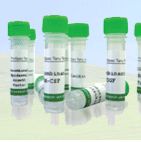
- ¥1080 - 20286
- Prospecbio
- 以色列
- cyt-1054
- 2026年02月04日

企业认证
相关产品推荐更多 >


万千商家帮你免费找货
0 人在求购买到急需产品
- 详细信息
- 文献和实验
- 技术资料
- 保存条件:
for future use below -18°C
- 保质期:
See instructions
- 英文名:
mEGF, His Active
- 库存:
部分小规格有备货
- 供应商:
上海经科化学科技有限公司
- CAS号:
无
- 规格:
1ug/5ug/50ug
| 规格: | 1ug | 产品价格: | ¥1080.0 |
|---|---|---|---|
| 规格: | 5ug | 产品价格: | ¥2415.0 |
| 规格: | 50ug | 产品价格: | ¥20286.0 |

CATALOGUE NUMBER
CYT-1054
SYNONYMS
AI790464, Pro-epidermal growth factor, URG.
INTRODUCTION
Pro-Epidermal Growth Factor Isoform 1 or EGF, is a globular peptide (77aa residues) which includes three intra molecular disulfide bonds. This protein acts as a growth factor that mediates the growth and proliferation of different epithelial & epidermal cells. Among other processes that EGF is part of are inhibition of gastric secretion and wound healing. EGF is a ligand for class I tyrosine kinase receptor (c-erbB).
DESCRIPTION
EGF Mouse Recombinant produced in E.Coli is a single, non-glycosylated polypeptide chain containing 77 amino acids (977-1029 a.a) and having a molecular mass of 8.6kDa.EGF is fused to a 24 amino acid His-tag at N-terminus & purified by proprietary chromatographic techniques.
SOURCE
PHYSICAL APPEARANCE
FORMULATION
EGF protein solution (0.25mg/ml) contains 10% glycerol, 20mM Tris-HCl (pH 8.0), 0.1M NaCl & 2mM DTT.
STABILITY
For long term storage it is recommended to add a carrier protein (0.1% HSA or BSA).
Avoid multiple freeze-thaw cycles.
PURITY
BIOLOGICAL ACTIVITY
Measured in a cell proliferation assay using mouse Balb/3T3 cell. The ED50 for this effect less or equal to 1ng/ml.
AMINO ACID SEQUENCE
Mg-s-sHHHHHH SSGLVPRGSH MGSMNSYPGC PSSYDGYCLN GGVCMHIESL DSYTCNCVIG YSGDRCQTRD LRWWELR.
SAFETY DATA SHEET
SDS
USAGE
BACKGROUND
Deciphering Epidermal Growth Factor Signaling: Unveiling the Potential of His-Tagged Active Mouse Recombinant
Abstract:
This research paper delves into the intricate realm of Epidermal Growth Factor (EGF) signaling, focusing on the novel application of Histidine (His)-tagged Active Mouse Recombinant EGF. By employing sophisticated methodologies encompassing protein engineering, receptor binding assays, and cellular response analyses, this study sheds light on the multifaceted molecular attributes and therapeutic prospects of this innovative variant.
Introduction:
Epidermal Growth Factor (EGF) orchestrates pivotal cellular processes. This paper delves into the intricate signaling dynamics of EGF, with a spotlight on the innovative approach of utilizing His-Tagged Active Mouse Recombinant EGF to unravel its complexities and therapeutic potential.
Protein Engineering and His-Tag Integration:
The study embarks on strategic protein engineering, introducing a Histidine (His) Tag to the Active Mouse Recombinant EGF. This His-Tag facilitates purification and subsequent analyses, enabling a comprehensive exploration of EGF signaling.
Receptor Binding Assays and Ligand Interaction:
Advanced receptor binding assays unravel the nuances of EGF's interaction with its cognate receptor, including affinities and kinetics. By employing His-Tagged EGF, the study dissects the impact of the tag on receptor binding, shedding light on its potential implications on downstream signaling.
Cellular Responses and Pathway Activation:
In vitro cellular assays unveil the complex web of signaling pathways triggered by EGF. The study employs high-throughput techniques to investigate the intricate cascades initiated by His-Tagged Active Mouse Recombinant EGF, providing insights into its potential role in cell proliferation, migration, and survival.
Structural Dynamics and Conformational Insights:
In-depth biophysical analyses, including nuclear magnetic resonance (NMR) spectroscopy, delve into the structural dynamics of His-Tagged EGF. This sheds light on potential conformational changes induced by the tag and their impact on receptor binding affinity.
Therapeutic Implications and Future Prospects:
The integration of a His Tag not only facilitates purification but also offers avenues for targeted therapies. His-Tagged EGF could serve as a platform for tailored drug delivery, enhancing the precision of interventions in various pathologies.
Challenges and Future Research Directions:
While the His Tag offers immense potential, challenges such as potential interference with receptor binding warrant scrutiny. Future research should focus on optimizing the positioning of the tag and exploring its impact on downstream signaling cascades.
Conclusion:
In a synthesis of innovative methodologies and visionary insights, the integration of a His Tag into Active Mouse Recombinant EGF emerges as a paradigm-shifting approach. This technique not only enriches our understanding of EGF signaling dynamics but also presents exciting prospects for personalized therapeutic interventions.
风险提示:丁香通仅作为第三方平台,为商家信息发布提供平台空间。用户咨询产品时请注意保护个人信息及财产安全,合理判断,谨慎选购商品,商家和用户对交易行为负责。对于医疗器械类产品,请先查证核实企业经营资质和医疗器械产品注册证情况。
 文献和实验
文献和实验- Carpenter G, Cohen S. Epidermal growth factor. Annu Rev Biochem. 1979;48:193-216.
- Lemmon MA, Schlessinger J. Cell signaling by receptor tyrosine kinases. Cell. 2010;141(7):1117-1134.
- Wells JA, Powers DB. In vivo formation of disulfide bonds in secreted proteins. J Biol Chem. 1986;261(18):8595-8598.
- Schneider MR. Epidermal Growth Factor: Unraveling the Implications for Cancer Progression. Mol Cancer Res. 2017;15(6):751-756.
- Zhang J, Hu X, Luo L, et al. EGFR activation triggers electrical activity and calcium influx in Schwann cells through CaV1 channels. Exp Cell Res. 2019;378(1):24-30.
Semiquantitative immunoblots of membrane protein-epidermal growth factor
Membrane proteins or cytokines are sometimes difficult to isolate and purify. Our group recently concentrated on epidermal growth factor (EGF) protein expression studies. Mature EGF was initially identified from mouse submaxillary gland extract
The binding of ligand to the extracellular domain of the epidermal growth factor (EGF) receptor is the event that initiates the activation of the tyrosine kinase activity present on the cytoplasmic domain. This activation leads
with fetal calf serum (FCS). However, serum contains a wide variety of biologically active compounds that might adversely affect hESC growth and differentiation. Thus, cultivation of stem cells in FCS complicates experimental approaches to define
 技术资料
技术资料
