

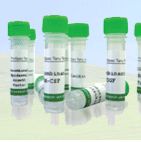
- ¥1080 - 45885
- Prospecbio
- 以色列
- cyt-438
- 2026年02月05日

企业认证
相关产品推荐更多 >


万千商家帮你免费找货
0 人在求购买到急需产品
- 详细信息
- 文献和实验
- 技术资料
- 保存条件:
for future use below -18°C
- 保质期:
See instructions
- 英文名:
CTGF, His
- 库存:
部分小规格有备货
- 供应商:
上海经科化学科技有限公司
- CAS号:
无
- 规格:
5ug/20ug/1mg
| 规格: | 5ug | 产品价格: | ¥1080.0 |
|---|---|---|---|
| 规格: | 20ug | 产品价格: | ¥2415.0 |
| 规格: | 1mg | 产品价格: | ¥45885.0 |

CATALOGUE NUMBER
CYT-438
SYNONYMS
INTRODUCTION
Full length secreted CCN proteins can show an antiproliferative activity, whereas truncated isoforms are likely to stimulate proliferation and behave as oncogenes. The full length protein consists of four modulesModule I shares partial identity with the N-terminal part of the Insulin-like Growth Factor Binding Proteins (IGFBPs).
Module II includes a stretch of 70amino acid residues – which shares sequence identity with the Von Willebrand Factor Type C repeat (VWC).
Module III contains sequences sharing identity with the Thrombospondin type 1 repeat (TSP1) (WSXCSXXCG), which is thought to be implicated in the binding of sulfated glycoconjugates and to be important for cell adhesion. Module IV, also designated CT, is encoded by exon5. It is the leasts conserved one of the four domains at the level of nucleotide sequence, but it appears to be critical for several of the biological functions attributed to the CCN proteins. Module IV resembles the CT domain of several extracellular protein including, Von Willebrand's factor and mucins. Sequence similarities to heparin-binding motifs are also found within this domain.
Proteolysis of the secreted full-length CCN proteins that has been reported in the case of CCN2 and CCN3 might result in the production of CCN-derived peptides with high affinity for ligands that full-length CNN proteins bind only poorly. Amino-truncated CCN2 isoforms were biologically active whereas no specific biological activity has been attributed to the truncated CCN3. Although the molecular processes underlying the production of these secreted isoforms is presently unknown, it is important to note that proteolysis occur at the same amino acid residues in both CCN2 and CCN3. An elevated expression of CCN2 has also been detected by Northern blotting in human invasive mammary ductal carcinomas, dermatofibromas, pyogenic granuloma, endothelial cells of angiolipomas and angioleiomyomas, and in pancreatic tumors. A study performed with chondrosarcomas representative of various histological grades established that CCN2 expression was closely correlated with increasing levels of malignancy. In agreement with CCN2 playing a role in brain tumor angiogenesis, immunocytochemistry studies indicated that both glioblastoma tumor cells and proliferating endothelial cells stained positive for CCN2. In astrocytomas, CCN2 expression was particularly elevated in high grade tumors, with a marked effect of CCN2 on cell proliferation. Downregulation of CCN2 expression in these cells was associated with a growth arrest at the G1/S transition while over-expression of CCN2 induced a two-fold increase of the number of cells in the G1 phase. Gene profiling analysis allowed to identify a set of about 50 genes whose expression might account for the proliferative activity of CCN2 in these cells. CCN2 was seen in a higher proportion of mononuclear cells of patients with acute lymphoblastic leukemia.
DESCRIPTION
The CTGF is fused to a 21 amino acid His-Tag at N-terminus and purified by proprietary chromatographic techniques.
SOURCE
PHYSICAL APPEARANCE
FORMULATION
STABILITY
Store, frozen at -20°C for longer periods of time.
For long term storage it is recommended to add a carrier protein (0.1% HSA or BSA).
Avoid multiple freeze-thaw cycles.
PURITY
AMINO ACID SEQUENCE
SAFETY DATA SHEET
SDS
USAGE
风险提示:丁香通仅作为第三方平台,为商家信息发布提供平台空间。用户咨询产品时请注意保护个人信息及财产安全,合理判断,谨慎选购商品,商家和用户对交易行为负责。对于医疗器械类产品,请先查证核实企业经营资质和医疗器械产品注册证情况。
 文献和实验
文献和实验CTGF Human Recombinant produced in E.coli is a single, non-glycosylated polypeptide chain containing 344 amino acids (27-349) and having a molecular mass of 37.7kDa.
The CTGF is fused to a 21 amino acid His-Tag at N-terminus and purified by proprietary chromatographic techniques.
the formation of scar tissue throughout the body. Furthermore, connective tissue growth factor (CTGF) has been shown to mediate most of the fibrotic actions of TGF-β, including stimulation of synthesis of extracellular matrix and differentiation of fibroblasts
Secretion of Recombinant Human Insulin-Like Growth Factor I (IGF-I)
The development of efficient recombinant protein production processes can be a critical factor in whether or not a pharmaceutical therapeutic protein can enter human clinical trials and ultimately the marketplace. This is especially true
The large number of cytokines and growth factors implicated in the regulation of liver regeneration has led to the possibility of using these molecules in therapy, namely, in the case of recombinant human hepatocyte growth factor (rhHGF
 技术资料
技术资料
