

- 询价
- gelatins
- JC264343
- 进口/国产
- 2025年07月09日
- ELISA, WB
- Rabbit
- 人/动物/植物

企业认证
相关产品推荐更多 >





万千商家帮你免费找货
0 人在求购买到急需产品
- 详细信息
- 文献和实验
- 技术资料
- 供应商:
上海机纯实业有限公司
- 库存:
大量
- 克隆性:
单克隆
- 保质期:
12个月
- 抗体英文名:
Anti-KDM4D antibody
- 宿主:
Rabbit
- 适应物种:
人/动物/植物
- 应用范围:
ELISA, WB
- 浓度:
0.78 mg/ml
- 保存条件:
-20°C
- 规格:
25 μl/100 μl/200 μl
Cat. No. JC264343
Package 25 μl/100 μl/200 μl
Storage -20°C, pH7.4 PBS, 0.05% NaN3, 40% Glycerol
Product overview
Description Anti-KDM4D rabbit polyclonal antibody
Applications ELISA, WB
Immunogen Synthetic peptide of human KDM4D
Reactivity Human
Content 0.78 mg/ml
Host species Rabbit
Ig class Immunogen-specific rabbit IgG
Purification Antigen affinity purification
Target information
Symbol KDM4D
Full name lysine demethylase 4D
Synonyms JMJD2D
Swissprot Q6B0I6
Target Background
Histone demethylase that specifically demethylates 'Lys-9' of histone H3, thereby playing a central role in histone code. Does not demethylate histone H3 'Lys-4', H3 'Lys-27', H3 'Lys-36' nor H4 'Lys-20'. Demethylates both di- and trimethylated H3 'Lys-9' residue, while it has no activity on monomethylated residues. Demethylation of Lys residue generates formaldehyde and succinate.
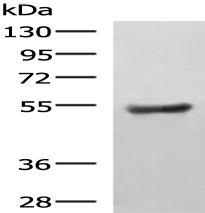
Anti-KDM4D antibody
Applications
Western blotting
Predicted band size:58 kDa
Positive control:Human fetal brain tissue lysate
Recommended dilution: 500-2000
风险提示:丁香通仅作为第三方平台,为商家信息发布提供平台空间。用户咨询产品时请注意保护个人信息及财产安全,合理判断,谨慎选购商品,商家和用户对交易行为负责。对于医疗器械类产品,请先查证核实企业经营资质和医疗器械产品注册证情况。
 文献和实验
文献和实验Generation of Antibody Molecules Through Antibody Engineering
been overcome to a large extent using genetic-engineering techniques to produce chimeric mouse/human and completely human antibodies. Such an approach is particularly suitable because of the domain structure of the antibody molecule ( 2 ), where functional
ELISA Procedure for Measuring Serum Antibody Titer
to the polystyrene microtiter plate first. The antiserum containing the anti-peptide antibody is then added to the well and allowed to bind. Finally, a second antibody, specific for the first antibody and labeled for detection, is added to the well and allowed
The importance of antibody molecules was first recognized in the 1890s, when it was shown that immunity to tetanus and diphtheria was caused by antibodies against the bacterial exotoxins (1 ). Around the same time, it was shown that antisera


