

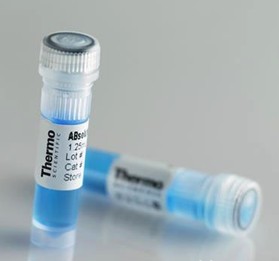
- ¥2219
- AAT
- 1265
- USA
- 2026年05月28日


相关产品推荐更多 >

万千商家帮你免费找货
0 人在求购买到急需产品
- 详细信息
- 文献和实验
- 技术资料
- 库存:
抗体标记试剂盒iFlour 790,优于Alexa Fluor
- 英文名:
Rapid iFluor™ 790 Antibody Labeling Kit *Microscale Optimized for Labeling 50 µg Antibody Per Reaction
- 保存条件:
低温
- 规格:
2 Labelings
Rapid iFluor™ 790 Antibody Labeling Kit *Microscale Optimized for Labeling 50 µg Antibody Per Reaction
现在来说说iFlourTM 染料是啥。大家对Alexa Fluor® 荧光应该很熟悉,iFlourTM 是比Alexa Fluor®稳定性及亮度更好的荧光 。
简单快速;
无需纯化;
Components
| Component A: iFluor™ 790 | 2 vials (One vial is for 50 μg protein) |
| Component B: Reaction Buffer | 1 vial (20 µL) |
| Component C: TQ™-Dyed Quench Buffer | 1 vial (20 µL) |
Example protocol
At a glance
Table 1. Available fluorophores in AAT Bioquest ReadyLink™ Rapid Antibody Labelling Kits
| Cat# | Labels | Ex (nm) | Em (nm) |
| 1100 | mFluor™ Violet 450 | 403 | 454 |
| 1105 | mFluor™ Violet 420 | 398 | 411 |
| 1110 | mFluor™ Violet 510 | 414 | 508 |
| 1114 | mFluor™ Violet 540 | 399 | 550 |
| 1120 | mFluor™ Blue 570 | 553 | 570 |
| 1123 | mFluor™ Green 620 | 522 | 617 |
| 1126 | mFluor™ Yellow 630 | 561 | 630 |
| 1130 | mFluor™ Red 700 | 657 | 700 |
| 1131 | mFluor™ Red 780 | 629 | 780 |
| 1220 | iFluor™ 350 | 345 | 442 |
| 1227 | iFluor™ 555 | 559 | 569 |
| 1230 | iFluor™ 594 | 592 | 614 |
| 1235 | iFluor™ 647 | 654 | 674 |
| 1240 | iFluor™ 680 | 682 | 701 |
| 1245 | iFluor™ 700 | 693 | 713 |
| 1250 | iFluor™ 750 | 753 | 779 |
| 1255 | iFluor™ 488 | 491 | 514 |
| 1260 | iFluor™ 633 | 638 | 655 |
| 1265 | iFluor™ 790 | 782 | 811 |
| 1290 | Cy3 | 555 | 565 |
| 1292 | Cy5 | 644 | 665 |
| 1294 | Cy7 | 749 | 776 |
| 1299 | FITC | 494 | 520 |
Preparation of working solution
Important
Warm all the components and centrifuge the vials briefly before opening, and immediately prepare the required solutions before starting your conjugation. The following protocol is for recommendation.
Protein working solution (Solution A):
For labeling 50 µg of protein (assuming the target protein concentration is 1 mg/mL), mix 5 µL (10% of the total reaction volume) of Reaction Buffer (Component B) with 50 µL of the target protein solution. Note: If you have a different protein concentration, adjust the protein volume accordingly to make ~50 µg of protein available for your labeling reaction. Note: For labeling 100 µg of protein (assuming the target protein concentration is 1 mg/mL), mix 10 µL (10% of the total reaction volume) of Reaction Buffer (Component B) with 100 µL of the target protein solution. Note: The protein should be dissolved in 1X phosphate buffered saline (PBS), pH 7.2 - 7.4; if the protein is dissolved in glycine buffer, it must be dialyzed against 1X PBS, pH 7.2 - 7.4, or use Amicon Ultra-0.5, Ultracel-10 Membrane, 10 kDa (cat# UFC501008 from Millipore) to remove free amines or ammonium salts (such as ammonium sulfate and ammonium acetate) that are widely used for protein precipitation. Note: Impure antibodies or antibodies stabilized with bovine serum albumin (BSA) or gelatin will not be labeled well. Note: For optimal labeling efficiency, a final protein concentration range of 1 - 2 mg/mL is recommended, with a significantly reduced conjugation efficiency at less than 1 mg/mL.
Procedure
Run conjugation reaction
- Add the protein working solution (Solution A) to ONE vial of labeling dye (Component A), and mix them well by repeatedly pipetting for a few times or vortex the vial for a few seconds. Note: If labeling 100 µg of protein, use both vials (Component A) of labeling dye by dividing the 100 µg of protein into 2 x 50 µg of protein and reacting each 50 µg of protein with one vial of labeling dye. Then combine both vials for the next step.
- Keep the conjugation reaction mixture at room temperature for 30 - 60 minutes. Note: The conjugation reaction mixture can be rotated or shaken for longer time if desired.
Stop Conjugation reaction
- Add 5 µL (for 50 µg protein) or 10 µL (for 100 µg protein) which is 10% of the total reaction volume of TQ™-Dyed Quench Buffer (Component C) into the conjugation reaction mixture; mix well.
- Incubate at room temperature for 10 minutes. The labeled protein (antibody) is now ready to use.
Storage of Protein Conjugate
The protein conjugate should be stored at > 0.5 mg/mL in the presence of a carrier protein (e.g., 0.1% bovine serum albumin). For longer storage, the protein conjugates could be lyophilized or divided into single-used aliquots and stored at ≤ –20°C.
风险提示:丁香通仅作为第三方平台,为商家信息发布提供平台空间。用户咨询产品时请注意保护个人信息及财产安全,合理判断,谨慎选购商品,商家和用户对交易行为负责。对于医疗器械类产品,请先查证核实企业经营资质和医疗器械产品注册证情况。
 文献和实验
文献和实验SE 活性部分远低于50%(AlexaFluor488微量标记试剂盒产品信息,Invitrogen)。相反,所有Biotium 的CF染料具有相对稳定的胺活性的SE基团型,这比大部分AlexaFluor 染料的SE更耐水解。总体来说,CF染料SE产品一贯的给出更高的标记效率,提供给用户更好的使用价值。选择方案:蓝色(350-450nm处激发) CF 350、Alexa Fluor 350、AMCA等----亮蓝和紫外光激发CF350是类似于Alexa Fluor 350和传统荧光染料AMCA的蓝色
红外荧光染料。 以花青素为基础的远红外荧光染料CF 647 比Cy 5、Alexa Fluor 647 明亮。 CF 660、Alexa Fluor® 660, Allophycocyanin (APC)等介于远红外近红外之间的荧光染料。 6、近红外(680-790nm处激发) CF 680R/ 680、Alexa Fluor 680, Cy 5.5, IR Dye 680等近红外荧光染料。 CF680 是高水溶性的以花青素为基础的染料,分子量大约为3000。该染料标记抗体极佳,发出
,一组使用 NaHS 处理,一组则不作处理;然后用荧光马来酰亚胺染料 Alexa Fluor 488 C5 maleimide(下文简称MAL,Invitrogen,A10254)标记半胱氨酸上的硫醇基团,使正常的半胱氨酸通过 -S- 与 MAL 连接,而硫巯基化的半胱氨酸通过二硫键 -S-S- 与 MAL 连接,如下图: 图 1. 文献 Fig. 6G,硫巯基化分析步骤 接下来加入 DTT,硫巯基化蛋白上特有的二硫键就会被解开,导致荧光 MAL 分子脱落,荧光信号减弱。所以,荧光信号发生变化就验证
 技术资料
技术资料暂无技术资料 索取技术资料

