

- 询价
- gelatins
- JC124465
- 进口/国产
- 2025年07月12日
- ELISA, WB
- Rabbit
- 人/动物/植物

企业认证
相关产品推荐更多 >
万千商家帮你免费找货
0 人在求购买到急需产品
相关阅读
源叶生物 十万种现货试剂速发,品质稳、品类全,实验不再等!Takara 秋促来袭,提取+反转录+定量套装仅 1200 元abinScience 体内级抗体 全年锁价 低至 ¥1200阿拉丁 22万+ 科研级产品现货速发,品质严控、科研无忧- 详细信息
- 文献和实验
- 技术资料
- 供应商:
上海机纯实业有限公司
- 库存:
大量
- 克隆性:
多克隆
- 保质期:
12个月
- 抗体英文名:
Anti-CD3G antibody
- 宿主:
Rabbit
- 适应物种:
人/动物/植物
- 应用范围:
ELISA, WB
- 浓度:
0.4 mg/ml
- 保存条件:
-20°C
- 规格:
25 μl/100 μl/200 μl
Cat. No. JC124465
Package 25 μl/100 μl/200 μl
Storage -20°C, pH7.4 PBS, 0.05% NaN3, 40% Glycerol
Product overview
Description Anti-CD3G rabbit polyclonal antibody
Applications ELISA, WB
Immunogen Fusion protein of human CD3G
Reactivity Human, Mouse
Content 0.4 mg/ml
Host species Rabbit
Ig class Immunogen-specific rabbit IgG
Purification Antigen affinity purification
Anti-CD3G antibody
Target information
Symbol CD3G
Full name CD3g molecule
Synonyms T3G; IMD17; CD3-GAMMA
Swissprot P09693
Target Background
The protein encoded by this gene is the CD3-gamma polypeptide, which together with CD3-epsilon, -delta and -zeta, and the T-cell receptor alpha/beta and gamma/delta heterodimers, forms the T-cell receptor-CD3 complex. This complex plays an important role in coupling antigen recognition to several intracellular signal-transduction pathways. The genes encoding the epsilon, gamma and delta polypeptides are located in the same cluster on chromosome 11. Defects in this gene are associated with T cell immunodeficiency.
Anti-CD3G antibody
Applications
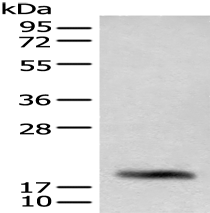
Western blotting
Predicted band size:20 kDa
Positive control:Mouse thymus tissue lysate
Recommended dilution: 200-1000
风险提示:丁香通仅作为第三方平台,为商家信息发布提供平台空间。用户咨询产品时请注意保护个人信息及财产安全,合理判断,谨慎选购商品,商家和用户对交易行为负责。对于医疗器械类产品,请先查证核实企业经营资质和医疗器械产品注册证情况。
 文献和实验
文献和实验ANTIBODY BINDING TO PROTEIN A AND PROTEIN G
Protein A, derived from the cell wall of Staphylococcus aureus , and protein G, derived from the cell wall of certain strains of b -hemolytic Streptococcci , binds the Fc region
Antibody Purification: Affinity Chromatography Protein A and Protein G Sepharose
G coupled to agarose. In the Subheading 3 there are also protocols for affinity purification using a specific ligand coupled to commercial matrices like CNBr- Sepharose 4-B and Affigel.
Analysis and Purification of Antibody Fragments Using Protein A, Protein G, and Protein L
Today, monoclonal antibodies (mAbs) form the largest category of biopharmaceuticals in clinical trials and their number is expanding rapidly (DataMonitor 2007). The antibodies or functional antibody fragments are being produced in artificial
 技术资料
技术资料需要更多技术资料 索取更多技术资料

