

- ¥2980
- LMAI Bio
- LM-13465R-FITC
- 中国/美国/欧洲
- 2025年07月07日
- ICC=1:50-200 IF=1:50-200
- Human, Mouse, Rat, Dog, Horse, Zebrafish,
- Human, Mouse, Rat, Dog, Horse, Zebrafish,

企业认证
相关产品推荐更多 >
万千商家帮你免费找货
0 人在求购买到急需产品
相关阅读
香烟烟雾如何加速声带纤维化?CD44-透明质酸轴是关键通路Takara 秋促来袭,提取+反转录+定量套装仅 1200 元abinScience 体内级抗体 全年锁价 低至 ¥1200阿拉丁 22万+ 科研级产品现货速发,品质严控、科研无忧- 详细信息
- 文献和实验
- 技术资料
- 供应商:
上海联迈生物工程有限公司
- 库存:
大量
- 靶点:
详见说明书
- 级别:
1
- 目录编号:
LM-13465R-FITC
- 克隆性:
多克隆
- 抗原来源:
Rabbit
- 保质期:
1年
- 抗体英文名:
Anti-GNB1L/FITC
- 抗体名:
Anti-GNB1L/FITC
- 标记物:
FITC标记
- 宿主:
Human, Mouse, Rat, Dog, Horse, Zebrafish,
- 适应物种:
Human, Mouse, Rat, Dog, Horse, Zebrafish,
- 免疫原:
详见说明书
- 亚型:
IGg
- 形态:
粉末、液体、冻干粉
- 应用范围:
ICC=1:50-200 IF=1:50-200
- 浓度:
1mg/ml
- 保存条件:
-20 °C
- 规格:
100ul
| 英文名称 | Anti-GNB1L/FITC |
| 中文名称 | FITC标记的G蛋白β样蛋白抗体 |
| 别 名 | DGCRK3; ESTM55; fb98e06; fj09d12; FKSG1; G-protein beta subunit-like protein; guanine nucleotide binding protein (G protein), beta polypeptide 1-like; guanine nucleotide binding protein beta-subunit-like polypeptide; GY2; KIAA1645; WDR14; WDVCF; wu:fb98e06; wu:fj09d12; zgc:55774. |
| 规格价格 | 100ul/2980元 购买 大包装/询价 |
| 说 明 书 | 100ul |
| 研究领域 | 心血管 细胞生物 信号转导 G蛋白偶联受体 G蛋白信号 |
| 抗体来源 | Rabbit |
| 克隆类型 | Polyclonal |
| 交叉反应 | Human, Mouse, Rat, Dog, Horse, Zebrafish, |
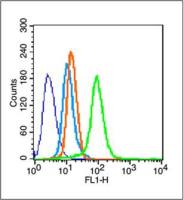
| 产品应用 | ICC=1:50-200 IF=1:50-200 not yet tested in other applications. optimal dilutions/concentrations should be determined by the end user. |
| 分 子 量 | 36kDa |
| 性 状 | Lyophilized or Liquid |
| 浓 度 | 1mg/ml |
| 免 疫 原 | KLH conjugated synthetic peptide derived from human GNB1L |
| 亚 型 | IgG |
| 纯化方法 | affinity purified by Protein A |
| 储 存 液 | 0.01M TBS(pH7.4) with 1% BSA, 0.03% Proclin300 and 50% Glycerol. |
| 保存条件 | Store at -20 °C for one year. Avoid repeated freeze/thaw cycles. The lyophilized antibody is stable at room temperature for at least one month and for greater than a year when kept at -20°C. When reconstituted in sterile pH 7.4 0.01M PBS or diluent of antibody the antibody is stable for at least two weeks at 2-4 °C. |
| 产品介绍 | background: This gene encodes a G-protein beta-subunit-like polypeptide which is a member of the WD repeat protein family. WD repeats are minimally conserved regions of approximately 40 amino acids typically bracketed by gly-his and trp-asp (GH-WD), which may facilitate formation of heterotrimeric or multiprotein complexes. Members of this family are involved in a variety of cellular processes, including cell cycle progression, signal transduction, apoptosis, and gene regulation. This protein contains 6 WD repeats and is highly expressed in the heart. The gene maps to the region on chromosome 22q11, which is deleted in DiGeorge syndrome, trisomic in derivative 22 syndrome and tetrasomic in cat-eye syndrome. Therefore, this gene may contribute to the etiology of those disorders. Transcripts from this gene share exons with some transcripts from the C22orf29 gene. [provided by RefSeq, Jul 2008]. Function: GNB1L is a G-protein beta-subunit-like polypeptide which is a member of the WD repeat protein family. WD repeats are minimally conserved regions of approximately 40 amino acids typically bracketed by gly-his and trp-asp (GH-WD), which may facilitate formation of heterotrimeric or multiprotein complexes. Members of this family are involved in a variety of cellular processes, including cell cycle progression, signal transduction, apoptosis, and gene regulation. This protein contains 6 WD repeats and is highly expressed in the heart. Therefore, this gene may contribute to the etiology of those disorders.This gene encodes a G-protein beta-subunit-like polypeptide which is a member of the WD repeat protein family. WD repeats are minimally conserved regions of approximately 40 amino acids typically bracketed by gly-his and trp-asp (GH-WD), which may facilitate formation of heterotrimeric or multiprotein complexes. Members of this family are involved in a variety of cellular processes, including cell cycle progression, signal transduction, apoptosis, and gene regulation. This protein contains 6 WD repeats and is highly expressed in the heart. The gene maps to the region on chromosome 22q11, which is deleted in DiGeorge syndrome, trisomic in derivative 22 syndrome and tetrasomic in cat-eye syndrome. Therefore, this gene may contribute to the etiology of those disorders. Tissue Specificity: Ubiquitous. Highly expressed in heart, liver, skeletal muscle, kidney, spleen, thymus and pancreas. Detected at low levels in lung, placenta and brain. Similarity: Contains 6 WD repeats. Database links: UniProtKB/Swiss-Prot: Q9BYB4.2 Important Note: This product as supplied is intended for research use only, not for use in human, therapeutic or diagnostic applications. |
风险提示:丁香通仅作为第三方平台,为商家信息发布提供平台空间。用户咨询产品时请注意保护个人信息及财产安全,合理判断,谨慎选购商品,商家和用户对交易行为负责。对于医疗器械类产品,请先查证核实企业经营资质和医疗器械产品注册证情况。
 文献和实验
文献和实验指标:确认流式细胞仪能检测多少个通道,流式抗体每个通道只能选择1种荧光素。各个通道之间的荧光素可以随意搭配。如实验者同时检测三个指标,可以在下图中绿色、黄色和红色三个通道中各选一个适当的荧光素标记,FITC、PE和PE-cy5。切忌所有指标选择同一个通道的荧光标记,以防止荧光的重叠和相互干扰,影响最后结果。因此,流式细胞仪的通道越多,同一份样本能同时做的表面/胞内标志就越多。常用荧光标记包括FITC, PE, PEcy5, PEcy5.5, APC等。 4、同型对照的选择: 流式
sunchangzheng 我打算用此抗体通过流式检测细胞表面P糖蛋白的表达量差异。 说明书中说是多抗,这种抗体有单抗的吧? 用于FCM: 1:20-100,这是说用于流式的稀释倍数,是不是稀释倍数越小越好呢? 同型对照抗体是不是必须要做的?如何选择阴型同型对照抗体呢! 我用的抗体是FITC标记的P-糖蛋白抗体 谢谢交流与帮助! freecell 抗体的稀释倍数是需要优化
光波长为550nm,最大发射光波长为620nm,呈橙红色荧光。与FITC的翠绿色荧光对比鲜明,可配合用于双重标记或对比染色。其异硫氰基可与蛋白质结合,但荧光效率较低。 (2)其他荧光物质 1)酶作用后产生荧光的物质某些化合物本身无荧光效应,一旦经酶作用便形成具有强荧光的物质。例如4-甲基伞酮-β-D半乳糖苷受β-半乳糖苷酶的作用分解成4-甲基伞酮,后者可发出荧光,激发光波长为360nm,发射光波长为450nm。其他如碱性酸酶的底物4-甲基伞酮磷酸盐和辣根过氧化物酶的底物对羟基苯乙酸等。
 技术资料
技术资料暂无技术资料 索取技术资料

