

- ¥13000
- cytoskeleton
- BK011
- USA
- 2025年12月03日

企业认证
相关产品推荐更多 >

万千商家帮你免费找货
0 人在求购买到急需产品
- 详细信息
- 询价记录
- 文献和实验
- 技术资料
- 供应商:
上海研卉
- 英文名:
Tubulin polymerization assay using >99% pure tubulin, fluorescence based (BK011P)
- 保存条件:
低温
- 规格:
96 assays
Tubulin polymerization assay using >99% pure tubulin, fluorescence based (BK011P)
Product Uses Include
- Cost effective high throughput screen for anti-cancer compounds.
- Basic research to measure compound IC50s and specificity for tubulin.
- Screening proteins for effects on tubulin polymerization activity.
- Teaching aid for undergraduate/graduate class in pharmacology.
Introduction
This assay is an economical one step procedure for determining the effects of drugs or proteins on tubulin polymerization. It is an adaptation of an assay originally described by Bonne, D. et al. (1). Polymerization is followed by fluorescence enhancement due to the incorporation of a fluorescent reporter into microtubules as polymerization occurs. The standard assay uses neuronal tubulin (Cat. # T240), which generates a polymerization curve representing the three phases of microtubule formation; namely nucleation, growth and steady state equilibrium. Other tubulins, such as HeLa cell tubulin (Cat. # H001) can also be used in this assay. The low volume per assay of 50 µl and the low tubulin concentrations, 2 mg/ml final concentration (100 µg per assay), makes this an ideal choice for studying the more expensive cancer cell tubulin reagents and for high throughput applications.
The classic tubulin polymerization assay uses absorbance readings at 340 nm to follow microtubule formation. It is based upon the fact that light is scattered by microtubules to an extent that is proportional to the concentration of microtubule polymer. This assay is offered by Cytoskeleton, Inc. (Cat. # BK006P). The fluorescence based assay has been compared to the absorbance based format and the comparisons are given in Table 1 below. For help in selecting the best assay format for your needs, contact tservice@cytoskeleton.com.
Table 1. Comparison of Fluorescence versus Absorbance Based Polymerization Assays
| Assay Characteristics | Absorbance Assay | Fluorescence Assay |
| Tubulin used per assay |
300 µg
|
100 µg
|
| Volume of reaction |
100 µl
|
50 µl
|
| Signal to noise ratio (S/N) |
2
|
4
|
| Coefficient of variation (cv)* |
13%
|
11%
|
| Paclitaxel EC50** |
1 µM
|
1 µM
|
| Vinblastine IC50 ** |
0.6 µM
|
0.6 µM
|
| Possible problems | Glycerol in standard assay format may interfere with drug or protein binding. Assay conditions can easily be altered to test this. | Fluorescent reporter may interfere with drug or protein binding. |
| *: Duplicate samples **: Under standard assay conditions. Conditions can be optimized for polymerization enhancers or inhibitors. |
||
Kit contents
The kit contains sufficient material for 96 assays in 50 µl format. The following components are included:
- >99% pure tubulin (Cat. # T240)
- General tubulin buffer with fluorescent reporter
- Microtubule glycerol buffer (Cat. # BST05)
- GTP solution (Cat. # BST06)
- Paclitaxel positive control (Cat. # TXD01)
- Half area 96-well plate. Black, flat bottom
- Manual with detailed protocols and extensive troubleshooting guide
Equipment needed
- Tempererature controlled 96-well plate fluorimeter equipped with filters for exitation at 340-360 nm and emission at 420-450 nm
Example results
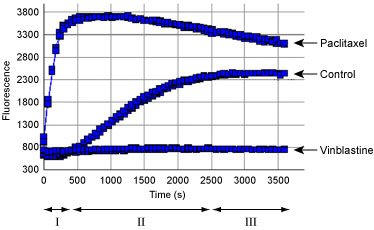
Compounds or proteins that interact with tubulin will often alter one or more of the characteristic phases of polymerization. For example, Figure 1 shows the effect of adding the anti-mitotic drug paclitaxel to the standard polymerization reaction. A 3 µM concentration of paclitaxel eliminates the nucleation phase and enhances the Vmax of the growth phase. Thus, one application of this assay is the identification of novel anti-mitotics. Figure 1 also shows the effect of adding the microtubule destabilizing drug, vinblastine. At 3 µM final concentration, vinblastine causes a drastic decrease in Vmax and reduction in final polymer mass.
|
|
|
|
|
Figure 1. Tubulin polymerization using the fluorescence based tubulin polymerization assay (BK011P). Tubulin was incubated alone (Control), with Paclitaxel or Vinblastine. Each condition was tested in duplicate. Polymerization was measured by excitation at 360 nm and emission at 420 nm. The three Phases of tubulin polymerization are marked for the control polymerization curve; I: nucleation, II: growth, III: steady state equillibrium. |
|
References
Bonne, D., Heusele, C., Simon, C., and Pantaloni, D. (1985). 4’, 6-Diamidino-2-phenylindole, a fluorescent probe for tubulin and mictrotubules. J. Biol. Chem. 260, 2819-2825.
B.-H. Choi et al. 2014. Suprafenacine, an indazole-hydrazide agent, targets cancer cells through microtubule destabilization. PLoS ONE. 9, e110955.
S. Senese et al. 2014. Chemical dissection of the cell cycle: probes for cell biology and anti-cancer drug development. Cell Death and Disease. 5, e1462.
M. Mei et al. 2014. A new 2a,5a,10b,14b-tetraacetoxy-4(20),11-taxadiene (SIA) derivative overcomes paclitaxel resistance by inhibiting MAPK signaling and increasing paclitaxel accumulation in breast cancer cells. PLoS ONE. 9, e104317.
I.M. Fawzy et al. 2014. Newly designed and synthesized curcumin analogs with in vitro cytotoxicity and tubulin polymerization activity. Chem. Biol. Drug Des. DOI: 10.1111/cbdd.12464.
W.M. Remers et al. 2014. Synthesis and antitumor activity of heterocycles related to carbendazim. J. Heterocycl. Chem. DOI: 10.1002/jhet.1976.
T. Shigehiro et al. 2014. Efficient drug delivery of paclitaxel glycoside: A novel solubility gradient encapsulation into liposomes coupled with immunoliposomes preparation. PLoS ONE. 9, e107976.
Sidhaye et al., 2012. A Novel Role for Aquaporin-5 in Enhancing Microtubule Organization and Stability. PLoS ONE 7: e38717.
Zach et al., 2012. The retinitis pigmentosa 28 protein FAM161A is a novel ciliary protein involved in intermolecular protein interaction and microtubule association. Hum. Mol. Genet. doi: 10.1093/hmg/dds268.
Dyrager et al., 2011. Inhibitors and promoters of tubulin polymerization: Synthesis and biological evaluation of chalcones and related dienones as potential anticancer agents. Bioorg. Med. Chem. v 19, pp 2659-2665.
Hwang et al., 2011. Induction of tubulin polymerization and apoptosis in malignant mesothelioma cells by a new compound JBIR-23. Cancer Lett. v 300, pp 189-196.
Kim et al., 2011. Zinc stimulates tau S214 phosphorylation by the activation of Raf/mitogen-activated protein kinase-kinase/extracellular signal-regulated kinase pathway. Neuroreport, v22, pp 839-844.
风险提示:丁香通仅作为第三方平台,为商家信息发布提供平台空间。用户咨询产品时请注意保护个人信息及财产安全,合理判断,谨慎选购商品,商家和用户对交易行为负责。对于医疗器械类产品,请先查证核实企业经营资质和医疗器械产品注册证情况。
- 作者
- 内容
- 询问日期
 文献和实验
文献和实验书太大了,上传不了,需要的话我可以发到邮箱或者各位在网上载,assaydesigns公司网页就有。 licanming 怎么无人回啊?只好自己顶一下! zhidanguilai 检测PKC活性可以用加拿大Immunechem公司的非放射性蛋白激酶C活性分析试剂盒,安全、快速、稳定,可用于筛选蛋白激酶C抑制剂或激活剂、定性定量分析纯化或部分纯化的PKC激酶活性。 测试盒原理: 基于ELISA的基本
Upstate公司在世界上最先开发出步骤优化简洁的商业化ChIP分析试剂盒,保证实验的准确性和可重复性,同时Upstate提供广泛可行的ChIP级别应用抗体。ChIP基本试剂盒和特定蛋白 质ChIP级别应用抗体结合完成一个完整的染色质免疫沉淀分析。在过去的数年中,Upstate提供的ChIP分析试剂盒和ChIP级别应用抗体得到了全世界科学家的认可,文献应用极为广泛。 Upstate最新推出EZ Chip™(catalog #:17-371)分析试剂盒,较第一
化物质检测等。 美国著名细胞产品公司Cell BioLabs为您提供完备的细胞氧化应激分析解决方案,其产品包含蛋白质羰基化、硝基化损伤及晚期氧化蛋白产物(AOPP)分析,脂质过氧化的标志物壬烯(HNE)和丙二醛(MDA)以及8-异前列腺素F2a快速检测试剂盒,核酸DNA/RNA的常规损伤分析如8-OHdG/8-OHG和AP位点检测,还包括细胞水平的彗星分析和DNA双链断裂分析试剂盒;除此之外,还有多种抗氧化物的活性检测方案供您选择,如过氧化物歧化酶(SOD)、过氧化氢酶 (CAT)及ORAC指标
 技术资料
技术资料暂无技术资料 索取技术资料

