- ¥1580
- LMAI Bio
- LM-12256R
- 进口/国产
- 2025年07月14日
- WB=1:500-2000 ELISA=1:500-1000 IHC-P=1:400-800 IHC-F=1:400-800 Flow-Cyt=1μg/Test ICC=1:100-500 IF=1:100-500 (石蜡切片需做抗原修复)
- Rabbit
- Human, Mouse, Rat, Dog, Cow, Horse, Rabbit,

企业认证
相关产品推荐更多 >

万千商家帮你免费找货
0 人在求购买到急需产品
- 详细信息
- 文献和实验
- 技术资料
- 供应商:
上海联迈生物工程有限公司
- 库存:
大量
- 目录编号:
LM-12256R
- 克隆性:
多克隆
- 抗原来源:
Rabbit
- 保质期:
1年
- 抗体英文名:
phospho-CXCR4 (Ser339)
- 抗体名:
磷酸化细胞表面趋化因子受体4抗体
- 宿主:
Rabbit
- 适应物种:
Human, Mouse, Rat, Dog, Cow, Horse, Rabbit,
- 免疫原:
KLH conjugated Synthesised phosphopeptide derived from human CXCR4 around the phosphorylation site of Ser339 [HS(p-S)VS]:HS(p-S)VS
- 亚型:
IgG
- 形态:
Lyophilized or Liquid
- 应用范围:
WB=1:500-2000 ELISA=1:500-1000 IHC-P=1:400-800 IHC-F=1:400-800 Flow-Cyt=1μg/Test ICC=1:100-500 IF=1:100-500 (石蜡切片需做抗原修复)
- 浓度:
1mg/ml
- 保存条件:
Store at -20 °C
- 规格:
100ul
| 英文名称 | phospho-CXCR4 (Ser339) |
| 中文名称 | 磷酸化细胞表面趋化因子受体4抗体 |
| 别 名 | p-CXCR4 (phospho S339); p-CD184 (phospho S339); C-X-C chemokine receptor type 4; CXC-R4; CXCR-4; Stromal cell-derived factor 1 receptor; SDF-1 receptor; Fusin; Leukocyte-derived seven transmembrane domain receptor; LESTR; CD184 antigen; CXCR4_HUMAN. |
| 规格价格 | 100ul/1580元 购买 大包装/询价 |
| 说 明 书 | 100ul |
| 产品类型 | 磷酸化抗体 |
| 研究领域 | 肿瘤 细胞生物 免疫学 神经生物学 干细胞 生长因子和激素 新陈代谢 |
| 抗体来源 | Rabbit |
| 克隆类型 | Polyclonal |
| 交叉反应 | Human, Mouse, Rat, Dog, Cow, Horse, Rabbit, |
| 产品应用 | WB=1:500-2000 ELISA=1:500-1000 IHC-P=1:400-800 IHC-F=1:400-800 Flow-Cyt=1μg/Test ICC=1:100-500 IF=1:100-500 (石蜡切片需做抗原修复) not yet tested in other applications. optimal dilutions/concentrations should be determined by the end user. |
| 分 子 量 | 40kDa |
| 细胞定位 | 细胞膜 |
| 性 状 | Lyophilized or Liquid |
| 浓 度 | 1mg/ml |
| 免 疫 原 | KLH conjugated Synthesised phosphopeptide derived from human CXCR4 around the phosphorylation site of Ser339 [HS(p-S)VS]:HS(p-S)VS |
| 亚 型 | IgG |
| 纯化方法 | affinity purified by Protein A |
| 储 存 液 | 0.01M TBS(pH7.4) with 1% BSA, 0.03% Proclin300 and 50% Glycerol. |
| 保存条件 | Store at -20 °C for one year. Avoid repeated freeze/thaw cycles. The lyophilized antibody is stable at room temperature for at least one month and for greater than a year when kept at -20°C. When reconstituted in sterile pH 7.4 0.01M PBS or diluent of antibody the antibody is stable for at least two weeks at 2-4 °C. |
| PubMed | PubMed |
| 产品介绍 | background: This gene encodes a CXC chemokine receptor specific for stromal cell-derived factor-1. The protein has 7 transmembrane regions and is located on the cell surface. It acts with the CD4 protein to support HIV entry into cells and is also highly expressed in breast cancer cells. Mutations in this gene have been associated with WHIM (warts, hypogammaglobulinemia, infections, and myelokathexis) syndrome. Alternate transcriptional splice variants, encoding different isoforms, have been characterized. Monomer. Can form dimers. Function: Receptor for the C-X-C chemokine CXCL12/SDF-1 that transduces a signal by increasing intracellular calcium ions levels and enhancing MAPK1/MAPK3 activation. Acts as a receptor for extracellular ubiquitin; leading to enhance intracellular calcium ions and reduce cellular cAMP levels. Involved in haematopoiesis and in cardiac ventricular septum formation. Plays also an essential role in vascularization of the gastrointestinal tract, probably by regulating vascular branching and/or remodeling processes in endothelial cells. Could be involved in cerebellar development. In the CNS, could mediate hippocampal-neuron survival. Acts as a coreceptor (CD4 being the primary receptor) for HIV-1 X4 isolates and as a primary receptor for some HIV-2 isolates. Promotes Env-mediated fusion of the virus. Subunit: Monomer. Can form dimmers. Subcellular Location: Cell membrane; Multi-pass membrane protein. Tissue Specificity: Expressed in numerous tissues, such as peripheral blood leukocytes, spleen, thymus, spinal cord, heart, placenta, lung, liver, skeletal muscle, kidney, pancreas, cerebellum, cerebral cortex and medulla (in microglia as well as in astrocytes), brain microvascular, coronary artery and umbilical cord endothelial cells. Isoform 1 is predominant in all tissues tested. Post-translational modifications: Phosphorylated on agonist stimulation. Rapidly phosphorylated on serine and threonine residues in the C-terminal. Phosphorylation at Ser-324 and Ser-325 leads to recruitment of ITCH, ubiquitination and protein degradation. Ubiquitinated by ITCH at the cell membrane on agonist stimulation. The ubiquitin-dependent mechanism, endosomal sorting complex required for transport (ESCRT), then targets CXCR4 for lysosomal degradation. This process is dependent also on prior Ser-/Thr-phosphorylation in the C-terminal of CXCR4. Also binding of ARRB1 to STAM negatively regulates CXCR4 sorting to lysosomes though modulating ubiquitination of SFR5S. Sulfation on Tyr-21 is required for efficient binding of CXCL12/SDF-1alpha and promotes its dimerization. O- and N-glycosylated. Asn-11 is the principal site of N-glycosylation. There appears to be very little or no glycosylation on Asn-176. N-glycosylation masks coreceptor function in both X4 and R5 laboratory-adapted and primary HIV-1 strains through inhibiting interaction with their Env glycoproteins. The O-glycosylation chondroitin sulfate attachment does not affect interaction with CXCL12/SDF-1alpha nor its coreceptor activity. DISEASE: Defects in CXCR4 are a cause of WHIM syndrome (WHIM) [MIM:193670]; also known as warts, hypogammaglobulinemia, infections and myelokathexis. WHIM syndrome is an immunodeficiency disease characterized by neutropenia, hypogammaglobulinemia and extensive human papillomavirus (HPV) infection. Despite the peripheral neutropenia, bone marrow aspirates from affected individuals contain abundant mature myeloid cells, a condition termed myelokathexis. Similarity: Belongs to the G-protein coupled receptor 1 family. SWISS: P61073 Gene ID: 7852 Database links: Entrez Gene: 7852 Human Entrez Gene: 12767 Mouse Entrez Gene: 60628 Rat Omim: 162643 Human SwissProt: P61073 Human SwissProt: P70658 Mouse SwissProt: O08565 Rat Unigene: 593413 Human Important Note: This product as supplied is intended for research use only, not for use in human, therapeutic or diagnostic applications. |
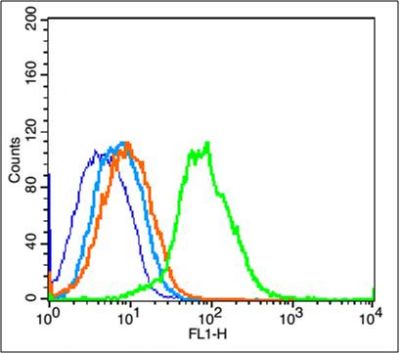
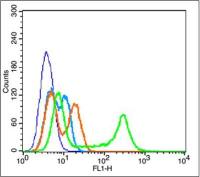
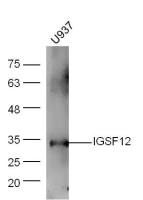
| 产品图片 | 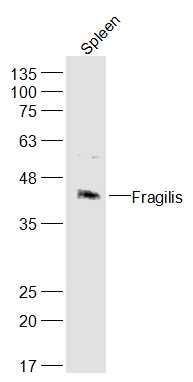 Sample: Spleen (Mouse) Lysate at 40 ug Primary: Anti-Fragilis (bs-12256R) at 1/300 dilution Secondary: IRDye800CW Goat Anti-Rabbit IgG at 1/20000 dilution Predicted band size: 40 kD Observed band size: 40 kD 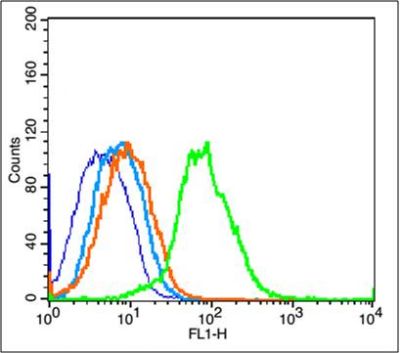 Blank control(mouse):Mouse Spleen Cells (fixed with 2% paraformaldehyde for 10 min at 37℃). Primary Antibody:Rabbit Anti-phospho-CXCR4 (Ser339) antibody (bs-12256R,Green); Dilution: 1μg in 100 μL 1X PBS containing 0.5% BSA; Isotype Control Antibody: Rabbit IgG(orange) ,used under the same conditions; Secondary Antibody: Goat anti-rabbit IgG-FITC(white blue), Dilution: 1:200 in 1 X PBS containing 0.5% BSA. |
风险提示:丁香通仅作为第三方平台,为商家信息发布提供平台空间。用户咨询产品时请注意保护个人信息及财产安全,合理判断,谨慎选购商品,商家和用户对交易行为负责。对于医疗器械类产品,请先查证核实企业经营资质和医疗器械产品注册证情况。
 文献和实验
文献和实验上海西唐生物科技有限公司 021-55229872, 65333639 www.westang.com 小鼠CXCR4 ( CXCR - 4 )ELISA 试剂盒 ( 用于血清、血浆、细胞培养上清液和其它生物体液内 ) 原理 本实验采用双抗体夹心 ABC-ELISA 法。用抗小鼠趋化因子受体-4( CXCR4 )单抗包被于酶标板上,标准品和样品中的 CXCR4
Using Phospho‐Motif Antibodies to Determine Kinase Substrates
the phosphorylation site; therefore, substrate?directed, phosphorylation?state?sensitive, motif?specific (?phospho?motif?) antibodies represent powerful tools to identify novel kinase substrates and to investigate mechanisms of substrate phosphorylation
让肿瘤变「热」!宋尔卫院士团队Nat Immunol发文报道肿瘤免疫治疗新策略
1 和/或 CTL 细胞计数患者的效应 T 细胞 RGS1 表达上调。此外,Th1 和/或 CTL 细胞中 RGS1 高表达的患者预后更差。图片来源:Nature ImmunologyRGS1 如何影响 T 细胞向肿瘤迁移?为了确定 RGS1 在效应 T 细胞迁移中的作用,作者敲低 RGS1 表达后发现,CTL 和 Th1 细胞向 CXCR3、CCR4 和 CXCR4 的配体迁移的能力增强。图片来源:Nature Immunology先前的研究表明 RGS 蛋白通过增强 GTP 酶活性来抑制趋化因子受体的细胞
 技术资料
技术资料暂无技术资料 索取技术资料