- ¥1580
- 康朗生物
- kl-13773R
- 中国/美国/德国
- 2025年07月14日
- WB=1:500-2000 ELISA=1:500-1000 IHC-P=1:400-800 IHC-F=1:400-800 Flow-Cyt=0.2μg/Test ICC=1:100-500 IF=1:100-500
- Rabbit
- Human, Mouse, Rat, Chicken, Dog, Pig, Cow, Horse,

企业认证
相关产品推荐更多 >


万千商家帮你免费找货
0 人在求购买到急需产品
- 详细信息
- 文献和实验
- 技术资料
- 供应商:
上海康朗生物科技有限公司
- 库存:
大量
- 目录编号:
kl-13773R
- 克隆性:
多克隆
- 抗原来源:
Rabbit
- 保质期:
12个月
- 抗体英文名:
phospho-14-3-3 beta + zeta (Ser186 / Ser184) antibody
- 抗体名:
磷酸化14-3-3 β/ζ抗体
- 宿主:
Rabbit
- 适应物种:
Human, Mouse, Rat, Chicken, Dog, Pig, Cow, Horse,
- 免疫原:
KLH conjugated synthesised phosphopeptide derived from human 14-3-3 beta + zeta around the phosphorylation site of Ser186 / Ser184:LN(p-S)PE
- 亚型:
IgG
- 形态:
冻干粉或液体
- 应用范围:
WB=1:500-2000 ELISA=1:500-1000 IHC-P=1:400-800 IHC-F=1:400-800 Flow-Cyt=0.2μg/Test ICC=1:100-500 IF=1:100-500
- 浓度:
1mg/ml
- 保存条件:
-20 °C
- 规格:
100ul
| 中文名称 | 磷酸化14-3-3 β/ζ抗体 |
| 别 名 | 14-3-3 beta + zeta (phospho S184 + S186); 14-3-3 beta + zeta (phospho S186); 14-3-3 beta + zeta (phospho Ser186); p-14-3-3 beta + zeta (Ser186) 14 3 3 protein beta; 14 3 3 protein beta/alpha; 14 3 3 protein zeta/delta; 14 3 3 zeta; HS1; KCIP1; YWHAB; YWHAZ. |
| 规格价格 | 100ul/1580元 购买 大包装/询价 |
| 说 明 书 | 100ul |
| 产品类型 | 磷酸化抗体 |
| 研究领域 | 细胞生物 神经生物学 信号转导 细胞凋亡 |
| 抗体来源 | Rabbit |
| 克隆类型 | Polyclonal |
| 交叉反应 | Human, Mouse, Rat, Chicken, Dog, Pig, Cow, Horse, |
| 产品应用 | WB=1:500-2000 ELISA=1:500-1000 IHC-P=1:400-800 IHC-F=1:400-800 Flow-Cyt=0.2μg/Test ICC=1:100-500 IF=1:100-500 (石蜡切片需做抗原修复) not yet tested in other applications. optimal dilutions/concentrations should be determined by the end user. |
| 分 子 量 | 28kDa |
| 细胞定位 | 细胞浆 细胞膜 |
| 性 状 | Lyophilized or Liquid |
| 浓 度 | 1mg/ml |
| 免 疫 原 | KLH conjugated synthesised phosphopeptide derived from human 14-3-3 beta + zeta around the phosphorylation site of Ser186 / Ser184:LN(p-S)PE |
| 亚 型 | IgG |
| 纯化方法 | affinity purified by Protein A |
| 储 存 液 | 0.01M TBS(pH7.4) with 1% BSA, 0.03% Proclin300 and 50% Glycerol. |
| 保存条件 | Store at -20 °C for one year. Avoid repeated freeze/thaw cycles. The lyophilized antibody is stable at room temperature for at least one month and for greater than a year when kept at -20°C. When reconstituted in sterile pH 7.4 0.01M PBS or diluent of antibody the antibody is stable for at least two weeks at 2-4 °C. |
| PubMed | PubMed |
| 产品介绍 | background: Members of the 14-3-3 family of proteins are highly conserved proteins, localized in neurons, and are axonally transported to the nerve terminals. They are also present, at lower levels, in various other eukaryotic tissues. 14-3-3 proteins appear to play important roles in a variety of signal transduction pathways, including those involved in cell cycle regulation and cell survival. Because 14-3-3 proteins bind to specific phosphoserine-containing sequences they are likely to have an important role in signaling pathways mediated by serine/threonine protein kinases. Evidence indicates 14-3-3 is required for Raf 1 kinase activity and phosphorylation amoung many other functions. Function: 14-3-3 proteins are highly conserved proteins which play a role in both signal transduction and progression through the cell cycle by binding to and regulating several different proteins. 14-3-3 proteins activate tyrosine and tryptophan hydroxylases and protein kinase C. They mediate signal transduction by binding to phosphoserine-containing proteins. There are at least 7 mammalian isoforms: alpha, beta, gamma, delta, epsilon, zeta, and eta. An eighth subtype, termed theta has been found in rat brain. The 14-3-3 proteins exists in vitro and in vivo as either homo- or heterodimers which interact via their N-terminal domains and are subject to phosphorylation by protein kinase C. 14-3-3 proteins are localized in the cytoplasm of neurons in the cerebral cortex and are axonally transported to the nerve terminals. They may be present at lower levels in various other eukaryotic tissues. Northern blot analysis has shown expression of the eta chain in cultured cell lines derived from various tumors. Subunit: Interacts with CDK16 and BSPRY. Interacts with WEE1 (C-terminal). Interacts with SAMSN1. Interacts with MLF1 (phosphorylated form); the interaction retains it in the cytoplasm. Interacts with Thr-phosphorylated ITGB2. Interacts with BCL2L11. Homodimer. Heterodimerizes with YWHAE. Homo- and hetero-dimerization is inhibited by phosphorylation on Ser-58. Interacts with FOXO4, NOXA1, SSH1 and ARHGEF2. Interacts with Pseudomonas aeruginosa exoS (unphosphorylated form). Interacts with BAX; the interaction occurs in the cytoplasm. Under stress conditions, MAPK8-mediated phosphorylation releases BAX to mitochondria. Interacts with phosphorylated RAF1; the interaction is inhibited when YWHAZ is phosphorylated on Thr-232. Interacts with TP53; the interaction enhances p53 transcriptional activity. The Ser-58 phosphorylated form inhibits this interaction and p53 transcriptional activity. Interacts with ABL1 (phosphorylated form); the interaction retains ABL1 in the cytoplasm. Interacts with PKA-phosphorylated AANAT; the interaction modulates AANAT enzymatic activity by increasing affinity for arylalkylamines and acetyl-CoA and protecting the enzyme from dephosphorylation and proteasomal degradation. It may also prevent thiol-dependent inactivation. Interacts with AKT1; the interaction phosphorylates YWHAZ and modulates dimerization. Interacts with GAB2 and TLK2. Subcellular Location: Cytoplasmic. Melanosome (fractions from stage I to stage IV) Post-translational modifications: The delta, brain-specific form differs from the zeta form in being phosphorylated (By similarity). Phosphorylation on Ser-184 by MAPK8; promotes dissociation of BAX and translocation of BAX to mitochondria. Phosphorylation on Ser-58 by PKA; disrupts homodimerization and heterodimerization with YHAE and TP53. This phosphorylation appears to be activated by sphingosine. Phosphorylation on Thr-232; inhibits binding of RAF1. Similarity: Belongs to the 14-3-3 family. SWISS: P31946 Gene ID: 7529 Database links: Entrez Gene: 7529 Human Entrez Gene: 7534 Human Entrez Gene: 22631 Mouse Entrez Gene: 54401 Mouse Entrez Gene: 25578 Rat Entrez Gene: 56011 Rat Omim: 601288 Human Omim: 601289 Human SwissProt: P31946 Human SwissProt: P63104 Human SwissProt: P35215 Mouse SwissProt: Q9CQV8 Mouse SwissProt: P35213 Rat SwissProt: P63102 Rat Unigene: 492407 Human Unigene: 643544 Human Unigene: 1292 Rat Unigene: 8653 Rat Important Note: This product as supplied is intended for research use only, not for use in human, therapeutic or diagnostic applications. |
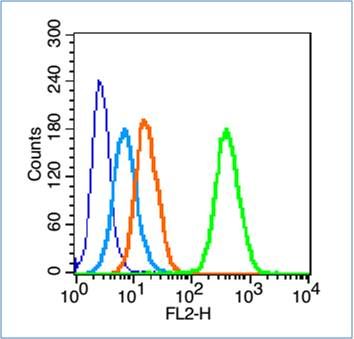
| 产品图片 | 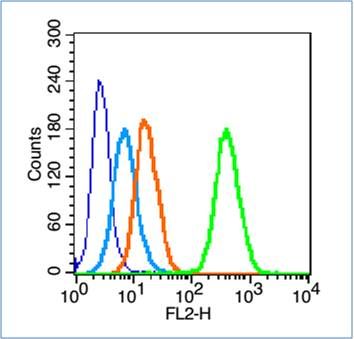 Blank control (blue line): HL60 (fixed with 70% ethanol (overninght at 4℃) and then permeabilized with 0.1% PBS-Tween for 20 min at room temperature). Primary Antibody (green line): Rabbit Anti-phospho-14-3-3 beta + zeta (Ser186) antibody (bs-13773R),Dilution: 0.2μg /10^6 cells; Isotype Control Antibody (orange line): Rabbit IgG . Secondary Antibody (white blue line): Goat anti-rabbit IgG-PE,Dilution: 1μg /test. |
风险提示:丁香通仅作为第三方平台,为商家信息发布提供平台空间。用户咨询产品时请注意保护个人信息及财产安全,合理判断,谨慎选购商品,商家和用户对交易行为负责。对于医疗器械类产品,请先查证核实企业经营资质和医疗器械产品注册证情况。
 文献和实验
文献和实验下调不能说明活性降低,因为决定GSK3-beta的活性的还与其磷酸化的比例和磷酸化的位点有关。所以你除了要做GSK3-beta总的蛋白表达之外,还要做磷酸化的GSK3-beta的蛋白表达。 (2)应该活性形式和非活性形式都做。一般来讲,GSK3-beta在Ser9位点磷酸化之后活性收到抑制,而在216位点磷酸化之后,其活性收到加强。因此建议将GSK3-beta的两个磷酸化位点都做了,另外还要同时检测GSK3-beta的总蛋白表达,这样才能全面的说明问题。
, a small but significant proportion of 14-3-3 in brain is tightly and selectively associated with some membranes. Using a panel of isoform-specific antisera we find that the epsilon, eta, gamma, beta, and zeta isoforms are all present in purified synaptic
Introduction of human 14-3-3 proteins
-3-3 proteins are cytosolic,a small but significant proportion of 14-3-3 in brain is tightly and selectively associated with some membranes.Using a panel of isoform-specific antisera we find that the epsilon,eta,gamma,beta,and zeta isoforms are all present
 技术资料
技术资料暂无技术资料 索取技术资料