


- $527
- Alomone
- 以色列
- APR-022-F
- 2025年07月14日
- FC
- Rabbit
- 见官方网站

企业认证
相关产品推荐更多 >

万千商家帮你免费找货
0 人在求购买到急需产品
- 详细信息
- 文献和实验
- 技术资料
- 免疫原:
见官方网站
- 亚型:
见官方网站
- 形态:
液体或冻干粉
- 保存条件:
-20°C
- 克隆性:
多克隆
- 标记物:
见官方网站
- 适应物种:
见官方网站
- 保质期:
6个月
- 抗原来源:
Rabbit
- 目录编号:
APR-022-F
- 级别:
高
- 库存:
大量
- 供应商:
上海信裕生物科技有限公司
- 宿主:
Rabbit
- 应用范围:
FC
- 浓度:
见官方网站
- 靶点:
见官方网站
- 抗体英文名:
Anti-P2X1 Receptor (extracellular)-FITC
- 抗体名:
Anti-P2X1 Receptor (extracellular)-FITC
- 规格:
50 µl
Anti-P2X1 Receptor (extracellular)-FITC
Purinergic Receptor P2X1, P2RX1Cat #: APR-022-F
Sizes: 50 µl
Source: Rabbit
Type: Polyclonal
Applications: FC
May also work in: IC, LCI
Reactivity: H, M, R
Application key:
CBE- Cell-based ELISA, FC- Flow cytometry, IC- Immunocytochemistry, IE- Indirect ELISA, IFC- Indirect flow cytometry, IH- Immunohistochemistry, IP- Immunoprecipitation, LCI- Live cell imaging, N- Neutralization, WB- Western blotSpecies reactivity key:
H- Human, M- Mouse, R- RatAnti-P2X1 Receptor (extracellular) (#APR-022) is a highly specific antibody directed against an epitope of the human protein. The antibody can be used in western blot, immunocytochemistry, immunohistochemistry, and indirect flow cytometry applications. It has been designed to recognize P2X1 receptor from rat, mouse, and human samples.
Alomone Labs is pleased to offer a new version of this antibody that is directly conjugated to fluorescein isothiocyanate (FITC). Anti-P2X1 Receptor (extracellular)-FITC antibody (#APR-022-F) can be used in immunofluorescent applications such as direct live cell flow cytometry.
- Applications
- Specifications
- Scientific Background
- Related Products
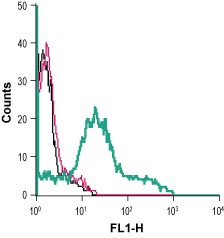
Direct flow cytometry of live intact human MEG-01 megakaryoblastic leukemia cells:
___ Cells.
___ Cells + rabbit IgG isotype control-FITC
___ Cells + Anti-P2X1 Receptor (extracellular)-FITC antibody (#APR-022-F), (5 µg antibody/0.5x106 cells).
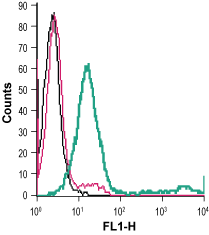
Direct flow cytometry of live intact mouse M1 myeloid leukemia cells:
___ Cells.
___ Cells + rabbit IgG isotype control-FITC
___ Cells + Anti-P2X1 Receptor (extracellular)-FITC antibody (#APR-022-F), 5µg.
Immunogen
Peptide CRPIYEFHGLYEEK, corresponding to amino acid residues 270-283 of human P2X1 receptor (Accession P51575). Extracellular loop.
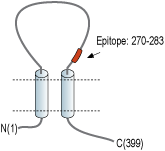
HomologyRat, mouse - 11/14 amino acid residues identical.
PurityAffinity purified on immobilized antigen.
FormulationLyophilized powder. Reconstituted antibody contains phosphate buffered saline (PBS), pH 7.4, 1% BSA, 0.05% NaN3.
LabelFluorescein isothiocyanate (FITC).
Standard quality control of each lotWestern blot analysis (unlabeled antibody), and direct flow cytometry (labeled antibody).
Peptide confirmationConfirmed by amino acid analysis and mass spectrometry.
Storage before reconstitutionThe antibody ships as a lyophilized powder at room temperature. Upon arrival, it should be stored at -20°C.
Reconstitution50 µl double distilled water (DDW).
Antibody concentration after reconstitution1 mg/ml.
Storage after reconstitutionThe reconstituted solution can be stored at 4°C, protected from the light, for up to 1 week. For longer periods, small aliquots should be stored at -20°C. Avoid multiple freezing and thawing. Centrifuge all antibody preparations before use (10000 × g 5 min).
Control antigen storage before reconstitutionLyophilized powder can be stored intact at room temperature for 2 weeks. For longer periods, it should be stored at -20°C.
Control antigen reconstitution100 µl DDW.
Control antigen storage after reconstitution-20ºC.
Preadsorption Control1 µg peptide per 1 µg antibody.
Scientific backgroundThe P2X receptors belong to the ligand-gated ion channel family and are activated by extracellular ATP.
The structure and function of the P2X receptors, investigated mainly using in vitro models, indicate their involvement in synaptic communication, cell death, and differentiation.
Seven mammalian P2X receptor subtypes (P2X1–P2X7) have been identified and cloned1-3. All P2X receptor subtypes share the same structure of intracellular N- and C-termini two membrane-spanning domains and a large extracellular loop.
All P2X receptor subtypes can assemble to form homomeric or heteromeric functional channels with the exception of P2X6, which only seems to function as part of a heteromeric complex4-9.
The various P2X receptor subtypes show distinct expression patterns. P2X1-6 have been found in the central and peripheral nervous systems, while the P2X7 receptor is predominantly found in cells of the immune system4. The P2X1 receptor is present in smooth muscle, cerebellum, dorsal horn spinal neurons, and platelets where it is suggested to play a regulatory role during in vivo homeostasis and thrombosis3,4,10,11.
References
- Prasad, M. et al. (2001) J. Physiol. 537, 667.
- Florenzano, F. et al. (2002) Neuroscience 115, 425.
- Ashcroft, F.M. et al. (2000) Ion Channels and Disease Ed 1, p. 405, Academic Press, San Diego.
- Khakh, B.S. et al. (2001) Pharmacol. Rev. 53, 107.
- Ding, Y. et al. (2000) J. Auton. Nerv. Syst. 81, 289.
- Lê, K.T. et al. (1998) J. Neurosci. 18, 7152.
- Robertson, S.J. et al. (2001) Curr. Opin. Neurobiol. 11, 378.
- Dunn, P.M. et al. (2001) Prog. Neurobiol. 65, 107.
- Kim, M. et al. (2001) EMBO J. 20, 6347.
- Burnstock, G. (2001) Trends Pharmacol. Sci. 22, 182.
- Oury, C. et al. (2003) Blood 101, 3969.
风险提示:丁香通仅作为第三方平台,为商家信息发布提供平台空间。用户咨询产品时请注意保护个人信息及财产安全,合理判断,谨慎选购商品,商家和用户对交易行为负责。对于医疗器械类产品,请先查证核实企业经营资质和医疗器械产品注册证情况。
 文献和实验
文献和实验Expression of Extracellular N-Terminal Domain of NMDA Receptor in Mammalian Cells
NMDA receptor is a ligand-gated ion channel receptor composed of multiple subunits encoded by at least five genes and their splice variants (1 ). Functional channels can be produced with only the NR1 subunit. These single-subunit channels
Assessment of Extracellular ATP Concentrations
. ATP concentrations at the cell surface, and consequently the magnitude of purinergic receptor stimulation, reflect a well-controlled balance between rates of ATP release and extracellular metabolism. Given the broad spectrum of responses triggered
Aspects of CNS Lupus: Mouse Models of Anti-NMDA Receptor Antibody Mediated Reactivity
of interest binds the N -methyl-d -aspartate receptor (NMDAR), a receptor for glutamate that is a major excitatory neurotransmitter in the brain involved in synaptic plasticity, in memory and learning, and in emotional responses. We introduce basic
 技术资料
技术资料暂无技术资料 索取技术资料

