

- ¥16640
- BioXcell
- BP0075-1-25MG
- 美国
- 2025年07月15日
- in vivo neutrophil depletion, in vivo MDSC depletion, Immunofluorescence, Immunohistochemistry (paraffin), Immunohistochemistry (frozen), Flow cytometry
- 随货说明
- mouse

企业认证
相关产品推荐更多 >


万千商家帮你免费找货
0 人在求购买到急需产品
相关阅读
源叶生物 十万种现货试剂速发,品质稳、品类全,实验不再等!Takara 秋促来袭,提取+反转录+定量套装仅 1200 元abinScience 体内级抗体 全年锁价 低至 ¥1200阿拉丁 22万+ 科研级产品现货速发,品质严控、科研无忧- 详细信息
- 文献和实验
- 技术资料
- 抗体名:
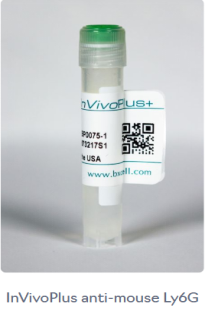
InVivoPlus anti-mouse Ly6G
- 抗体英文名:
InVivoPlus anti-mouse Ly6G
- 靶点:
随货说明
- 浓度:
随货说明
- 应用范围:
in vivo neutrophil depletion, in vivo MDSC depletion, Immunofluorescence, Immunohistochemistry (paraffin), Immunohistochemistry (frozen), Flow cytometry
- 宿主:
随货说明
- 适应物种:
mouse
- 级别:
体内研究级别
- 库存:
现货
- 供应商:
欣博盛生物
- 标记物:
无
- 克隆性:
1A8
- 保存条件:
4度避光
- 形态:
液体
- 亚型:
Rat IgG2a
- 免疫原:
mouse Ly6G
- 规格:
25 mg
BioXcell InVivoPlus anti-mouse Ly6G 1A8单克隆抗体与小鼠Ly6G反应。Ly6G分子量为21-25kDa,是GPI锚定的细胞表面蛋白Ly-6超家族的成员,在细胞信号传导和细胞粘附中发挥作用。Ly6G在发育过程中由骨髓谱系中的细胞(包括单核细胞、巨噬细胞、粒细胞和嗜中性粒细胞)差异表达。单核细胞通常在发育过程中瞬时表达Ly6G,而成熟的粒细胞和外周嗜中性粒细胞保持表达,使Ly6G成为这些群体的良好细胞表面标志物。与BioXcell RB6-8C5抗体不同,1A8抗体与小鼠Ly6G特异性反应,而与Ly6C没有交叉反应性的报道。
产品详情
| 产品名称 |
InVivoPlus anti-mouse Ly6G |
| 产品货号 |
BP0075-1 |
| 产品规格 |
5/25/50/100mg |
| 反应种属 |
Mouse |
| 克隆号 |
1A8 |
| 同种型 |
Rat IgG2a, κ |
| 免疫原 |
EL4J cells transfected with Ly6G |
| 实验应用 |
in vivo neutrophil depletion in vivo MDSC depletion Immunofluorescence Immunohistochemistry (paraffin) Immunohistochemistry (frozen) Flow cytometry |
| 产品形式 |
PBS, pH 7.0,Contains no stabilizers or preservatives |
| 纯度 |
>95%, Determined by SDS-PAGE |
| 聚合 |
<5%, Determined by SEC |
| 无菌处理 |
0.2 µm filtration |
| 纯化方式 |
Protein G |
| RRID |
AB_1107721 |
| 分子量 |
150 kDa |
| 小鼠病原检测 |
Ectromelia/Mousepox Virus: Negative Hantavirus: Negative K Virus: Negative Lactate Dehydrogenase-Elevating Virus: Negative Lymphocytic -Choriomeningitis -virus: Negative Mouse Adenovirus: Negative Mouse Cytomegalovirus: Negative Mouse Hepatitis Virus: Negative Mouse Minute Virus: Negative Mouse Nor-ovirus: Negative Mouse Parvovirus: Negative Mouse Rotavirus: Negative Mycoplasma Pulmonis: Negative Pneumonia Virus of Mice: Negative Polyoma Virus: Negative Reovirus Screen: Negative Sendai Virus: Negative Theiler’s Murine Encephalomyelitis: Negative |
| 保存条件 |
抗体原液保存在4°C,不能冷冻保存。 |
| 推荐同型对照 |
InVivoPlus rat IgG2a isotype control, anti-trinitrophenol(货号BP0089) |
| 推荐抗体稀释液 |
InVivoPure pH 7.0 Dilution Buffer(货号IP0070) |
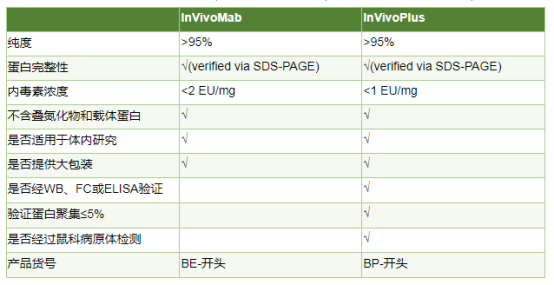
为什么选择InVivoPlus抗体?
InVivoPlus级别的产品内毒素含量更低,经过多种实验验证,更适合用于体内实验研究
该产品自上市已被多篇SCI文献引用,品质有保证,以下是部分已发表的文献引用:
| 应用 |
文章 |
| 体内中性粒细胞耗竭 (in vivo neutrophil depletion) |
1. Davis, R. W. t., et al. (2018). 'Luminol Chemiluminescence Reports Photodynamic Therapy-Generated Neutrophil Activity In Vivo and Serves as a Biomarker of Therapeutic Efficacy' Photochem Photobiol . 2. Moynihan, K. D., et al. (2016). 'Eradication of large established tumors in mice by combination immunotherapy that engages innate and adaptive immune responses' Nat Med. doi : 10.1038/nm.4200. 3. Conde, P., et al. (2015). 'DC-SIGN(+) Macrophages Control the Induction of Transplantation Tolerance' Immunity 42(6): 1143-1158. 4. Griseri, T., et al. (2015). 'Granulocyte Macrophage Colony-Stimulating Factor-Activated Eosinophils Promote Interleukin-23 Driven Chronic Colitis' Immunity 43(1): 187-199. 5. Yamada, D. H., et al. (2015). 'Suppression of Fcgamma-receptor-mediated antibody effector function during persistent viral infection' Immunity 42(2): 379-390. 6. Ellis, G. T., et al. (2015). 'TRAIL+ monocytes and monocyte-related cells cause lung damage and thereby increase susceptibility to influenza-Streptococcus pneumoniae coinfection' EMBO Rep 16(9): 1203-1218. 7. Deshmukh, H. S., et al. (2014). 'The microbiota regulates neutrophil homeostasis and host resistance to Escherichia coli K1 sepsis in neonatal mice' Nat Med 20(5): 524-530. |
| 体内中性粒细胞耗竭、流式细胞术、免疫组化石蜡切片(in vivo neutrophil depletion, Flow Cytometry, Immunohistochemistry (paraffin)) |
Coffelt, S. B., et al. (2015). 'IL-17-producing gammadelta T cells and neutrophils conspire to promote breast cancer metastasis' Nature 522(7556): 345-348. |
| 体内中性粒细胞耗竭、流式细胞术、免疫组化石蜡切片、免疫组化冰冻切片(in vivo neutrophil depletion, Flow Cytometry, Immunohistochemistry (paraffin), Immunohistochemistry (frozen)) |
Finisguerra, V., et al. (2015). 'MET is required for the recruitment of anti-tumoural neutrophils' Nature 522(7556): 349-353. |
| 体内中性粒细胞耗竭、流式细胞术(in vivo neutrophil depletion, Flow Cytometry) |
1.Moser, E. K., et al. (2014). 'Late engagement of CD86 after influenza virus clearance promotes recovery in a FoxP3+ regulatory T cell dependent manner' PLoS Pathog 10(8): e1004315. 2. Chen, K. W., et al. (2014). 'The neutrophil NLRC4 inflammasome selectively promotes IL-1beta maturation without pyroptosis during acute Salmonella challenge' Cell Rep 8(2): 570-582. 3. Garraud, K., et al. (2012). 'Differential role of the interleukin-17 axis and neutrophils in resolution of inhalational anthrax' Infect Immun 80(1): 131-142. 4. Lee, W. B., et al. (2012). 'Neutrophils Promote Mycobacterial Trehalose Dimycolate-Induced Lung Inflammation via the Mincle Pathway' PLoS Pathog 8(4): e1002614. |
| 体内骨髓来源抑制细胞耗竭(in vivo MDSC depletion) |
Deng, L., et al. (2014). 'Irradiation and anti-PD-L1 treatment synergistically promote antitumor immunity in mice' J Clin Invest 124(2): 687-695. |
| 体内中性粒细胞耗竭、免疫荧光(in vivo neutrophil depletion,Immunofluorescence) |
Edelson, B. T., et al. (2011). 'CD8alpha(+) dendritic cells are an obligate cellular entry point for productive infection by Listeria monocytogenes' Immunity 35(2): 236-248. |

更多产品详情请咨询 BioXcell 中国授权代理——欣博盛生物
风险提示:丁香通仅作为第三方平台,为商家信息发布提供平台空间。用户咨询产品时请注意保护个人信息及财产安全,合理判断,谨慎选购商品,商家和用户对交易行为负责。对于医疗器械类产品,请先查证核实企业经营资质和医疗器械产品注册证情况。
 文献和实验
文献和实验in vivo neutrophil depletion
Davis, R. W. t., et al. (2018). "Luminol Chemiluminescence Reports Photodynamic Therapy-Generated Neutrophil Activity In Vivo and Serves as a Biomarker of Therapeutic Efficacy" Photochem Photobiol . PubMed
Inflammatory cells, most especially neutrophils, can be a necessary component of the antitumor activity occurring after administration of photodynamic therapy. Generation of neutrophil responses has been suggested to be particularly important in instances when the delivered photodynamic therapy (PDT) dose is insufficient. In these cases, the release of neutrophil granules and engagement of antitumor immunity may play an important role in eliminating residual disease. Herein, we utilize in vivo imaging of luminol chemiluminescence to noninvasively monitor neutrophil activation after PDT administration. Studies were performed in the AB12 murine model of mesothelioma, treated with Photofrin-PDT. Luminol-generated chemiluminescence increased transiently 1 h after PDT, followed by a suBS-Equent decrease at 4 h after PDT. The production of luminol signal was not associated with the influx of Ly6G(+) cells, but was related to oxidative burst, as an indicator of neutrophil function. Most importantly, greater levels of luminol chemiluminescence 1 h after PDT were prognostic of a complete response at 90 days after PDT. Taken together, this research supports an important role for early activity by Ly6G(+) cells in the generation of long-term PDT responses in mesothelioma, and it points to luminol chemiluminescence as a potentially useful approach for preclinical monitoring of neutrophil activation by PDT.
in vivo neutrophil depletion
Moynihan, K. D., et al. (2016). "Eradication of large established tumors in mice by combination immunotherapy that engages innate and adaptive immune responses" Nat Med. doi : 10.1038/nm.4200. PubMed
Checkpoint blockade with antibodies specific for cytotoxic T lymphocyte-associated protein (CTLA)-4 or programmed cell death 1 (PDCD1; also known as PD-1) elicits durable tumor regression in metastatic cancer, but these dramatic responses are confined to a minority of patients. This suboptimal outcome is probably due in part to the complex network of immunosuppressive pathways present in advanced tumors, which are unlikely to be overcome by intervention at a single signaling checkpoint. Here we describe a combination immunotherapy that recruits a variety of innate and adaptive immune cells to eliminate large tumor burdens in syngeneic tumor models and a genetically engineered mouse model of melanoma; to our knowledge tumors of this size have not previously been curable by treatments relying on endogenous immunity. Maximal antitumor efficacy required four components: a tumor-antigen-targeting antibody, a recombinant interleukin-2 with an extended half-life, anti-PD-1 and a powerful T cell vaccine. Depletion experiments revealed that CD8+ T cells, cross-presenting dendritic cells and several other innate immune cell suBS-Ets were required for tumor regression. Effective treatment induced infiltration of immune cells and production of inflammatory cytokines in the tumor, enhanced antibody-mediated tumor antigen uptake and promoted antigen spreading. These results demonstrate the capacity of an elicited endogenous immune response to destroy large, established tumors and elucidate essential characteristics of combination immunotherapies that are capable of curing a majority of tumors in experimental settings typically viewed as intractable.
in vivo neutrophil depletion
Conde, P., et al. (2015). "DC-SIGN(+) Macrophages Control the Induction of Transplantation Tolerance" Immunity 42(6): 1143-1158. PubMed
Tissue effector cells of the monocyte lineage can differentiate into different cell types with specific cell function depending on their environment. The phenotype, developmental requirements, and functional mechanisms of immune protective macrophages that mediate the induction of transplantation tolerance remain elusive. Here, we demonstrate that costimulatory blockade favored accumulation of DC-SIGN-expressing macrophages that inhibited CD8(+) T cell immunity and promoted CD4(+)Foxp3(+) Treg cell expansion in numbers. Mechanistically, that simultaneous DC-SIGN engagement by fucosylated ligands and TLR4 signaling was required for production of immunoregulatory IL-10 associated with prolonged allograft survival. Deletion of DC-SIGN-expressing macrophages in vivo, interfering with their CSF1-dependent development, or preventing the DC-SIGN signaling pathway abrogated tolerance. Together, the results provide new insights into the tolerogenic effects of costimulatory blockade and identify DC-SIGN(+) suppressive macrophages as crucial mediators of immunological tolerance with the concomitant therapeutic implications in the clinic.
in vivo neutrophil depletion
Griseri, T., et al. (2015). "Granulocyte Macrophage Colony-Stimulating Factor-Activated Eosinophils Promote Interleukin-23 Driven Chronic Colitis" Immunity 43(1): 187-199. PubMed
The role of intestinal eosinophils in immune homeostasis is enigmatic and the molecular signals that drive them from protective to tissue damaging are unknown. Most commonly associated with Th2 cell-mediated diseases, we describe a role for eosinophils as crucial effectors of the interleukin-23 (IL-23)-granulocyte macrophage colony-stimulating factor (GM-CSF) axis in colitis. Chronic intestinal inflammation was characterized by increased bone marrow eosinopoiesis and accumulation of activated intestinal eosinophils. IL-5 blockade or eosinophil depletion ameliorated colitis, implicating eosinophils in disease pathogenesis. GM-CSF was a potent activator of eosinophil effector functions and intestinal accumulation, and GM-CSF blockade inhibited chronic colitis. By contrast neutrophil accumulation was GM-CSF independent and dispensable for colitis. In addition to TNF secretion, release of eosinophil peroxidase promoted colitis identifying direct tissue-toxic mechanisms. Thus, eosinophils are key perpetrators of chronic inflammation and tissue damage in IL-23-mediated immune diseases and it suggests the GM-CSF-eosinophil axis as an attractive therapeutic target.
0.1ml 190 进口分装 C0351 Streptavidin-AP 0.1ml 190 进口分装 C0352 APAAP(mouse) 0.1ml 400 进口分装 C0353
) A431 cells. At 48 h after infection, these cells were stained with ten different primary antibodies (5 g/ml) specific for different cell surface markers: anti-CD15 (clone 2F3; BD, PharMingen, San Diego, CA), anti-ERBB-2 (clone SP77; ref. 5), anti-ERBB
抗原呈递不足 + 免疫逃逸?级联响应肽自组装技术破局!Absin 助力肿瘤免疫联合治疗新突破
115675-50uL Rabbit anti-CD274 Polyclonal Antibody 1-2周 abs9235-5mL 抗荧光淬灭封片剂(含DAPI) 现货 abs9235-25mL 抗荧光淬灭封片剂(含DAPI) 现货 更多抗体推荐 货号-规格 名称 货期 abs120006-50uL Rabbit anti-GABABR1 Polyclonal Antibody 1-2周 abs120008-50uL Rabbit anti-TFF3 Polyclonal
 技术资料
技术资料暂无技术资料 索取技术资料

