


- ¥1712
- BioXcell
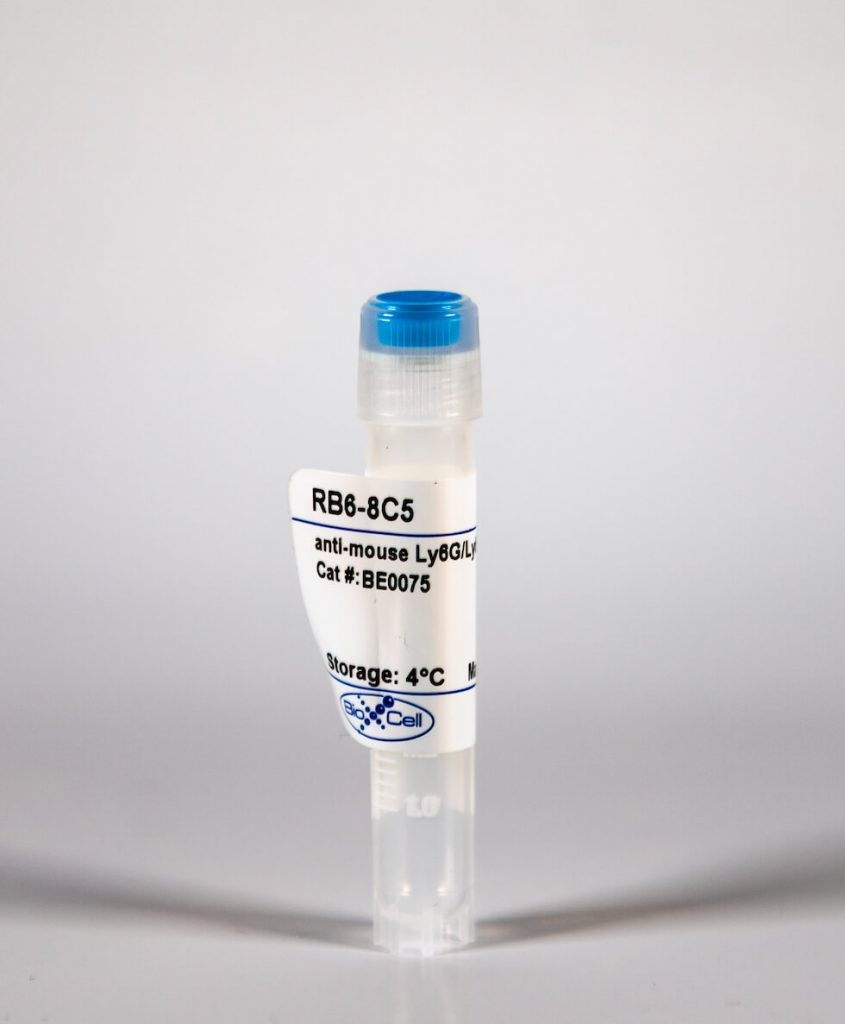
- BE0075
- 美国
- 2025年07月15日
- in vivo depletion of Gr-1+ myeloid cells, Flow cytometry, Immunohistochemistry (paraffin), Immunohistochemistry (frozen)
- Rat
- mouse

企业认证
相关产品推荐更多 >

EGF receptor (human) Recombinant monoclonal antibody (528) (Rabbit IgGκ)
¥7683.98NgR2 Recombinant monoclonal antibody (P14) (Rabbit IgGκ)
¥7822.68Hapten 4-hydroxy-3-nitrophenyl acetyl NP Recombinant monoclonal antibody (B1-8) (Mouse IgG2aλ)
¥7683.98
RAT ANTI MOUSE CD49d:Preservative Free
询价CD40L Recombinant monoclonal antibody (hu5c8) (Human IgG1κ)
¥7683.98
万千商家帮你免费找货
0 人在求购买到急需产品
相关阅读
细胞污染识别与处理全攻略:5 种常见类型+关键误区Cytoscape 教程来了!快速实现顶刊同款通路网络图五大应用案例:Mustang Q 膜层析应用全解析1 个小工具,一次性搞定流程图、质粒图谱和信号通路图- 详细信息
- 询价记录
- 文献和实验
- 技术资料
- 抗体名:
InVivoMab anti-mouse Ly6G/Ly6C (Gr-1)
- 抗体英文名:
InVivoMab anti-mouse Ly6G/Ly6C (Gr-1)
- 浓度:
请见产品说明
- 应用范围:
in vivo depletion of Gr-1+ myeloid cells, Flow cytometry, Immunohistochemistry (paraffin), Immunohistochemistry (frozen)
- 宿主:
Rat
- 适应物种:
mouse
- 保质期:
请参考说明
- 库存:
大量
- 供应商:
欣博盛生物科技有限公司
- 标记物:
无
- 克隆性:
单克隆
- 保存条件:
4度避光
- 形态:
液体
- 亚型:
Rat IgG2b
- 免疫原:
mouse Ly6G/Ly6C (Gr-1)
- 规格:
1 mg
RB6-8C5单克隆抗体与小鼠Ly6G有较强反应,而与小鼠Ly6C(以前称为GR-1)反应弱。Ly6G是GPI锚定的细胞表面蛋白Ly-6超家族中的成员,分子量为21- 25kDa,在细胞信号传导和细胞粘附中发挥作用。Ly6G在髓系细胞包括单核细胞、巨噬细胞、粒细胞和中性粒细胞的发育过程中的表达量是不同的。Ly6G通常在单核细胞发育过程中瞬时表达,而在成熟粒细胞和外周血中性粒细胞保留表达,这使Ly6G成为非常好的细胞表面标记物。RB6-8C5抗体已被证明能抑制1A8抗体的结合。1A8单克隆抗体可与小鼠Ly6G特异性反应,但没有与Ly6C交叉反应的报道。
产品信息
克隆号:RB6-8C5
货号:BE0075
规格:1mg\5mg\25mg\50mg\100mg
类别:InVivoMAb 抗体
亚型:Rat IgG2b, κ
推荐同型对照:IInVivoMAb rat IgG2b isotype control, anti-keyhole limpet hemocyanin(货号:BE0090)
推荐稀释液:InVivoPure™ pH 7.0 Dilution Buffer(货号:IP0070)
免疫原:小鼠中性粒细胞
应用:in vivo depletion of Gr-1+ myeloid cells
Flow cytometry
Immunohistochemistry (paraffin)
Immunohistochemistry (frozen)
产品形式:PBS, pH 7.0 Contains no stabilizers or preservatives
内毒素:<2EU/mg (<0.002EU/μg) Determined by LAL gel clotting assay
纯度:>95% Determined by SDS-PAGE
无菌:0.2 μM过滤
纯化:Protein G
RRID:AB_10312146
分子量:150 kDa
储存:抗体原溶液应保存在4°C条件下,不要冷冻保存。
详情请咨询 BioXcell 中国授权代理-欣博盛生物科技
风险提示:丁香通仅作为第三方平台,为商家信息发布提供平台空间。用户咨询产品时请注意保护个人信息及财产安全,合理判断,谨慎选购商品,商家和用户对交易行为负责。对于医疗器械类产品,请先查证核实企业经营资质和医疗器械产品注册证情况。
 询价记录
询价记录 暂无询价记录
 文献和实验
文献和实验in vivo depletion of Gr-1+ myeloid cells
Schulze, F. S., et al (2014). "Fcgamma receptors III and IV mediate tissue destruction in a novel adult mouse model of bullous pemphigoid" Am J Pathol 184(8): 2185-2196. PubMed
Bullous pemphigoid (BP) and epidermolysis bullosa acquisita are subepidermal autoimmune blistering diseases mediated by autoantibodies against type XVII collagen (Col17) and Col7, respectively. For blister formation, Fc-mediated events, such as infiltration of inflammatory cells in the skin, complement activation, and release of proteases at the dermal-epidermal junction, are essential. Although in the neonatal passive transfer mouse model of BP, tissue destruction is mediated by Fcgamma receptors (FcgammaRs) I and III, the passive transfer model of epidermolysis bullosa acquisita completely depends on FcgammaRIV. To clarify this discrepancy, we developed a novel experimental model for BP using adult mice. Lesion formation was Fc mediated because gamma-chain-deficient mice and mice treated with anti-Col17 IgG, depleted from its sugar moiety at the Fc portion, were resistant to disease induction. By the use of various FcgammaR-deficient mouse strains, tissue destruction was shown to be mediated by FcgammaRIV, FcgammaRIII, and FcgammaRIIB, whereas FcgammaRI was not essential. Furthermore, anti-inflammatory mediators in already clinically diseased mice can be explored in the novel BP model, because the pharmacological inhibition of FcgammaRIV and depletion of granulocytes abolished skin blisters. Herein, we extended our knowledge about the importance of FcgammaRs in experimental BP and established a novel BP mouse model suitable to study disease development over a longer time period and explore novel treatment strategies in a quasi-therapeutic setting.
in vivo depletion of Gr-1+ myeloid cells
Ermann, J., et al (2014). "Nod/Ripk2 signaling in dendritic cells activates IL-17A-secreting innate lymphoid cells and drives colitis in T-bet-/-.Rag2-/- (TRUC) mice" Proc Natl Acad Sci U S A 111(25): E2559-2566. PubMed
T-bet(-/-).Rag2(-/-) (TRUC) mice spontaneously develop microbiota-driven, TNF-mediated large bowel inflammation that resembles human ulcerative colitis. We show here that IL-23 and IL-1-dependent secretion of IL-17A by innate lymphoid cells (ILCs; defined as CD45(+)lin(-)Thy1(hi)NKp46(-)) is a second critical pathway in this model. Using an in vitro coculture system of bone marrow-derived dendritic cells (DCs) and freshly isolated FACS-purified ILCs, we demonstrate that IL-23 and IL-1 secreted by DCs in response to microbial stimulation work together to induce IL-17A production by ILCs. TNF is not required for IL-17A secretion by ILCs in vitro but synergizes with IL-17A to induce the expression of neutrophil-attracting chemokines. Upstream, activation of the IL-23/IL-17A axis is regulated by nucleotide-binding oligomerization domain containing (Nod)/receptor-interacting serine-threonine kinase 2 (Ripk2) signals in DCs. Genetic ablation of the Nod/Ripk2 signaling pathway protects TRUC mice from developing colitis without affecting the colitogenicity of the intestinal microbiota. Our data provide insight into the complex network of interactions between IL-17A-secreting ILCs and other components of the innate immune system in the development of colitis.
in vivo depletion of Gr-1+ myeloid cells
Khmaladze, I., et al (2014). "Mannan induces ROS-regulated, IL-17A-dependent psoriasis arthritis-like disease in mice" Proc Natl Acad Sci U S A 111(35): E3669-3678. PubMed
Psoriasis (Ps) and psoriasis arthritis (PsA) are poorly understood common diseases, induced by unknown environmental factors, affecting skin and articular joints. A single i.p. exposure to mannan from Saccharomyces cerevisiae induced an acute inflammation in inbred mouse strains resembling human Ps and PsA-like disease, whereas multiple injections induced a relapsing disease. Exacerbation of disease severity was ob-served in mice deficient for generation of reactive oxygen species (ROS). Interestingly, restoration of ROS production, specifically in macrophages, ameliorated both skin and joint disease. Neutralization of IL-17A, mainly produced by gammadelta T cells, completely blocked disease symptoms. Furthermore, mice depleted of granulocytes were resistant to disease development. In contrast, certain acute inflammatory mediators (C5, Fcgamma receptor III, mast cells, and histamine) and adaptive immune players (alphabeta T and B cells) were redundant in disease induction. Hence, we propose that mannan-induced activation of macrophages leads to TNF-alpha secretion and stimulation of local gammadelta T cells secreting IL-17A. The combined action of activated macrophages and IL-17A produced in situ drives neutrophil infiltration in the epidermis and dermis of the skin, leading to disease manifestations. Thus, our finding suggests a new mechanism triggered by exposure to exogenous microbial components, such as mannan, that can induce and exacerbate Ps and PsA.
11b)-IgG2b-FITC 1:100 Pharmingen 553310 Gr-1(Ly6G)-IgG2b-FITC 1:100 Pharmingen 553127 CD3-IgG2b-FITC 1:100 Pharmingen 555274
Intracellular Cytokine Staining Protocol
)2d/3danti-CD3 (10ug/ml immobilized)+anti-CD28 (2ug/ml soluble) 5hrMonensinJES6-5H4IL-4mouse spleenConA (3ug/ml) (2d)/IL-2 (20ng/ml)+IL-4 (20ng/ml) (3d)2d/3danti-CD3 (10ug/ml immobilized)+anti-CD28 (2ug/ml soluble) 5hrMonensinBVD6-24G2IL-6mouse
Intracellular Cytokine Staining Protocol
(100ng/ml)(22hr) 2hr/22hr - Monensin B122 IL-2 mouse spleen ConA (3ug/ml) (2d)/IL-2 (20ng/ml)+IL-4 (20ng/ml) (3d) 2d/3d anti-CD3 (10ug/ml immobilized
 技术资料
技术资料暂无技术资料 索取技术资料

