

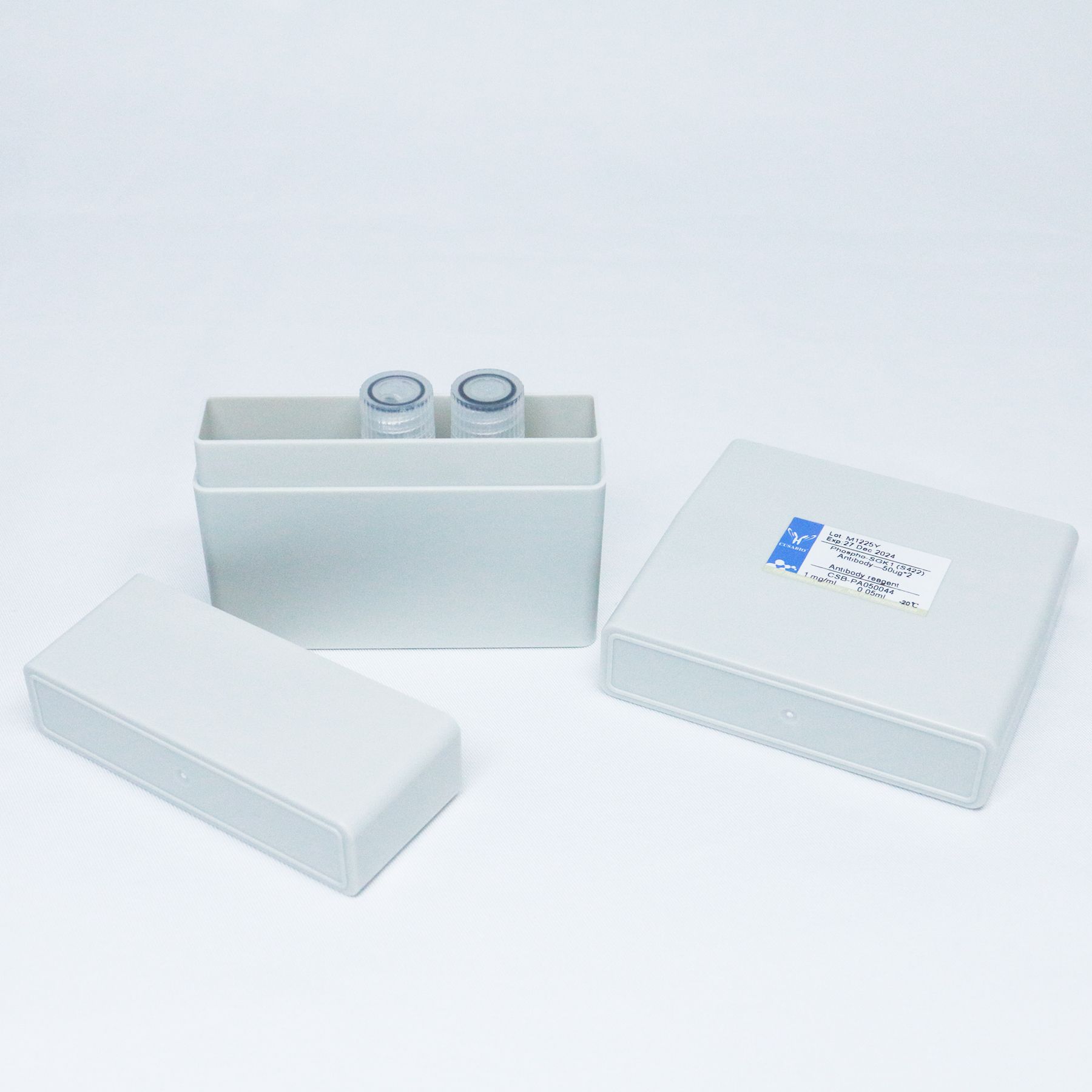
- ¥2024
- CUSABIO

- CN
- CSB-PA932880
- 2025年07月14日
- ELISA,WB;WB:1:500-1:3000
- Rabbit
- Human,Mouse

企业认证
相关产品推荐更多 >
ATAD3A抗体ATAD3A兔多抗抗体ATPase family AAA domain-containing protein 3A抗体ATAD3A Antibody, HRP conjugated抗体
¥880
PDCL3抗体PDCL3兔多抗抗体Viral IAP-associated factor 1 antibody抗体PDCL3 Antibody, HRP conjugated抗体
¥880MYO19抗体MYO19兔多抗抗体unconventional myosin-XIX antibody抗体MYO19 Antibody抗体
¥440
ATF1抗体ATF1一抗抗体TREB36 protein antibody抗体Phospho-ATF1 (S63) Antibody抗体
¥880
FILIP1L抗体FILIP1L兔多抗抗体Protein down-regulated in ovarian cancer 1 antibody抗体FILIP1L Antibody, Biotin conjugated抗体
¥880
万千商家帮你免费找货
0 人在求购买到急需产品
- 详细信息
- 文献和实验
- 技术资料
- 免疫原:
Synthesized non-phosphopeptide derived from Human AKT1/3 around the phosphorylation site of tyrosine 437/434 (T-R-Y(p)-F-D).
- 亚型:
/
- 形态:
Liquid
- 保存条件:
Upon receipt, store at -20℃ or -80℃. Avoid repeated freeze.
- 克隆性:
Polyclonal
- 标记物:
/
- 适应物种:
Human,Mouse
- 保质期:
6个月
- 抗原来源:
Homo sapiens (Human)
- 目录编号:
P31749/Q9Y243
- 级别:
优
- 库存:
200
- 供应商:
武汉华美生物工程有限公司
- 宿主:
Rabbit
- 应用范围:
ELISA,WB;WB:1:500-1:3000
- 浓度:
>95%,The antibody was affinity-purified from rabbit antiserum by affinity-chromatography using epitope-specific immunogen.
- 靶点:
/
- 抗体英文名:
AKT1/AKT3 (Ab-437/434) Antibody
- 抗体名:
/
- 规格:
100μl
保存缓冲液
/功能
AKT1 is one of 3 closely related serine/threonine-protein kinases (AKT1, AKT2 and AKT3) called the AKT kinase, and which regulate many processes including metabolism, proliferation, cell survival, growth and angiogenesis. This is mediated through serine and/or threonine phosphorylation of a range of downstream substrates. Over 100 substrate candidates have been reported so far, but for most of them, no isoform specificityhas been reported. AKT is responsible of the regulation of glucose uptake by mediating insulin-induced translocation of the SLC2A4/GLUT4 glucose transporter to the cell surface. Phosphorylation of PTPN1 at 'Ser-50' negatively modulates its phosphatase activity preventing dephosphorylation of the insulin receptor and the attenuation of insulin signaling. Phosphorylation of TBC1D4 triggers the binding of this effector to inhibitory 14-3-3 proteins, which is required for insulin-stimulated glucose transport. AKT regulates also the storage of glucose in the form of glycogen by phosphorylating GSK3A at 'Ser-21' and GSK3B at 'Ser-9', resulting in inhibition of its kinase activity. Phosphorylation of GSK3 isoforms by AKT is also thought to be one mechanism by which cell proliferation is driven. AKT regulates also cell survival via the phosphorylation of MAP3K5 (apoptosis signal-related kinase). Phosphorylation of 'Ser-83' decreases MAP3K5 kinase activity stimulated by oxidative stress and thereby prevents apoptosis. AKT mediates insulin-stimulated protein synthesis by phosphorylating TSC2 at 'Ser-939' and 'Thr-1462', thereby activating mTORC1 signaling and leading to both phosphorylation of 4E-BP1 and in activation of RPS6KB1. AKT is involved in the phosphorylation of members of the FOXO factors (Forkhead family of transcription factors), leading to binding of 14-3-3 proteins and cytoplasmic localization. In particular, FOXO1 is phosphorylated at 'Thr-24', 'Ser-256' and 'Ser-319'. FOXO3 and FOXO4 are phosphorylated on equivalent sites. AKT has an important role in the regulation of NF-kappa-B-dependent gene transcription and positively regulates the activity of CREB1 (cyclic AMP (cAMP)-response element binding protein). The phosphorylation of CREB1 induces the binding of accessory proteins that are necessary for the transcription of pro-survival genes such as BCL2 and MCL1. AKT phosphorylates 'Ser-454' on ATP citrate lyase (ACLY), thereby potentially regulating ACLY activity and fatty acid synthesis. Activates the 3B isoform ofcyclic nucleotide phosphodiesterase (PDE3B) via phosphorylation of 'Ser-273', resulting in reduced cyclic AMP levels and inhibition of lipolysis. Phosphorylates PIKFYVE on 'Ser-318', which results in increased PI3P-5 activity. The Rho GTPase-activating protein DLC1 is another substrate and its phosphorylation is implicated in the regulation cell proliferation and cell growth. AKT plays a role as key modulator of the AKT-mTOR signaling pathway controlling the tempo of the process of newborn neurons integration during adult neurogenesis, including correct neuron positioning, dendritic development and synapse formation. Signals downstream of phosphatidylinositol 3-kinase (PI3K) to mediate the effects of various growth factors such as platelet-derived growth factor (PDGF), epidermal growth factor (EGF), insulin and insulin-like growth factor I (IGF-I). AKT mediates the antiapoptotic effects of IGF-I. Essential for the SPATA13-mediated regulation of cell migration and adhesion assembly and disassembly. May be involved in the regulation of the placental development. Phosphorylates STK4/MST1 at 'Thr-120' and 'Thr-387' leading to inhibition of its: kinase activity, nuclear translocation, autophosphorylation and ability to phosphorylate FOXO3. Phosphorylates STK3/MST2 at 'Thr-117' and 'Thr-384' leading to inhibition of its: cleavage, kinase activity, autophosphorylation at Thr-180, binding to RASSF1 and nuclear translocation. Phosphorylates SRPK2 and enhances its kinase activity towards SRSF2 and ACIN1 and promotes its nuclear translocation. Phosphorylates RAF1 at 'Ser-259' and negatively regulates its activity. Phosphorylation of BAD stimulates its pro-apoptotic activity. Phosphorylates KAT6A at 'Thr-369' and this phosphorylation inhibits the interaction of KAT6A with PML and negatively regulates its acetylation activity towards p53/TP53. AKT1-specific substrates have been recently identified, including palladin (PALLD), which phosphorylation modulates cytoskeletal organization and cell motility; prohibitin (PHB), playing an important role in cell metabolism and proliferation; and CDKN1A, for which phosphorylation at 'Thr-145' induces its release from CDK2 and cytoplasmic relocalization. These recent findings indicate that the AKT1 isoform hasa more specific role in cell motility and proliferation. Phosphorylates CLK2 thereby controlling cell survival to ionizing radiation.Jones P.F., Proc. Natl. Acad. Sci. U.S.A. 88:4171-4175(1991).
Matsubara A., Diabetologia 44:910-913(2001).
The MGC Project Team; Genome Res. 14:2121-2127(2004).
风险提示:丁香通仅作为第三方平台,为商家信息发布提供平台空间。用户咨询产品时请注意保护个人信息及财产安全,合理判断,谨慎选购商品,商家和用户对交易行为负责。对于医疗器械类产品,请先查证核实企业经营资质和医疗器械产品注册证情况。
 文献和实验
文献和实验脾细胞与小鼠骨髓瘤细胞(P3-X63/Ag8)融合,融合的细胞既获得了亲代脾细胞分泌特异性抗体的特性,又具有骨髓瘤细胞大量繁殖的能力,成为一种既能分泌特异性抗体又能长命的杂交瘤细胞。该技术为抗体的分子生物学研究提供了全新的手段。极大地促进了免疫学,遗传学,分子生物学的快速发展。 但传统抗体目前也面临诸多问题,如: 每使用一管新抗体都需要进行滴定测试; 多种同型对照,实验设计繁琐; 需要添加Fc阻断试剂; 抗体不佳,阳性细胞群不明显; 抗体作为细胞生物学和生物化学中最重要的试剂之一,科学界每年在这类
luozhifeng339 请教各位达达,我准备做EMSA,如果做SUPER-SHIFT的话,该选择原装抗体还是分装的抗体呢,盼不吝赐教! wanglinling 看到一篇EMSA的文章,不知道里面有没有回答你的问题哈,不过英文的值得阅读哈。 GEL SUPER-SHIFT ASSAY/ EMSA Materials/Reagents: See Gel-shift assay Procedure
(3)同上。两个磷酸化位点都要做,但是可能在不同的病理条件下,侧重点有所不同,这主要体现在你的论文的讨论中。因此建议实验前多做论文研究,查阅一下别人的发表文章,看看与你的病理模型更相关的是哪个位点。 真爱满行囊 非常感谢你 的回复,现在我遇到的问题是我做出来蛋白总量还有216位点是有变化的,9位因为买的是santa curz的抗体,现在死活做不出来,很头痛,我要说明的问题是他的活性降低,我也看到216位点磷酸化水平降低了,可是现在没有第九位的结果(就是没有办法得到第九
 技术资料
技术资料暂无技术资料 索取技术资料

