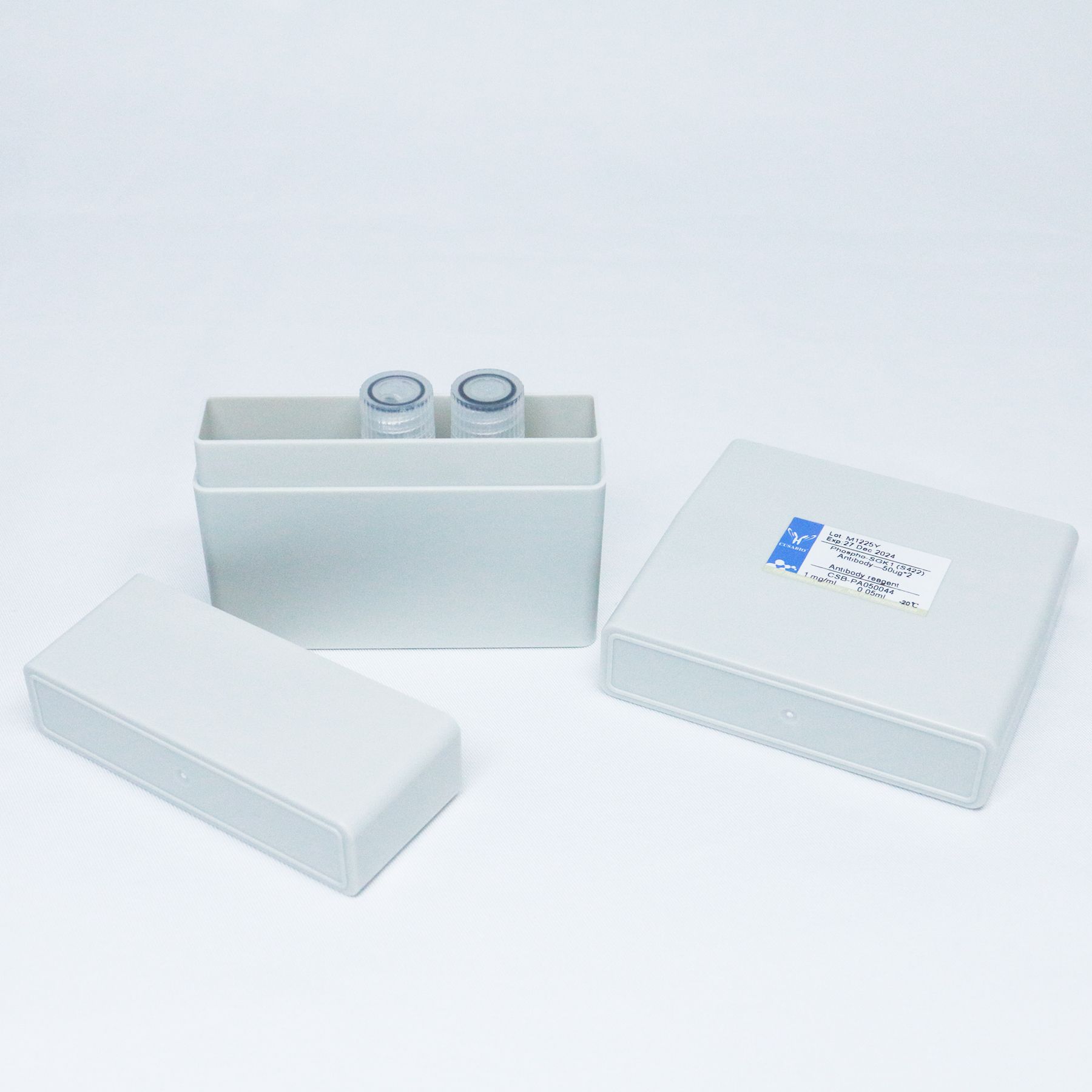
- ¥2024
- CUSABIO

- CN
- CSB-PA790629
- 2025年07月05日
- ELISA,WB;WB:1:500-1:1000
- Rabbit
- Human,Mouse,Rat

企业认证
相关产品推荐更多 >
TMEM91抗体TMEM91兔多抗抗体DSPC3抗体TMEM91 Antibody, FITC conjugated抗体
¥880
KRT8抗体KRT8一抗抗体Type-II keratin Kb8 antibody抗体KRT8 Antibody抗体
¥880
STIL抗体STIL兔多抗抗体TAL-1-interrupting locus protein antibody抗体STIL Antibody, FITC conjugated抗体
¥880
PELI3抗体PELI3兔多抗抗体Protein pellino homolog 3 antibody抗体PELI3 Antibody抗体
¥440
RPL19抗体RPL19兔多抗抗体rpl19 antibody抗体RPL19 Antibody抗体
¥3900
万千商家帮你免费找货
0 人在求购买到急需产品
- 详细信息
- 文献和实验
- 技术资料
- 免疫原:
Peptide sequence around aa.179-183(M-T-G-Y-V) derived from Human P38 MAPK.
- 亚型:
/
- 形态:
Liquid
- 保存条件:
Upon receipt, store at -20℃ or -80℃. Avoid repeated freeze.
- 克隆性:
Polyclonal
- 标记物:
/
- 适应物种:
Human,Mouse,Rat
- 保质期:
6个月
- 抗原来源:
Homo sapiens (Human)
- 目录编号:
Q15759
- 级别:
优
- 库存:
200
- 供应商:
武汉华美生物工程有限公司
- 宿主:
Rabbit
- 应用范围:
ELISA,WB;WB:1:500-1:1000
- 浓度:
/
- 靶点:
/
- 抗体英文名:
MAPK11 (Ab-180/182) Antibody
- 抗体名:
/
- 规格:
100μl
保存缓冲液
/功能
Serine/threonine kinase which acts as an essential component of the MAP kinase signal transduction pathway. MAPK14 is one of the four p38 MAPKs which play an important role in the cascades of cellular responses evoked by extracellular stimuli such as proinflammatory cytokines or physical stress leading to direct activation of transcription factors. Accordingly, p38 MAPKs phosphorylate a broad range of proteins and it has been estimated that they may have approximately 200 to 300 substrates each. Some of the targets are downstream kinases which are activated through phosphorylation and further phosphorylate additional targets. RPS6KA5/MSK1 and RPS6KA4/MSK2 can directly phosphorylate and activate transcription factors such as CREB1, ATF1, the NF-kappa-B isoform RELA/NFKB3, STAT1 and STAT3, but can also phosphorylate histone H3 and the nucleosomal protein HMGN1. RPS6KA5/MSK1 and RPS6KA4/MSK2 play important roles in the rapid induction of immediate-early genes in response to stress or mitogenic stimuli, either by inducing chromatin remodeling or by recruiting the transcription machinery. On the other hand, two other kinase targets, MAPKAPK2/MK2 and MAPKAPK3/MK3, participate in the control of gene expression mostly at the post-transcriptional level, by phosphorylating ZFP36 (tristetraprolin) and ELAVL1, and by regulating EEF2K, which is important for the elongation of mRNA during translation. MKNK1/MNK1 and MKNK2/MNK2, two other kinases activated by p38 MAPKs, regulate protein synthesis by phosphorylating the initiation factor EIF4E2. MAPK14 interacts also with casein kinase II, leading to its activation through autophosphorylation and further phosphorylation of TP53/p53. In the cytoplasm, the p38 MAPK pathway is an important regulator of protein turnover. For example, CFLAR is an inhibitor of TNF-induced apoptosis whose proteasome-mediated degradation is regulated by p38 MAPK phosphorylation. In a similar way, MAPK14 phosphorylates the ubiquitin ligase SIAH2, regulating its activity towards EGLN3. MAPK14 may also inhibit the lysosomal degradation pathway of autophagy by interfering with the intracellular trafficking of the transmembrane protein ATG9. Another function of MAPK14 is to regulate the endocytosis of membrane receptors by different mechanisms that impinge on the small GTPase RAB5A. In addition, clathrin-mediated EGFR internalization induced by inflammatory cytokines and UV irradiation depends on MAPK14-mediated phosphorylation of EGFR itself as well as of RAB5A effectors. Ectodomain shedding of transmembrane proteins is regulated by p38 MAPKs as well. In response to inflammatory stimuli, p38 MAPKs phosphorylate the membrane-associated metalloprotease ADAM17. Such phosphorylation is required for ADAM17-mediated ectodomain shedding of TGF-alpha family ligands, which results in the activation of EGFR signaling and cell proliferation. Another p38 MAPK substrate is FGFR1. FGFR1 can be translocated from the extracellular space into the cytosol and nucleus of target cells, and regulates processes such as rRNA synthesis and cell growth. FGFR1 translocation requires p38 MAPK activation. In the nucleus, many transcription factors are phosphorylated and activated by p38 MAPKs in response to different stimuli. Classical examples include ATF1, ATF2, ATF6, ELK1, PTPRH, DDIT3, TP53/p53 and MEF2C and MEF2A. The p38 MAPKs are emerging as important modulators of gene expression by regulating chromatin modifiers and remodelers. The promoters of several genes involved in the inflammatory response, such as IL6, IL8 and IL12B, display a p38 MAPK-dependent enrichment of histone H3 phosphorylation on 'Ser-10' (H3S10ph) in LPS-stimulated myeloid cells. This phosphorylation enhances the accessibility of the cryptic NF-kappa-B-binding sites marking promoters for increased NF-kappa-B recruitment. Phosphorylates CDC25B and CDC25C which is required for binding to 14-3-3 proteins and leads to initiation of a G2 delay after ultraviolet radiation. Phosphorylates TIAR following DNA damage, releasing TIAR from GADD45A mRNA and preventing mRNA degradation. The p38 MAPKs may also have kinase-independent roles, which are thought to be due to the binding to targets in the absence of phosphorylation. Protein O-Glc-N-acylation catalyzed by the OGT is regulated by MAPK14, and, although OGT does not seem to be phosphorylated by MAPK14, their interaction increases upon MAPK14 activation induced by glucose deprivation. This interaction may regulate OGT activity by recruiting it to specific targets such as neurofilament H, stimulating its O-Glc-N-acylation. Required in mid-fetal development for the growth of embryo-derived blood vessels in the labyrinth layer of the placenta. Also plays an essential role in developmental and stress-induced erythropoiesis, through regulation of EPO gene expression. Isoform MXI2 activation is stimulated by mitogens and oxidative stress and only poorly phosphorylates ELK1 and ATF2. Isoform EXIP may play a role in the early onset of apoptosis.风险提示:丁香通仅作为第三方平台,为商家信息发布提供平台空间。用户咨询产品时请注意保护个人信息及财产安全,合理判断,谨慎选购商品,商家和用户对交易行为负责。对于医疗器械类产品,请先查证核实企业经营资质和医疗器械产品注册证情况。
 文献和实验
文献和实验脾细胞与小鼠骨髓瘤细胞(P3-X63/Ag8)融合,融合的细胞既获得了亲代脾细胞分泌特异性抗体的特性,又具有骨髓瘤细胞大量繁殖的能力,成为一种既能分泌特异性抗体又能长命的杂交瘤细胞。该技术为抗体的分子生物学研究提供了全新的手段。极大地促进了免疫学,遗传学,分子生物学的快速发展。 但传统抗体目前也面临诸多问题,如: 每使用一管新抗体都需要进行滴定测试; 多种同型对照,实验设计繁琐; 需要添加Fc阻断试剂; 抗体不佳,阳性细胞群不明显; 抗体作为细胞生物学和生物化学中最重要的试剂之一,科学界每年在这类
luozhifeng339 请教各位达达,我准备做EMSA,如果做SUPER-SHIFT的话,该选择原装抗体还是分装的抗体呢,盼不吝赐教! wanglinling 看到一篇EMSA的文章,不知道里面有没有回答你的问题哈,不过英文的值得阅读哈。 GEL SUPER-SHIFT ASSAY/ EMSA Materials/Reagents: See Gel-shift assay Procedure
) 2、Input 条带清晰,co-IP 条带很弱? 设X为诱饵蛋白,Y 为靶蛋白,有可能为 X 和 Y 的相互作用本身比较弱 X 蛋白并不是 Y 的唯一,只部分 Y 与 X 互作 可以尝试反向拉,比如用 Y 去拉 X,可能效果比较好 3、我的 p 53 蛋白正好和抗体重链分子量接近,要如何减少抗体干扰? 建议方案: IP/WB 一抗使用不同种属来源,选择与IP抗体种属无交叉反应的二抗(Cross Adsorbed secondary antibody) 特殊二抗:比如仅识别重链或者轻链的二抗,或者仅
 技术资料
技术资料暂无技术资料 索取技术资料